Fanny Cradock wasn't really known for her love of other people, let's be honest. She was rarely portrayed as a supporter of other cooks, other broadcasters, other writers or for that matter other women. There are of course many exceptions, she did have some friends (honest) and some professionals that she raved about, but they were few and far between. She saved all her very special wrath for one particular female cookbook author however. She was a marketing genius, expert at self-promotion, and remains famous to this day. Sound familiar? Fanny 's blood boiled for a perfect four minutes at the very thought of Mrs Beeton.
Fanny was proud of the amount of research that she did to dis-credit this 'no-cook cookery writer' who 'could not even fry an egg.' The recipes that she published were not her own, but rather other people's ancestors recipes, sent in as part of a competition and published by Beeton - who Fanny recognised was at least 'a clever journalist'. Mrs Beeton died aged 29, and Fanny calculated that if she had tested every recipe in the Book of Household Management, even if she had cooked for 32 hours a day, she wouldn't have been able to cook them all even once. Fanny, by comparison, never poached other people's recipes (ahem) and always tested them over and over and over again before publication. Or at least her petrified assistants did. Fanny was too busy doing the research.
One area of severe criticism that is often scrambled Mrs Beeton's way was her recipes which began 'take 16 eggs...' People thought them excessive and out of reach for most household budgets. Fanny, rather surprisingly, defends her arch rival, stating that the criticism is simply NOT valid. Eggs are cheap and nutritious, and quite frankly, according to Fanny, Mrs Beeton certainly knew her eggs.
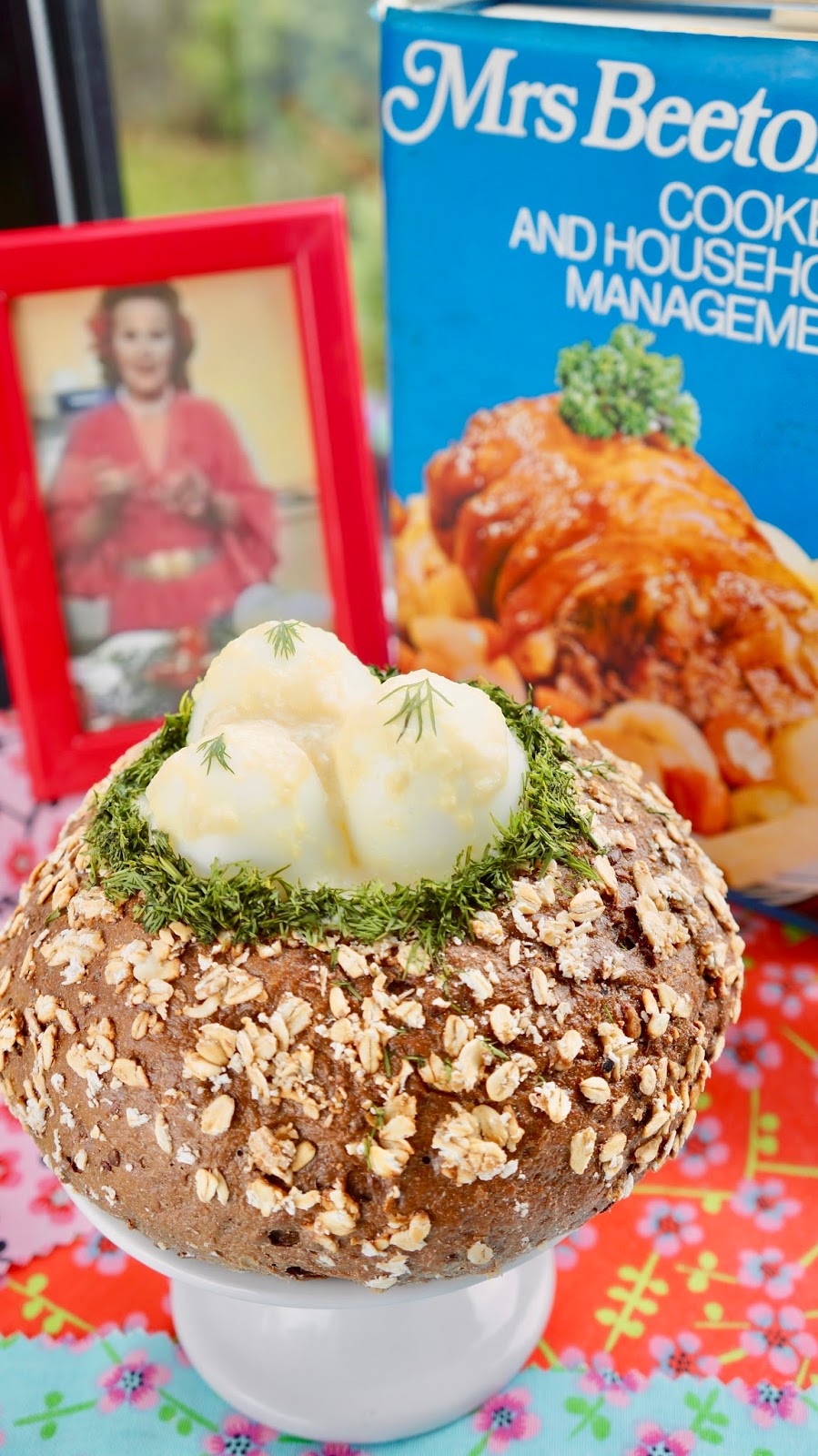
To showcase these wonderful orbs, Fanny chooses a very filling dish which makes the humble egg go a very long way indeed. There are three main components. The first is an onion sauce, which Fanny makes very simply from simmering chopped onions in milk until they are soft, draining and straining them through a sieve. Meanwhile the saved milk is further heated until it reduces, before the sieved onions are returned to it. It smells amazing. The next essential part is of course perfectly soft-boiled eggs. Four minutes, remember? Run them under cold water immediately and shell them. No need for 16 by the way.
Finally, Fanny takes an old cottage loaf, trims all the crusts off, cuts a large cavity in the top and deep fries it. This seems a step too far for me, and with premonitions of the fire brigade beating down my door (although...) I decide against this. I do cut a deep cavity though, which is filled with the onion sauce. Then the eggs. Fanny completes this treat by pouring a little of the onion sauce over the eggs, and decorating them with dill frongs. And of course a frill of dill around the edge of the cavity. Mrs Beeton would never have time for any of this marvellous detail.
Showing posts with label Book of Household Management. Show all posts
Monday, 23 October 2017
Thursday, 18 February 2016
Lacto Lenten Luncheon
Fanny wasn't a fan of Mrs Beeton. She mentions her often. Never in a good way. She says that the original Book of Household Management 'stuff' (she clearly can't bring herself to call it a 'cookbook') is all 'fiddle-faddle'. Fanny blames Mrs Beeton for so many English women failing. She gave all the wrong information. Fanny cannot imagine any professional chef in a professional kitchen wasting their time and money playing the farcical 'games' she outlined. After all, she never had time in her very short life to actually learn how to cook. The only evidence Fanny has seen that she cooked anything came from her sister who remarked that a cake she made when 8 years old 'was a sad failure and turned out like a biscuit'. In what seems to be the ultimate put down, Fanny asserts that Mrs Beeton 'couldn't even fry an egg'.
For Fanny, egg-skills are the most important. Especially for lacto-vegetarians. Especially during Lent. Especially when preparing a buffet for lacto-vegetarian guests during Lent. Not only a time of exclusion, but also a time for frugalness. To confront any nonsense in readers minds that eggs may be an out-of-reach expense, Fanny tells us that she, as a private person, buys her eggs direct from the local farmer at 19p per dozen. Fanny reminds us that any member of the public can do precisely the same thing. If in any doubt, Fanny points out that an egg has the nutritional equivalency to over two ounces of meat, so surely we must accept more readily that 5p is better spent on three fresh eggs than on almost any other foodstuff.
Fanny's point seems to be that the recipes for these lacto-vegetarian (she does love this description!) are good for the household too. As a result of spending prudently on ingredients, we should have more time to spend on cooking them. Apparently. So the less you spend, the more time you have. Great! Making a little go a long way demands more cooking time if what you make is to taste delicious. According to Fanny the only alternative is to cut down on both (and risk a nutritional crisis) and open a tin of something. This can never be a substitute for good cooking. Fanny does say that tins can be superb 'props or aids to good cookery', presumably just in case you happen to own her cookbook devoted to Cooking with Can and Pack in which she does exactly that.
No tins here, this is fresh, locally purchased, farmer approved, lacto-vegetarian fare after all. Oh, except the tin of sweetcorn. She serves it on a bed of 'health' rice, which is brown. All lacto-vegetarians love a bit of brown health. Simply sparkle it up with a hard boiled egg and a dash of paprika. Just like her Mum used to make. The Mushroom and Tomato Bake is layers of mushrooms and tomatoes, chopped roughly, cooked together, then layered with breadcrumbs and milled hazelnuts, also cooked together in butter. With Marjoram in-between each layer. Lacto-Vegetarians, like plain old vegetarians today, love a salad. So Fanny whips up her special Banana, Walnut and Orange Salad of sliced bananas doused in honey and lemon juice, with scattered chopped dates and walnuts, garnished with orange segments. It brings all the lacto-vegetarians to Fanny's yard. Or buffet.
To crown it all off, it has to be more eggs. Stuffed. Boil the economical yet nutritious eggs, peel and carefully slice the top off. Scoop out the yolk, carefully, mix with mayonnaise, ground almonds, grated cheese, a little tomato juice (for 'moistening' purposes), season and then, naturally, pipe it gloriously back into the hollowed out egg. Serve in egg cups stuffed with lettuce leaves. Poor old Mrs Beeton would never manage any of this, but thankfully for us with Fanny's help the buffet is a triumph. It all tastes good, even the Banana Salad. Fanny would never let us fail. Fanny would never let us present 'fiddle-faddle'. Thank heavens for Fanny!
Labels:
Bananas,
Book of Household Management,
Brown Rice,
Buffet,
Dates,
Eggs,
Green Giant,
hazelnuts,
Lacto-Vegetarian,
Lent,
Lenten,
marjoram,
Mrs Beeton,
sweetcorn,
Tomatoes,
Walnuts
Monday, 23 February 2015
Fannys Fancy Face
Fanny prides herself that everything featured in the weekly partwork has been tested, tested and tested again in the Cradock kitchen. Presumably by the ever energetic and eager assistants. Fanny herself was quick to criticise Mrs Beeton for being a 'shameless charlatan', claiming that had she cooked everything in her Book of Household Management she'd have been locked in the kitchen all her life. Going one step further Fanny lets us know that everything we see has been made by Fanny herself, garnished by Fanny and photographed by Michael in the Cradock home. Unlike Mrs Beeton, Fanny has a lifetime of experience. With one solitary exception. Fanny shares a very special photo with us all which breaks her golden rule. A very fancy bread indeed, the traditional Harvest-time Loaf.
The version Fanny shows us is a rectangular centrepiece depicting a windmill, with plaited borders. It was made for her by a wonderful Master Baker credited only as Mr Hall. He is a wonder with shapes, plaits and rings seemingly. He also has a large oven, much larger than any ordinary domestic oven we are likely to find in our own homes. Fanny reckons these are required to make such a masterpiece, which is the reason she has decided not to share the technique with us, which seems rather a tease.
Fanny lets us know that she herself has a huge caterers' cake baking oven, but there would be little point in her making this in hers as it is so unlikely that any of us would have the same in our modest homes. So essentially Fanny could make this herself, could garnish it herself and Michael could photograph it, but still she gets the enigmatic Mr Hall on the case. Clearly it never entered her wonderful head that all she had to do was make it SMALLER and then we could all enjoy it too?
In tribute to the fantastic, fabulous Fanny, I set about recreating her own familiar, fearful face in my harvest-time showpiece. My very favourite image which I use for my Twitter profile seems appropriate. Fanny says that these sensational show-off specimens can be fashioned in white bread dough, brown bread dough or in brown scone meal dough. The scone meal dough has no yeast or raising agent in it, so would seem most suitable for Fannys Face, I don't want to end up with Fanny portrayed in a puffed up portrait, bloated as if she'd forgotten to take her slimming tablets. Television piles on the pounds. The scone meal bread seems more like a pastry. Butter is rubbed into the flour with only salt added. Once at the breadcrumb stage, a mix of water and milk is blended in to make a dough, which is kneaded until smooth.
As Fanny refuses to give any instructions as to what to do next I improvise, or should I say use the Cradock knowledge that I have accumulated to date. So, half the dough is rolled into a rectangle shape around the same size as my baking sheet, to ensure it fits in my domestic oven. I trim it very neatly, and with the trimmings I roll out very thing strands of dough. I use these to create an 'image' of Fanny for which I hope she'd approve. Don't judge my artistic endeavours too harshly, I am no Master Baker. The other half of the dough is divided into thirds and rolled out into long strands to plait for the border. Once my harvest highlight is hatched, I brush it with an Anglaise glaze - which Fanny does give the recipe for - which is simply beaten egg and salt. Thankfully once baked for around half an hour, Fanny is still visible and almost recognisable. Almost. Can you see her? Maybe I should've started with a windmill? Or Maybe, like Fanny herself, just skipped this and got someone else to make it?
Subscribe to:
Posts (Atom)


