Showing posts with label Fresh Yeast. Show all posts

Monday, 16 November 2015

Bish, Bash, Brioche!

Fanny is keen to demonstrate that she is 'exploding yet another fallacy' by guiding us with ease through the often-thought-of-as-tricky yeast cookery. 'Bang goes the fable that yeast is difficult to handle' she boldly states as we skip into the kitchen together... Yes, yeast takes time, but not nearly as much as the 'misinformed' (that's all those who disagree with Fanny you understand) would have you imagine. Fanny calls them 'know-alls' who happen to be 'absolutely wrong'. So 'know-nothings' really. Fanny has something to 'prove' to us all, when it comes to yeast, it should be simple.

Fanny Cradock Brioche

We've already mastered croissants (sort of), explored the differences between Babas and Savarins, so the sensible yet simple next step is to look at the mighty Brioche. Fanny has another secret up her over-blown chiffon sleeve... the yeasted batter for Brioche is exactly the same as we have just made for Babas and Savarins. Exactly. With a feeling of déjà-vu I set to mixing it all together, but as Fanny says, it is at least simple.

Fanny Cradock Brioche

Fanny likes to think of Brioches as 'edible containers' for either sweet or savoury fillings. She maintains that the incidence of sugar in the batter is not high enough to offend the palate which receives savoury mouthfuls. Not too sweet then. Fanny would give us wondrous recipes for Fois Gras fillings (which would command a hefty price of £1.25 per slice in fancy restaurants as a first course) but we aren't quite ready for that. Phew. Instead she entices us (seemingly) with a drab crab filling or a French Soufflé. If in doubt, add a soufflé to anything and everything, that's Fannys mantra. She hollows out a giant brioche, fills it with a superb show-off soufflé mix and bakes it again. Ta-dah!

Fanny Cradock Brioche

Brioches are versatile however. As an alternative Fanny gets poor old Sally to cobble together another giant brioche, this time suitable for a range of Family Occasions, 'La Brioche Familiale'. Shamefully Sally has burnt the top of an otherwise beautiful bake, but Fanny is at hand with her trusty icing sugar to cover it liberally with an inch or two of heavy dusting before it is presented. Sally is no longer invited to the family occasion. For Sally's own good, a picture of it is presented in all it's glory for readers to see. She must learn and not become one of those 'know-alls'. Fanny also makes some 'Brioche Ordinaries' herself in little miniature brioche pans. It is these plain brioches I go for, mainly as I have the pans, and I don't want to end up cast out like Sally.

Fanny Cradock Brioche

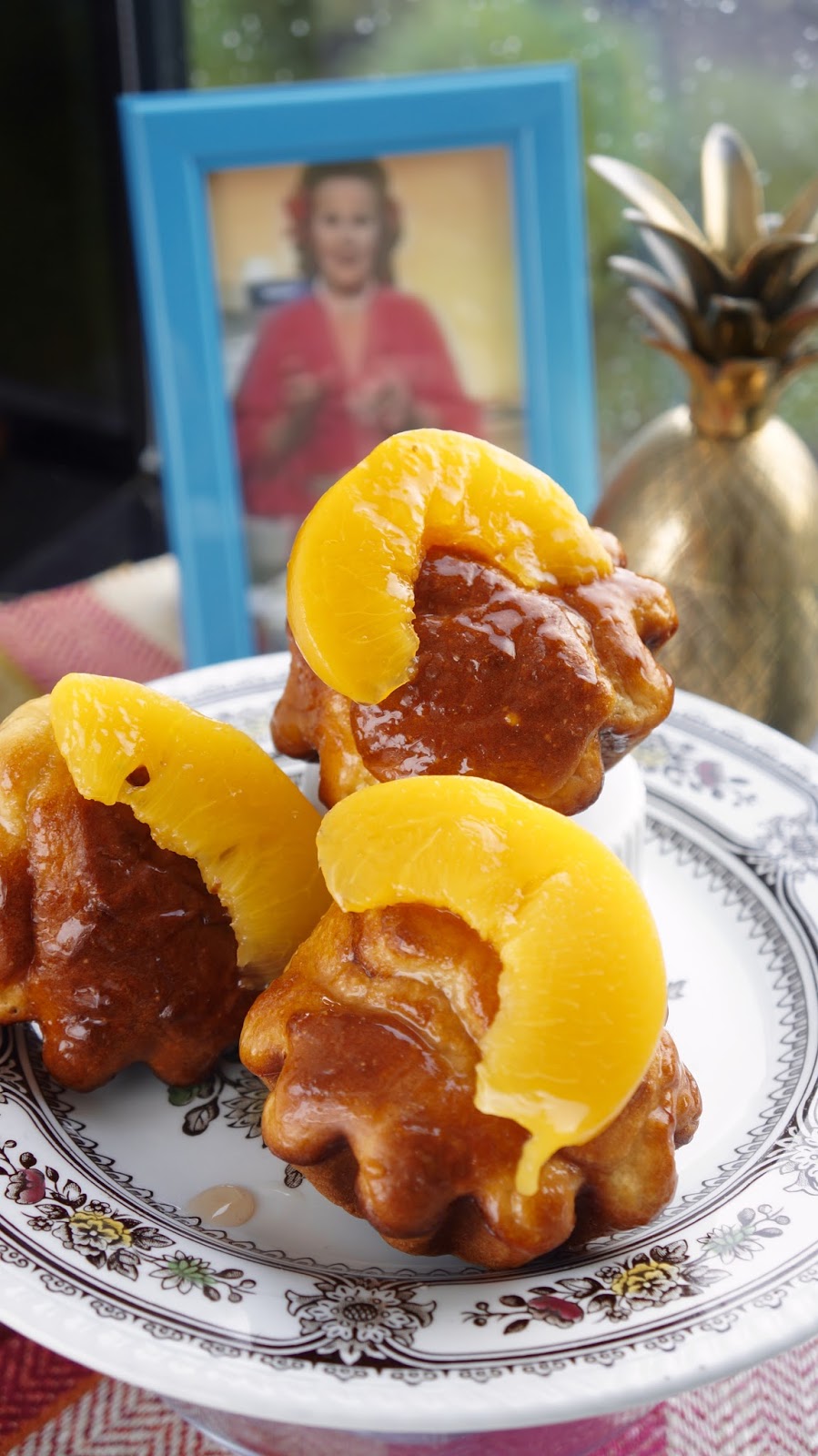
Fanny is not normally known for her plainness however, so she suggests a simple way to tiddle them up a little for very special occasions. Tinned fruit. It's always my first port of call when I want to go fancy. Actually it is a bit of a guilty pleasure, so I am of course delighted that Fanny approves. She gives her brioches a little scoop out to create a hollow, filling them with an apricot cup. My tinned fruit of choice is the marvellous peach, sliced and smothered with a generous painting of crab apple jelly. A joy to eat, yet so simple, and so there to all you misinformed 'know-alls'...
Fanny Cradock Brioche

Monday, 9 November 2015

Rum Babies

Have you ever sat alone at home in the evening dwelling and mulling, pondering and wondering, or just plainly puzzling what the difference is between a Savarin and a Baba? Fanny is super keen that we are absolutely clear as we progress through the culinary ladder with all things yeasted. To support us to bring our questioning to an end, she devotes a whole page to explaining the difference. A whole page. If you've ever seen Father Ted you might be a step ahead here. Let me try to summarise. Both are generally ring shaped, and are made of the same yeasted sponge mixture. And both soaked in syrup. One is big (the Savarin) and one is small (the Baba). Not far away. So, the difference is that they are different sizes.

Fanny Cradock Rum Babas

Fanny chronicles her crush on the credited creator, French gastronome Jean Anthelme Brillat-Savarin (1755-1826) and his generally great gastronomic work La Physiologie du Goût. It doesn't sound all that appealing, but he sounds fascinating. A real party animal by all accounts. Fannys says his family were 'curious' (I do wonder if this is judged by her standards) - his two sisters (both 'maiden ladies') spent nine months of the year in bed, only rising eventually to spend an entire month readying the house for the arrival of their famous brother. He stayed a month, they partied, then they spent the twelfth month putting everything away again before slipping back into bed to 'restore' themselves for his next visit nine months later. Wow, must've been some party!

Fanny Cradock Rum Babas

Fanny starts her recreation of Savarins' brilliant pudding by fermenting. Yeast, sugar, milk and a little flour. Fanny explains this is a basic of yeast cookery that we must master. After half an hour, she adds the doubled mixture, which should be jumping 'like a bag of fleas'  to flour with butter rubbed in, a little more sugar and finally eggs. Fanny warns not to mix the sponge mixture until the ferment has fermented. Particularly handy if you are unsure what that means or looks like... luckily I do. Her final warning is to make sure that the eggs are blended in without beating - gentle actions are required here.

Fanny Cradock Rum Babas

Fanny pipes the yeasty mix into her range of savarin and baba moulds. Either large rings for Savarin or small ones for Babas. Remember? Not far away. I have neither, but I do spot some Jelly Baby silicone moulds lurking around in my kitchen that I bought ages ago and have never used. They seem perfect - Babies not Babas. This is my mantra. I spray them lightly with oil and pipe in the mixture - much more easily controlled than spooning. Fanny doesn't say how far to fill them, so I guess two-thirds of the way. I expect them to prove for a while, but Fanny flings them straight into the oven for exactly 14 minutes, so I do too.

Fanny Cradock Rum Babas

While they are baking, Fanny suggests I ready myself with the syrup. She uses a basic stock syrup, diluted, but that doesn't seem fancy enough for my babies. I use some gorgeous crab apple jelly I made for foraged fruit last month, slightly diluted. It's a stunning colour, and taste. The babies jump out the oven and plunge themselves into their hot syrupy bath. Once they soak up all the goodness, Fanny fishes them out and douses them in rum. Seems fair enough. They do look a little bit like E.T. rather than cute babies, but they taste so good. So moist and squidgy, with an apple-rum-y hit. Fanny completes hers with piped cream and a garnish. It only seems appropriate to choose actual Jelly Babies* for this. I wouldn't want my Rum Babies to party alone. I have high expectations after nine months of bed-rest, so let's get ready to Rum-ble...

Fanny Cradock Rum Babas

* Please, please do not send me nasty letters, I know that Jelly Babies are not vegetarian, but they are cute...

Monday, 2 November 2015

Ces Croissants Ne Sont Pas Français

Fanny Cradock has a canny knack of convincing us that almost everything is perfectly French, even when it clearly isn't, including her own questionable heritage. Just by saying it, or writing it, it becomes true, n'est-ce pas? I mean, who could possibly cross-check these things back in the day? However for once Ma Chérie Fanny takes something which we all (possibly) would imagine to be so utterly French through and through and lets us know in no uncertain terms that it is not. We are wrong. Bien sûr. Croissants are most definitely NOT French. Non madam.

Fanny Cradock Croissants

How silly of us to not know our history. Especially when it comes to cold yeasted dough. Especially when the true story is 'such a pretty one', according to Fanny. Croissants were of course created by the bakers of Budapest in 1686. During a siege on the city by the Turks when their forces surrounded the city walls, the guards on the parapets fell asleep one night. Fanny doesn't bother to explain why. The bakers were of course still awake and baking, as usual. The bakers heard strange noises and awoke the guards, thereby driving back the Turks. The next day it was hailed that as a reward for the bakers saving the city a new bread was to be created. Inspiration was taken from the crecents on the sleeves of the Turks' ottomans, and hence Croissants were born. Naturellement.

Fanny Cradock Croissants

Fanny wants to continue on her myth busting way by convincing us that croissants are also easy to make, real croissants that is. Fanny says that is 'nonsense' that they take 8 hours to make and can be easily made even in cold environments. Even when there is a draught in the kitchen, or a door is left open it makes not a halfpenny of a difference. They need no proving. Yes, that's what Fanny says. Just whip up the dough, which can then be left in the fridge for up to 7 days, prepare the croissants, slip them into the oven for 13 or 14 minutes while you make tea or coffee and do the rest of your breakfast chores if you have guests. Remember Fanny is not too keen on weekend guests. Ou quelqu'un.

Fanny Cradock Croissants

Fanny gets going by cutting some flour into butter with two knives, sharing it into an oblong and chilling it in the fridge. Fresh yeast (which I love) is mixed with some sugar to liquefy and then a beaten egg while you make a mound of flour on your work surface. Fanny doesn't specify which kind of flour to use, but she always says to use self raising for everything, so I do. The liquid is poured into the mound and gently mixed to a dough, without breaking the flour rim until it is thick enough. Fanny them simply slaps it from side to side until its smooth and picks up all the remaining flour. Sounds like her treatment of the poor assistants. Quelle surprise.

Fanny Cradock Croissants

With the chilled butter in the centre, the dough is folded over, spun round, rolled out gently (Fanny notices you should see small bubbles on the surface, I do, meaning the yeast is waking up, springy and light), turned and folded again, and again, and again until a lovely parcel is created. I decide to store it in the fridge until weekend guests arrive. Fanny rolls out her dough to a quarter inch thick and uses a complicated triangular wooden template to cut out shapes to be rolled as croissants. I go more freehand with a pizza cutter. Look, it's Sunday morning and I am still asleep. Curled, egg washed and in the oven. Once baked they are golden and crisp, a little bobbly but maybe that's because I stored the dough for a few days. They don't look all that French, but do look a little like croissants, but a little more like little crabs - luckily I can tell my guests I am trying out an old authentic 17th century Budapest pastry recipe to distract them... Je suis si vilain.

Fanny Cradock Croissants

Thursday, 19 February 2015

Plait du Jour

Fanny includes several variations for bread in the partwork to help raise our skills from the basic white loaf. There's Brown Bread, Cracked Wheat Bread, Milk Bread, Sweet Rye Bread and also Spiced Sweet Rye Bread. So many to choose from. The ingredients don't vary too much - a spot of 'lard' here and there, and from time to time some treacle or syrup instead of, and as well as, sugar. The technique doesn't vary at all, it's clearly a tried and trusted method which Fanny loves for her loaves, all made 'without a steam proving oven' in a futuristic nod of disapproval to the Bake Off. Fanny is much more excited about the shape of bread rather than the flavour or style, which can be made with 'unorthodox containers for bread shapes' or ordinary baking sheets. How versatile.. Above all garnish and presentation. As ever.


Fanny pays particular attention to plaits. To illustrate her fondness for them she dedicates several pages and many pic-strips to showing us how to plait successfully. Or rather Johnnie does. He seems to do most of the pic-strip demonstrations. Presumably Fanny is off practising her most feminine facial expressions. She's keen however that we learn two types of plaits, a three-strand and a five-strand version. Fanny says to use any of her breads for plaits, and if you are feeling particularly adventurous why not 'knit' strands of each together? Maybe it's because it's midweek, but I'm not really feeling THAT adventurous, so I plump for Brown.


To 'score' brown bread flour, and indeed Rye flour and Cracked Wheat, luckily there isn't any localised baker flirting involved - it's a simple trip to the 'nearest' health food store. For me, that's a welcome skip along to Real Foods. They've got loads of different flours and also sell flour 'loose' which is great if you only want to try a small amount for a recipe. I snap up a packet of Marriage's Strong Wholemeal Flour though as I know I'll use it a lot. Fanny looks disdainfully at the 'flimsy paper packets' that flour comes in though. She insists that we all sift them immediately, and store them 'correctly' in flour bins or even plastic 'burper' boxes at home. Presumably that's Tupperware to you and I. I think I'll be calling them Burper Boxes from now on though.


So, same technique as before, but most of the white flour is replaced with brown. Other additions are some lard rubbed in. Time for trusty Trex for me. The lovely fresh yeast is liquified in brown sugar this time, and Fanny adds Treacle to the milk and water mix. My store cupboard is out of treacle, but luckily my Aunt gave me some Jersey Black Butter when she was over recently, which is a great substitute. Well, I hope so anyway!


Once the dough has been mixed in two stages and kneaded for 10 minutes, until it's 'as lively as a bag of fleas', it's time to plait! I've made plaited loaves before, but Fanny does it differently. She rolls out her dough into a flat rectangle, cuts it into either three or five strands leaving an uncut end holding it all together. Johnnie uses a professional pastry cooks scraper for his, but Fanny says an ordinary sharp knife does very well. I have a professional scraper. Get me. She numbers the three plait stands as left to right '1, 3 and 2' for some reason. The sequence to plait is 1 over 3, 2 over 3 and repeat. Fanny clarifies incase the numbering is confusing. It's left over centre, right over centre. The flatness of the strands looks strange, but my finished plaits look like Fannys. Or like the ones in the pic-strip. For the five plait strand the numbering goes left to right '1, 2, 3, 4 and 5' (nothing is straightforward with Fanny) and the sequence is 2 over 3, 5 over 2, 1 over 3 and repeat. It looks just like the three strand version, only a little tighter, with the ends tucked in neatly. Once baked (and egg washed after 10 minutes as before) they look even more similar. I'm struggling to tell them apart really. They remain flatter than I expected, but the brown loaf is tasty and light. Can you tell which is which?


<a href="http://www.bloglovin.com/blog/9429149/?claim=gnd54njtpav">Follow my blog with Bloglovin</a>