Everything Fanny prepared had a foundation in the world of Escoffier, for her he was the pinnacle for professionalism that we should all aspire for. Fanny was all about aspiration. Fanny was not aspiring you'll understand, she was already there, but she longed to inspire us, the everyday, ordinary cooks, to share her aspiration. It was also a complicated ambition, as we were meant to admire Fanny at the same time, otherwise we'd just aim straight for the Escoffier books instead of hers and Fannys sales would plummet. So she added some eagerness to it all, switched thing up a little, added a little colour here and there, and in her mind at least, she made it easier for the ordinary housewife to desire to access the grand levels that Escoffier inhabited.
Fannys aim in passing on these Poached Apples or Pommes Pochées à l'Escoffier was simply to transform the humble fruit into a dreamy dessert which would have been at home on those higher rungs of the culinary ladder. Fanny poached her apples in ever-so-English Cider, matching the crispness of the rouged up russets perfectly. I've got a yearning for something just a little different though, so I'm switching the cider for the oh-so-Scottish and oh-so-lovely Outaspace Apple Ale from Glasgow based Drygate Brewery that jumped into my trolley at the supermarket. I hope my aspirations aren't above my station.
Fanny starts by peeling the apples very carefully, very professionally. I try to do it all in one round, and I mostly manage, with only a slight tear. When I was young I am sure everyone peeled their apples before they ate them, but I was the odd one who then ate the peel. It may explain a lot. The peeled pommes are popped into a shallow-ish pan that is deep enough for them to be covered while the poaching liquor is prepared.
The poaching liquid is a heady mix of the booze, water and some fruit jelly, but I'm switching it all up again. I know, no stopping me! Fanny uses her beloved Red Currant Jelly to give the finished apples a jolt of colour, but I am using (again) my Bramble and Gin Jelly. It has a glorious colour, and taste. The jelly is mixed first with the water to dissolve it, then the ale (or cider if you like sticking to the rules) before being poured over the waiting apples. Fanny pops them over a 'thread' of a heat and leaves them until they are semi-transparent and bright pink underneath. It takes about half an hour.
They are then ready to be turned over for the topside to be tinted. I found they bobbed around a little but eventually found their way. Okay I had to wrestle them for a while with crossed fingers, not easy. Do not be tempted to turn the heat up to speed up the poaching. Fanny warns if the liquid bubbles hard the apples will collapse and the whole thing will be ruined. Be patient and you will be rewarded. Fanny says when they are 'not ruined but cooked' to lift them out, drain and place them on your chosen dish. Then, and only then, boil the liquor hard to reduce, as you would for any top level sauce, just as the great Escoffier himself did. The resulting sauce, with no added thickeners, is then poured over the Pommes Pochées and, well, scoffed like Escoffier would. Garnish with a leaf first though, above all presentation and garnish. Apples, beer, jelly and gin - these are aspirations I can easily strive for!
Showing posts with label Apples. Show all posts
Monday, 25 May 2015
Friday, 8 May 2015
A Pile of Crêpes
Johnnie should be worried. More worried than usual. He often looked somewhat concerned anyway, but somehow remained unflappable in Fanny's presence. Perhaps not today. There is something different in the air, a change of mood, a change of intention. Poor Johnnie. He's probably quietly taken himself off and is hoping to remain hidden downstairs in the dank and dark wine cellar. Maybe Fanny won't notice he is absent, or maybe she has devious plans... She's not in a rage, she's not cross and there is no suggestion she will be walloping anyone. Not today. Quite the opposite. She's felling, well, a little fruity to be honest.
Fruit Pancakes that is. And she is not in the mood for hanging around, this potent feeling may not last. She has her crêpes already prepared, layered, wrapped in ordinary kitchen foil and stacked in the refrigerator, so she's good to go. It's as if she has been planning this flush of lustiness. I made mine earlier too, following Fannys instructions but using her recipe which contained white wine. It's all part of Fannys seduction plan, fling in some booze wherever possible. The wine actually makes the crêpes very thin and flow around the pan with ease, making crêpes that look like tracing paper.
The first of Fannys fruity flairs are Crėpes Caramelisées aux Pommes, or Caramel Apple Pancakes. Fanny quickly peels and cores a cooking apple before slicing it into thin rings. These are laid over a single pre-prepared crêpe, sprinkled with sugar and popped under a hot grill until they bubble and brown. Fanny warns not to have it too close to the heat, much as there is hurry for seduction, as they will caramelise before the apple cooks, so she asks that you please remember! Fanny hasn't even noticed that Johnnie is missing, she's engrossed in her next temptation - oomphing up the fruitiness with a Tiered Orange creation, or Gâteau des Crêpes aux Oranges.
These are fairly similar to the Pommes, but are made with layers of pre-prepared crêpes sandwiched with home-made orange custard. Fanny frisks up egg yolks with flour and sugar until they are pale and foamy. Meanwhile she heats a mixture of orange juice and orange curaçao gently on the stove top. There is always room for more alcohol, poor Johnnie doesn't stand a chance. Just before the alco-juice boils, she pours it over the sweetly eggy mixture, stirs until its blended and pops it over a double boiler to thicken up, stirring constantly of course. It should coat the back of a spoon. The custard is spread between the crêpes and then topped with thick orange slices, sugar and grilled until brown. Now, where is Johnnie?
Fanny clearly is not convinced that these two alone are enough to woo Johnnie, so includes a third option. Stuffed Pancakes, or Crêpes Farcies. Soft fruits this time, radiant red raspberries and beaming, burnished blueberries made into a quick jam. With internal temperatures soaring, there's no time for it to set, so Fanny has a little trick. The fruits are heated in a pan, then a mix of white wine (I know!) and a little potato flour is added. It thickens in seconds! Fanny then rolls up some fruit with jam in her crêpes, and tops with more of the glazed, lusty preserve. Johnnie will surely not be able to resist. The whiff of the fruit and sugar would surely be enough to tempt him back upstairs, but I have no doubt that the waft of alcohol will certainly bait him back into Fanny's arms, unable to resist. Run, Johnnie, Run!
Tuesday, 24 December 2013
It's All In The Booklet #4 - Christmas Pudding
Fanny has rescued this festive recipe from the vaults of the esteemed French Chef Escoffier, but of course is keen to add in her own twist too. She wants us to revive the perfectly round Christmas Pudding which was the centrepiece of dinner tables everywhere in bygone days. Only one problem, they used to always be made in the old 'coppers' which families boiled up their laundry in, on Mondays. Fanny however doesn't recommend flinging your pudding into the modern day washing machine, so instead turns to modifiying a standard kitchen sieve. I am less concerned with a perfectly round pudding, so I just use a pudding bowl, in truth I decide to make individual puddings in small moulds, please don't tell Fanny. I've never in my life made or tasted a Christmas Pudding, but the ingredients seem lovely - fruits, breadcrumbs, ginger, suet (I use some lovely vegetarian suet from Suma) nuts, alcohol... As ever, Fanny gives detailed instructions in the booklet.
All the dried ingredients are mixed together, the chopped apples added, followed by the eggs, citrus juices, beer and Brandy. It's really quite boozy. Why have I never had this before? Once combined the loose, floppy mixture is left overnight to rest and become a firmer, thicker mixture as the breadcrumbs expand.
Next day the mixture is pressed into the buttered moulds (or large bowl, or indeed sieve), covered with greased butter papers (please don't do as Fanny does on TV and shamefully show the label) or ordinary squares of oiled greaseproof paper, cover again with foil, secure with string, tie a handle and steam. As mine as individual I am using my electric steamer, which is very rarely used but is perfect here as I can get three layers. Fanny of course uses a steriliser which is very large and deep but any large pot would do.
Fanny steams her pudding for 10 whole hours at first, my smaller ones take just 3, and then they are left to cool, stored away for a few weeks somewhere to mature until the Christmas feast. When they are required, on Christmas Day, they need to be steamed again - the large one for 3 hours, my individual ones just for an hour. Fanny wants us all to have the drama of wow-ing our guests with a flaming pudding, something to upset the neighbours and put their nose out of joint. Her trick is to use a mixture of Brandy and Vodka for the flame to give a longer burn time. This is something she often used when doing her demonstrations at the Royal Albert a Hall and such like, so if it's good enough for that it's grand for me. I have been making some fresh Cranberry Vodka this year, so this seems like the perfect time to crack it open. More booze!
The alcohol needs to be warmed gently, over a mere thread of heat. Fanny suggests until you can just feel the heat with your (spotlessly clean, before anyone thinks of writing in to complain) fingers, ouch. Fanny recommends training a friend to carry the flaming pudding to the table wiggling it all the time, which gives a boost of oxygen and keeps the flames going. I presume Fanny makes poor darling Sarah do this, as she points out on TV she gets VERY nervous in front of the camera and her hands tremble so badly - this sounds perfect. My first ever Christmas Pudding is lovely, very, very boozy and surprisingly light to taste as always with Fanny. Fanny serves hers with green coloured Brandy butter and tiny scraps of angelica and glacé cherry. Of course. Merry Christmas one and all, hic...
I've linked this post up other Fresh Cranberry recipes over at Blue Kitchen Bakes hosted by Jen - pop over for a look http://bluekitchenbakes.blogspot.co.uk/2013/11/fresh-cranberry-recipe-link-up.html
Wednesday, 4 December 2013
Mush, Mush Sweet Charlotte
Fannys take on the French Classic Apple Charlotte is intended, she tells us 'dear readers', to introduce some simple techniques to make it quick and easy to produce. I've never made a Charlotte, but reading between the lines here I assume it's hard to do, and so I try my best to knuckle down and pay close attention to every word of wisdom Fanny is sharing. I've had to buy another loaf for this one, eek.
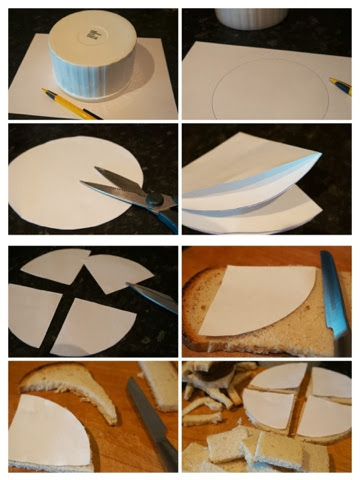
Fannys simple instructions seem quite complicated to me, and involve drawing round a soufflé dish, cutting out a circle, cutting it into quarters and then using these templates to cut bread the same shape. I also need to cut smaller squares of bread all the same size, no template given. I'm doing it because Fanny tells me to, but all the while I'm wondering if there is an easier way...
Fanny tells me then to beat an egg in some milk 'very quickly' before slipping the bread in and deep frying it until golden brown. Mmm, did someone mention deep fried bread?
I also need to 'collapse' the quartered apples in a very little water, sieve them when soft to make a purée and reheat them with a little sugar 'to taste' until they 'blow and bubble' all the excess moisture out. The purée seems so silky and smooth and soon thickens up to a paste as Fanny suggests.
Once the fried bread is golden it's time to build the structure inside the soufflé dish. Fanny says everything should fit snuggly if I have used my templates correctly, but maybe I've done something wrong? The bread seems to have puffed up a wee bit during frying and is a little mis-shapen. Fanny hasn't warned me about this, but a bit of trimming and all seems well. Then the apple mixture goes in.
Now all Fanny suggests is to chill it until firm before turning out. After a few hours it's still a bit wobbly, but when I turn it out it keeps it's shape well. Maybe it's been successful? However when I cut into it, it sadly collapses a little, but still tastes great. Not too sweet, the texture of the apples is lovely and the bread still quite crunchy. I wouldn't say the techniques made it any easier, but a dollop of cream cheers most things up I suppose.
Labels:
Apples,
Bread,
Charlotte,
Deep-Fried,
French
Location:
Edinburgh Edinburgh
Friday, 13 September 2013
Saved from the 16th Century - a Flowery Flan
I've never made anything with edible flowers before, not even the staple of modern vegetarian chic - the Courgette Flower. This recipe from the past (that's Fanny's past, realising all the recipes I am working on are old too) calls for Borage, Marigold and Cowslip flowers. I've never really seen them anywhere before, but after asking folk on Twitter was soon pointed to some local suppliers, and I found these beauties at the Stockbridge Market at the weekend. So colourful! Maybe not the exact three Fanny recommends but they are good enough for me!
Fanny says I can use other flowers but cautions against using any part of a plant for food unless studying first 'Modern Herbal' by Mrs Grieve and Mrs Leyel. I'm guessing that Fanny has done this for me, and also that the guys at the market have also done their homework and are totally sure their flowers clearly marked 'edible' are indeed. Fanny I am sure did not have the modern day luxury of a farmers market to pick up such things.
The ingredients are fairly simple - apples, egg yolks, butter, the flowers and mace. How very medieval. Even the word 'mace' makes me think historically. No sugar though, so I'm expecting this tart to be quite sharp.
Fanny tells me that back in 'those days' this flan was baked in a 'raised pastry coffin' which doesn't sound very appealing at all, but does conjure up images of Knights and Round Tables. Thankfully Fanny suggest updating it slightly with her very one sweet paste, baked as before, simply as demonstrated by Peter. The apples need to be sliced thinly and poached in the 'least amount of water' possible.
I wasn't sure how long for, so I kept going until they were puréed. It seemed to make sense. Then Fanny asked me to simmer the lovely flowers in water until they were tender. The water turned a very lovely shade of blue...
So all that remains is to fill the baked flan case, allow to cool and decorate with a few flowers I saved from the simmering. I of course changed into my very favourite medieval outfit before tasting - it was indeed extremely 'tart' and the peppery taste of the flowers was unusual, but not unpleasant at all, just made me realise how sweet modern day tastes must be. I really do feel transported back to the 16th Century with this one, and will certainly use more edible flowers in the future. Safely of course. I will complete my studies. Now, quick joust anyone?
Location:
Edinburgh Edinburgh
Tuesday, 27 August 2013
Could a soggy bottom upset the Apple Tarte?
Fanny doesn't like questions, after all she has the knowledge and is simply passing it on, why would you have any queries? "Do as I say and you will have good results". If she were around today I would have a few questions, but only to help me understand her recipes and techniques better. If she was on Twitter I'd be logging on to her live #AskFanny chat and Question 1 would be - why do you sometimes blind bake pastry and sometime bake it 'raw'? This recipe for a Classic French Apple Flan - Tarte aux Pommes - uses 'raw'. Maybe I've been overly influenced by the return of the Great British Bake Off, but I am concerned about a soggy bottom here...
Fanny gives me some instructions on how to slice my apples for this recipe. I should peel them, but not core them. Then, slice in very thin rounds until I hit the core on one side before turning the apple round and repeating on the opposite side. Fanny says I will be left with two very narrow round edges wedges when cut off the core, which I should stand on the base of the cut and slice very thinly too. I am left with either half rounds or rounds, just as Fanny says. Oh and some oblong ones, I went wrong somewhere! My mistake, not Fanny's!
The recipe itself is fairly simple again - line out my flan case with sweet paste, top with a thick layer of confectioners custard (I had some left over from Madame Fleurette's Flan, which was handy) and top with the sliced apples, copying the pattern in her own picture of course.
A quick sprinkling of caster sugar and in the oven it goes. Fanny doesn't say how long for, testing me again, but guiding me that it will be ready when the pastry edges are lightly brown and the apples 'strongly' brown. Meanwhile I am to make a redcurrant jelly glaze, with some shop bought jelly and water, simply heated and reduced a little.
Fanny recommends if I am a 'flan addict' (and who wouldn't be with almost every recipe in Part Two devoted to flans) that I invest in a fluted or plain edge flan ring, as these will slide off easily after cooking. I have a loose bottomed one instead, which seems fair enough to me - again I'd #AskFanny though if I should invest in a proper ring?
After half an hour my pastry edges look lightly brown, but the apples are only just starting to turn brown. Oh dear, decisions decisions - do I remove it now? What if the pastry edges were to go 'strongly' brown too? I take the plunge anyway, and take it out. Fanny says I am to immediately brush the entire surface, including my edges, liberally with the redcurrant glaze. Perhaps my glaze isn't reduced enough, but it just seems to run off. If I'm honest the entire flan looks a little 'liquidy' so I am sure that my feared soggy bottom will be there. However I am pleasantly surprised once it is cooled and sliced (transferred as Fanny recommends with two metal slices underneath at right angles), no soggy bottom at all. I can hear Fanny reminding me not to question her, just do as she says...
Location:
Edinburgh Edinburgh
Subscribe to:
Posts (Atom)