Showing posts with label Cradock. Show all posts

Tuesday, 24 December 2013

It's All In The Booklet #4 - Christmas Pudding

Fanny has rescued this festive recipe from the vaults of the esteemed French Chef Escoffier, but of course is keen to add in her own twist too. She wants us to revive the perfectly round Christmas Pudding which was the centrepiece of dinner tables everywhere in bygone days. Only one problem, they used to always be made in the old 'coppers' which families boiled up their laundry in, on Mondays. Fanny however doesn't recommend flinging your pudding into the modern day washing machine, so instead turns to modifiying a standard kitchen sieve. I am less concerned with a perfectly round pudding, so I just use a pudding bowl, in truth I decide to make individual puddings in small moulds, please don't tell Fanny. I've never in my life made or tasted a Christmas Pudding, but the ingredients seem lovely - fruits, breadcrumbs, ginger, suet (I use some lovely vegetarian suet from Suma) nuts, alcohol... As ever, Fanny gives detailed instructions in the booklet. 


All the dried ingredients are mixed together, the chopped apples added, followed by the eggs, citrus juices, beer and Brandy. It's really quite boozy. Why have I never had this before? Once combined the loose, floppy mixture is left overnight to rest and become a firmer, thicker mixture as the breadcrumbs expand.


Next day the mixture is pressed into the buttered moulds (or large bowl, or indeed sieve), covered with greased butter papers (please don't do as Fanny does on TV and shamefully show the label) or ordinary squares of oiled greaseproof paper, cover again with foil, secure with string, tie a handle and steam. As mine as individual I am using my electric steamer, which is very rarely used but is perfect here as I can get three layers. Fanny of course uses a steriliser which is very large and deep but any large pot would do.


Fanny steams her pudding for 10 whole hours at first, my smaller ones take just 3, and then they are left to cool, stored away for a few weeks somewhere to mature until the Christmas feast. When they are required, on Christmas Day, they need to be steamed again - the large one for 3 hours, my individual ones just for an hour. Fanny wants us all to have the drama of wow-ing our guests with a flaming pudding, something to upset the neighbours and put their nose out of joint. Her trick is to use a mixture of Brandy and Vodka for the flame to give a longer burn time. This is something she often used when doing her demonstrations at the Royal Albert a Hall and such like, so if it's good enough for that it's grand for me. I have been making some fresh Cranberry Vodka this year, so this seems like the perfect time to crack it open. More booze!


The alcohol needs to be warmed gently, over a mere thread of heat. Fanny suggests until you can just feel the heat with your (spotlessly clean, before anyone thinks of writing in to complain) fingers, ouch. Fanny recommends training a friend to carry the flaming pudding to the table wiggling it all the time, which gives a boost of oxygen and keeps the flames going. I presume Fanny makes poor darling Sarah do this, as she points out on TV she gets VERY nervous in front of the camera and her hands tremble so badly - this sounds perfect. My first ever Christmas Pudding is lovely, very, very boozy and surprisingly light to taste as always with Fanny. Fanny serves hers with green coloured Brandy butter and tiny scraps of angelica and glacé cherry. Of course. Merry Christmas one and all, hic...


I've linked this post up other Fresh Cranberry recipes over at Blue Kitchen Bakes hosted by Jen - pop over for a look http://bluekitchenbakes.blogspot.co.uk/2013/11/fresh-cranberry-recipe-link-up.html

Saturday, 21 December 2013

It's All In The Booklet #3 - Your Christmas Cake


With only a hint of disgust, Fanny agrees to give two recipes for Christmas Cake - her Grandmothers Rich Fruit Cake, that so many people love (although not Fanny it would seem), and a 'spit new' one that Fanny has never shared before, her White Christmas Cake, which is beige of course. Fanny insists in the tough economic times that she is writing the booklet - which really has so much in it that it's a small book - that we all enjoy at least ONE decent cake in the year. I decide to make and enjoy both of course. The ingredients are similar, but instead of all dark fruits, the White Christmas cake has glacé pineapple, oranges, coloured cherries and her very favourite and long forgotten angelica. It's also made with a mixture of self raising flour and cornflour.


On TV Fanny assures viewers that she has scrubbed and scrubbed 'downstairs', but innuendo fans can relax as she means her hands in the make up room, presumably the studio is upstairs. For both cakes, hands are used to mix and squelch the ingredients together before they are plopped into the prepared cake tins ready for baking. I may have also used a spatula, luckily poor darling Sarah didn't attempt to tidy mine away, so no need to bark at her this time.


Once baked they really do look quite different, the old fashioned one is gloriously dark, shiny and heavy while the spit new version is light, and sparkly - but Fanny pleas that we please do not mistake it for a Madeira cake, Fanny will go right off you if you do. I know they are ready as they come out the oven NOT singing. This is Fannys top tip for cake testing, although if you are deaf, she says, use a skewer. I've made both cakes several weeks ago of course, Fanny says they are best if made a year in advance but I'm not convinced, or that prepared. I've been steadily feeding them with a Brandy ever since. Fanny recommends using the very cheapest of cooking Brandy from a miniature bottle, but feeling flush I go for something much more high end, it's just who I am. Sorry Fanny.


Fanny covers her cakes in real, classic, Almond Paste, which shouldn't be confused with nasty, cheap, shop bought Marzipan. It's made with ground almonds, icing sugar, raw egg whites, orange flower water and rose flower water. Please do not irritate Fanny, as one person did after at a demonstration at the Royal Albert Hall who wrote afterwards to tell Fanny her recipe was disgusting, and use flowery Face Cream instead of flavoured waters for culinary use. Okay? The waters used to be only available from the chemist, hence the mistake, but are now widely available in supermarkets thankfully. Fanny will NOT tolerate criticism from viewers and readers if they do not follow her recipes CORRECTLY. I do and it was a joy to make the almond paste actually, and easy to roll and cover the cakes.


For the icing, Fanny gets upset that we might revert to the usual Royal Icing which will create a fearful mess, break our teeth and fly across the room as we cut into it, but she grudgingly gives a recipe for it anyway. However her favoured recipe is for triumphant and easy to handle Fondant Icing and she encourages us to make this instead. Oh, I've never made my own, just bought some and rolled it out. It was surprisingly easy to make too though - just icing sugar, egg whites and gently warmed liquid glucose.


Fanny has another top tip for rolling out the icing, which I am dubious about but it really works well, and that's to use cornflour. It never sticks, and won't spoil the icing. Fabulous. Fanny shows us how to slip our arms under the rolled out fondant, of course making sure our nails are well manicured and clean, and lift it carefully over the cakes before smoothing down. For old fashioned cake I keep it traditional, but for the White Christmas version I add a swirl of blue food colouring for a marbled effect. Fanny thinks blue colouring is best for cakes and green for potatoes. I have transformed the 'rather dull assembly of cakes' into sparkly festive crackers. I'm almost as relieved as Fanny when she rather surprisingly proclaims 'we've done it' to poor Sarah. Unfortunately, I don't have a Johnnie, who is terribly good at these things, on hand with ordinary florist paper and a tube of UHU glue to make my trims, but I manage. Merry Christmas!

Tuesday, 17 December 2013

It's All In The Booklet #2 - Petits Fours

It may seem bizarre for Fanny to dedicate an entire episode of her Cradock Cooks for Christmas series, and so a whole chapter in the booklet, to Petits Fours but what seems even stranger is that she only gives one recipe - for choux paste. I think if she was on TV today she'd have an array of Macarons and cake pops, but as her legacy is preserved in her very favourite aspic, it's choux paste all the way. Fanny reminds us however that she is helping us to dazzle our guests with a treat which is not available outside of France, which is simple to create (if you know how) and above all is so very economical to produce. All we need is some flour, butter, two standard eggs and some ordinary tap water, which by any reasonable person could not be considered extravagant, apparently.


With some help from poor darling Sarah, Fanny demonstrates the technique for melting the butter in the water, and when it reaches boiling point 'shooting' in the flour and beating before adding carefully the eggs. It should be very thick and absolutely smooth, past the globule stage, as Fanny points out 'such nasty little lumps'. Fanny reveals her own special trick to ensure that the finished baked buns don't contain any 'shameful goo' and that is to allow it to cool at room temperature and NEVER in a refrigerator. Fanny is particularly cross on screen about an un-named and shamed women's magazine who gave a perfectly correct recipe, except the stage where goo had to be scraped out. Made properly, there should be no goo. Fanny pushes her finger into her baked buns to prove it.

I am sure Fanny would be most pleased with my piped and baked eclairs, buns and little miniature buns - not a hint of goo anywhere. Baked high in the oven and on a high heat, they are light and crisp when cooled, although I couldn't bear to bake mine as long as Fanny recommends. Fanny reveals hers from the oven proudly, and claims they should be very dark brown, and not prone to the perils of humidity as they are baked solid. Mine are golden. Oh dear, sorry Fanny, I fear I will be in for some of the same treatment as poor Sarah. Once cooled however I push on, fill them with the required mix of confectioners custard and whipped cream, and top with flavoured and coloured glacé icing. Fanny recommends a gentle pink perhaps, chocolate or coffee coloured, but my modern day choux buns are slightly more vibrant than even Fanny herself would make.


The same process is used for eclairs and the larger buns. Fanny, in a moment of faux modesty, reveals that her reputation for producing these wonderful Petits Fours is quite unjustifiable, after all it is so easy.  Her piping technique, which includes cutting the choux paste from the piping bag with a wet knife, does indeed produce wonderfully shaped eclairs. I do need to improve my technique, as from time to time I did forget, pulling up the piping bag and ending up with 'dreadful tails', but as Fanny demonstrates these are easily snipped off and re-shaped without much fuss.


Fanny says you can make these six months ahead of when you want them and they are perfectly fine, if stored correctly in the freezer of course, but they are so very simple and quick it seems unlikely that you'd bother. Fanny stresses throughout the show, and of course in the booklet, how very simple it is, and fun. However she does appear to be a little fuddled on screen, forgetting which buns she's filled and so on, perhaps it's because poor darling Sarah has disappeared? She seems worried about the year ahead, perhaps she knew this might be her last time in the spotlight? Soldiering on, Fanny displays a full table of completed eclairs and buns, even a Croquembouche which she does not explain how to make, at the end. She warns any friends who are watching that she does not appreciate their nerve in asking for a doggy bag to take any home that may be left over from the party, how very dare they. I am guessing the guests were too dazzled by the sight of all those garish buns to eat them on the night.


I've entered these Petits Fours into this months #TreatPetite hosted by @Cakeyboi and @bakingexplorer


Thursday, 12 December 2013

It's All In The Booklet #1 - Our Royal Mincemeat

I think I love Christmas time almost as much as Fanny does, and she gets VERY excited about the whole thing. For me it's a time to think about food, drink, friends and family... and Fanny! No matter how many times I have seen them, I still get so excited when her series Cradock Cooks for Christmas is shown on TV. This year it's being shown on the Food Network in the UK, so this special series of posts is in celebration of the shows, and of course the famous booklet which Fanny constantly refers to. So, grab your booklet, pop on your very best ballgown, pretend to decorate your tree, switch on the TV and cook-along for the perfect Cradock Christmas.


Fanny thinks it's such a pity that people only make mincemeat for one day in the year, and then forgot about it again until Christmas comes around next year. So, to reverse this trend she recommends making BUCKETLOADS of this 'Cinderalla of Christmas Cooking' and sharing with us a variety of special dishes to use it in... Aren't we lucky? Fannys favoured technique is to mix up the mincemeat ingredients, store them to mature and then cooking as required. When I've made it before I have cooked it then stored in jars, so chopping and swirling things 'pell mell' into a bowl, packing it into jars and storing it away well in advance is all new to me. Fanny insists this is done three months before required, and even better if it's left for a whole year. Lucky I was prepared!


Fanny gets very cross with folk who make those nitty little individual mince pies, which she claims are really just a waste of time. Millions agree with her, she says, men hate them, they are a dead bore to make and always end up like British Rail Sausage Rolls with the first bite up to the filling and the second bite over it. Whatever that means, Fannys solution is to make one big one!


No Cradock collection would be complete without reference to French cookery, and here Fanny tells us that her French twist on the classic mince pie is 'almost more popular'. She doesn't really sound convinced, however her Mincemeat Galette using discs of crisp and flaky puff pastry slapped onto trays, baked and served with cooked mincemeat in the middle, are lovely! I think the puff pastry twist must've caught on going by the offerings available in my local supermarket this year.


Continuing the French theme, Fanny would now have us combining mincemeat and home made pancakes, or crêpes, in a baked dessert. The pancakes can of course be made in advance and stored in between greased sheets of paper in an ordinary domestic freezer and rescued to be used when required. Roll up some mincemeat in the pancakes, dust with icing sugar and bake - or pass them to poor darling Sarah to do so - until piping hot! They are actually great, I had forgotten how satisfying pancakes were.


Fanny is so particularly proud of her next invention - a mincemeat filled Swiss Roll, using her never crack recipe to wow your guests over the festive period. It was the first recipe I tackled in this blog, and again worked a treat for this. Simply replace jam or cream with cooked mincemeat and voilá... Fanny says she uses one that is a fortnight old, but I made one fresh. Mine didn't crack, but don't look too closely at Fannys on TV, just saying...


Fanny saves the dish she is most pleased with in her mincemeat story until last, and despite her pride I doubt it went down well in the 1970's and still today seems quite stomach churning - the Mincemeat Omelette. It is essentially an omelette richly filled with mincemeat and dusted liberally with icing sugar quicker than you could snap your fingers and chastise poor darling Sarah for being in the wrong place at the wrong time, taking away the wrong equipment. It tastes as you'd imagine, no matter how much icing sugar is sifted on top. Perhaps this was made as a punishment for poor Sarah to keep her in line? Fanny shares all these recipes selfishly but gets great pleasure in doing so, as a salute to housewives everywhere who will try to feed their families well over Christmas. Although remember, there is no need to merely try, it's all in the booklet...


Saturday, 30 November 2013

Plain or Gilded - a Toast to Fanny's Mama

Fanny has made me do something I haven't done for years. I'm fooling myself it's in the name of retro-ness and of course to allow me to cook what Fanny insists, but I am secretly quite excited. Maybe it's a common feeling amongst those that bake their own bread - but actually buying a loaf feels like a splendid crime. You see, Fanny wants to show us how to make toast. At first it seems like a joke, but if I have picked up anything this far, it's to trust Fanny. Reminiscing about childhood toast I am reminded of the very Scottish Plain Loaf so I venture into my local supermarket, pick one up and sneak out before anyone sees me. I should add, I did pay for it, I'm not really a criminal.


Fanny wants me to make PROPER toast, just like her Mama used to do. If you are expecting 'pop the bread in the toaster and eat' as the recipe, think again. This toast will be 'all crisp on the underneath and gloriously oozy with butter on top' which will be perfect in front of a roaring log fire in winter. Or a chilly morning in Edinburgh. Fanny insists that we NEVER use a toast rack, which her Mama described as a 'draught with wire around it' but instead recommends a velvet lined box contraption to keep unbuttered toast warm at the dining room table. I don't have one of those. However it's Fanny's Mama's trick for buttered toast that I'm going for...


The trick is essentially to make toast as normal, but instead of spreading butter on, which may tear the toast and make it soggy, Fanny melts some butter in a tray on the hob and whacks in the fresh, hot toast when it's melted. It doesn't stay there long, Fanny warns too long and it will be 'sog', before lifting out and enjoying. I am actually amazed at how good it is, it tastes SO buttery and is indeed very crisp and oozy... I may never butter toast in the usual way again! 

NOTHING infuriates Fanny more than sitting down to dinner in a glossy restaurant and being served a pretty Water Lily napkin filled with Toast Melba that is OLD and COLD. Fanny is fuming as she tells us that it simply takes seconds to make in the proper fashion, and if we don't know how to we are in luck as Peter and Fanny show us in a series of pic-strips. Peter makes the toast, and Fanny makes the lily.


Peter guides us through the process of taking off the crusts, toasting each side gently, slicing the bread along the centre and toasting again until it curls beautifully. I'm not sure if Fanny would approve of me using the wrapper from the Plain Loaf to make my lily but I certainly would like to see her face in the glossy restaurant as it was delivered. It's like making one of those paper folders at school where you choose numbers and colours to decide who you 'fancy' really, except this one is to hold the Toast Melba. Much more practical.

I'm still feeling a little bit guilty if I'm honest, but with Fannys help I have certainly gilded the lily and expanded my knowledge of something so simple. Under Fannys instruction I shall never make batches of toast, Melba or Proper, and store them in tins (who would I wonder? The glossy restaurants?) but instead whip them up in seconds perfectly fresh and crisp. So, a toast to Fanny and her formidable Mama! 

Wednesday, 27 November 2013

Could it be Black Magic?

I can't resist switching up this very simple recipe from Fanny Cradock, I wonder if she'd approve? I'm not sure Fanny would want us having our own thoughts at this early stage, but here goes! Fanny continues in this partwork to 'introduce' us to the many wonders of bread, this time making a simple staple - garlic bread. As ever, it seems strange today to even consider a recipe for this as the supermarket shelves are groaning with different garlic loaves either ready prepared or ready to bake at home. It's so easy, how could Fanny make it easier? When this collectIon was published it was a different story, and to be honest even today flavour would win for me over convenience. This looks easy, and will hopefully be tastier too - win/win.


The ingredients are straightforward, with Fanny suggesting I use a standard loaf. Always keen to impress the teacher, I use a home made one. Truth is I've not bought bread for such a long time as I love baking it myself. The other ingredients are butter, garlic and parsley. My own twist is to use some Black Garlic which I found recently and have been desperate to try. Black Garlic starts out as normal garlic, but it's aged slowly in a warm environment and becomes dark, sweet and jelly-like. Sounds perfect for this loaf! Have to admit though that it doesn't look overly appealing when added to softened butter... Have I made a mistake?


To finish off the garlic butter, Fanny asks me to add some freshly milled parsley heads and some salt, but just a scant teaspoon. These are some of Fannys favourite words, so I am hoping 'milled' parsley is finely chopped and 'scant' is less than a full teaspoon? The green is making the butter look more appealing already! 


As with every recipe, there is one part that Fanny gets quite stroppy about this time it's slicing the loaf. She stresses that on NO account should I allow the knife to cut all the way through the base crust at ANY point. Not trusting myself, I use a couple of chopsticks placed either side to stop the knife going 'all the way' and get slicing! 


It worked. Now all that needs to happen is for the black garlic butter to be spread on every cut surface before the loaf is pushed back together, wrapped tightly in foil and heated in a gentle oven until it is JUST piping hot. Fanny gives no indication of timing here, but I left this loaf for 10 minutes which seemed good. The finished loaf smells beautiful, and the black garlic adds a really mellow, sweet taste, almost balsamic. Perfect accompaniment to some hearty Kale soup, another switch up from Fannys suggestions, but mmmm, it's lovely!

Friday, 22 November 2013

Specially for Small Fry

Fanny was always keen to get youngsters involved in cooking, and the weekly Cradock Cookery Programme was no exception - each installment included a page 'specially for small fry'. I'm not too sure what today's Junior Masterchef and Junior Bake-off hopefuls would've made of it, but for Fanny it was important that the young generation followed in the footsteps of 'their grown ups' and embraced the 'above all garnish and presentation' mantra. Fanny and Johnnie had already published several cookbooks aimed at young people, and had even produced a special children's cookery TV programme as early as 1959, which of course had it's own range of cookbooks to match - Fanny was never one to miss a marketing opportunity.


The first few ideas for the youngsters to get their heads around involve no cooking whatsoever, just assembly. Fanny kicks off with an idea for Stuffing Ducks. Fanny suggests that the grown-ups give their usual and ordinary stuffing used for birds or meats to the children instead to fashion these cute little ducks. The construction instructions are simple, wash your hands, mould the body, head and then finish off with an almond beak. I have used my trusty Vegetarian Haggis from Macsweens here instead, how do they look?


For pudding it's slightly more complicated as we attempt Edible Clowns. The youngsters are trusted to melt chocolate very carefully and mould it around a half orange to make a cup which is then released from the orange and filled with ice-cream. This is topped with a scoop of ice-cream and some chocolate petals to form a Pierots ruffle, a few chopped pieces of glacé cherry and a cone hat... Voilà the edible clown.  


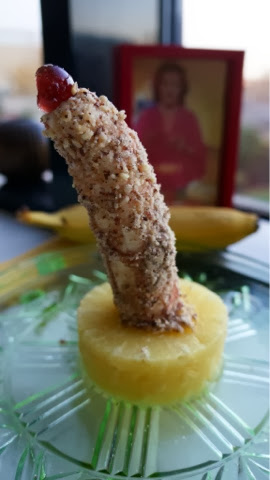
The final in this initial trio of treats for the young at heart seems decidedly risqué in appearance in this day and age, however I am hoping that Fanny designed it with innocence. I am worried that this blog will get banned as a result, but here goes. For Banana Candles, all you need is an ordinary banana, coated with strawberry jam, rolled in chopped nuts and stood up in a few pineapple rings. Oh, and topped off with a glacé cherry flame. I think bananas must have been straighter back in the 1970s, but even so how many parents would be able to keep a straight face if presented with these?


They all tasted just fine, and I am sure were a fun way to get young folk involved and interested in food. It will be interesting to see how Fanny develops the skills of these small fry as the parts progress, but for now I don't think we'll be seeing any of these creations on Junior Masterchef - which is a shame as I'd love to see those judges faces when presented with a Banana Candle...

Tuesday, 19 November 2013

Resuscitate flaked, baked, left-over laminates

"You bought those expensive croissants , your guests hardly touched them and now they are as hard as rocks." Fanny clearly has had troublesome house guests before writing this section, and is venting her anger on the page. How dare the guests not touch the croissants that were so very expensive? I guess back in 1970 they would be hardly heard of and beyond the purse of many readers of Fannys weekly publication, but Fanny pretends that 'we all know' that they will not re-heat. Once the pesky guests have gone though they can be easily turned into a delicious dish - a Croissant Bake or Quiche au Fromage in Fannys favoured French.


It's essentially a savoury bread and butter pudding, and in fairness to Fanny does seem like a good way to use up croissants. Fanny of course makes her own croissants but does not give the recipe yet (we are still learning the basics), and having made my own before I can understand why she was so very upset that her guests didn't bother with them - they do take a long time to produce. However Fanny concedes that shop bought croissants are just fine, even if 'we all know' that they only have a 'life of a few hours' before they are inedible. I'm imagining many housewives in 1970 in an utter panic once their guests have left trying to whip up this recipe and resuscitate the croissants before it's too late. Luckily it's quick and simple.


First of all, to make a savoury custard. I'm using unsweetened Almond milk for a deeper, nuttier, savoury flavour but of course Fanny uses plain old milk. While it's 'raising to a heat, but not boiled' I whisk up three eggs and an extra yolk. When the milk is at temperature (whichever temperature that is) it's poured on top and beaten in. Fanny warns not to whisk at this stage, as this will create irritating and useless foam. Oops.


Once it's seasoned well with salt and pepper, grated Parmesan (or alternative) is added with some soft white breadcrumbs, before pouring into a well buttered oven dish. Fanny insists these are 'proper' homemade crumbs, passed through a hair sieve. Fanny gets angry at the thought of those horrid packets of yellow grit that look like the sediment from the bottom of poor old Polly's cage, and insists that these are NEVER used. Oh dear, I'm guessing she's seen my Croque Monsieur blog pits and that's why she's so angry. That, and those inconsiderate guests. Can't just be me upsetting her, can it?


Finally the croissants are 'sunk' into the mixture before being baked uncovered. I had to hold them down for a bit to soak in the custard (clearly my croissants weren't as rock hard as Fannys were) and push them down again halfway through baking. Fanny issues a warning that if I choose a dish which is too large the croissants will not be totally immersed and will come out 'black as an old boot' by the time the custard is set. Mine look well baked, but not black as old boots, so perhaps I chose well. The croissant bake is warming, comforting and tasty served with some vegetarian sausages and onion gravy... Just the thing to de-stress once those cheeky and frankly rude guests have gone. 


Sunday, 3 November 2013

Pitt-y Panna - the Art of Using Up Leftovers

Fanny shows throughout the Cookery Programme her flair for bringing dishes from Europe (or the Common Market as Fanny referred to it then) to the British dinner table, and this self-saucing Scandinavian supper dish is a perfect example. Apparently it is enjoyed by Swedish people, particularly after the Theatre, in very grand hotels while their teenagers are also 'forking it up in their flatlets'. Really, that's what Fanny says. She is keen to teach us all that there is a very fine art to turning the simplest of leftovers into fabulous treats, and this she says turns ordinary cooks and chefs into Super-Cooks. So here goes, I want to be a Super-Cook.


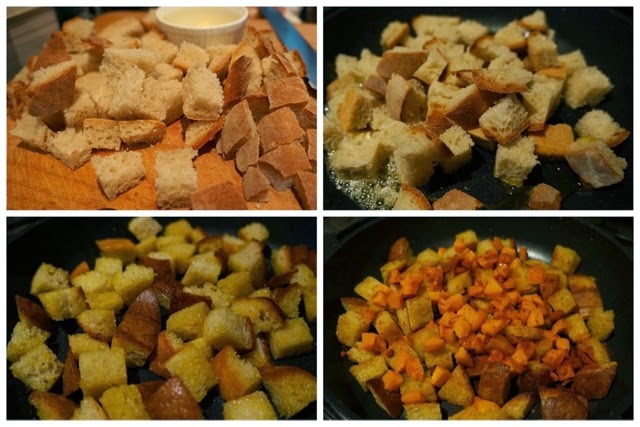
This recipe comes at just the right time as I have plenty of bits of food left over after having friends round for dinner. Not out to the theatre, oh dear. Fannys recipe calls for leftover bread, potatoes, bacon and eggs - but in the spirit of actually using leftovers I am substituting the potato for some squash I have to hand. As ever, it seems fairly simple to put together, but really isn't something I would've thought of. I need to dice the squash and fry it gently first of all.


Then, the same with the bread - cut into croûtons and fry gently until they are golden. I am cooking them in rapeseed oil and butter, so they take on a fantastic colour. Fanny suggests any cooking oil (even dripping, but only if it is VERY clean) and notes that the croûtons should take up every scrap of oil as they start to brown. They do. 


I add a sprinkle of my favourite smoky substitute flavour in place of the bacon - Paprika - and mix the squash and croûtons together, with some seasoning. They need to be piping hot when served, so I heat them slowly and gently while I prepare the eggs. This simply involves separating the whites (which are not used) from the yolks and returning the yolks to one half of the cracked shells. 

To serve, Fanny says that the Swedish pop the mixture into a bowl, make an indent in the middle and place the yolk-in-shell in the centre. So, if that's what they do in Sweden, that's what I do too. At the table, each person tips the yolk into the hot contents and stirs with a fork - creating the sauce. That's it, and that's what I do. Simple as it is, it is very tasty and really comforting - just the sort of thing I'd love after the theatre, or even a simple Sunday night supper. Clearly I am beyond forking it up in my flatlet.

Monday, 28 October 2013

Not rockin' the casseroling

I swithered whether to plough through Part Three of the Cookery Programme using all meat replacements - there's plenty of Quorn, soya and tofu products I could choose from. Almost every meat and fish is available in 'fake' varieties it seems. However, as it's all about the techniques involved for casseroles and treating meat with respect, it seemed a little unnecessary, so I decide to skip over it. Will Fanny forgive me?


This part is rammed full of hints, tips and tricks to successful casseroles as you'd expect. However I am filled with regret at not tackling them, not for the skills or the tastes but as Fanny herself has supplied some of the very best innuendos and puns to go with this collection. I am missing making Fanny's Cod Casserole ('a peak of culinary lunacy'), learning how to make and store faggots (of herbs) and best of all I will never know how to stiffen my prepared meat. 


Fanny clearly loves meat and clearly loves casseroles. She goes to great lengths to encourage readers to love it too. For me, however, this 'before and after' platter of Oxtail with 'amusing presentation' - including a cauliflower to replace the brain - which Fanny claims is copied from the many stalls she has seen in the open markets in Tours, is simply a step too far... I can't see how I could recreate that with soya-based items. What would Linda McCartney think?


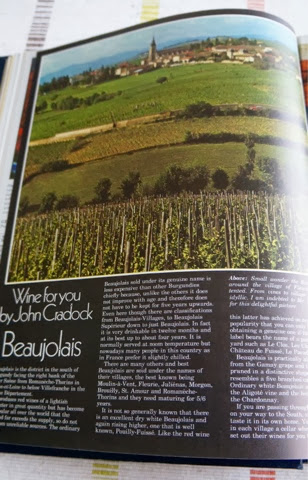
In what seems like a minor irritation to Fanny, Johnnie introduces us to the wonders of Beaujolais, both red and white varieties. Johnnie urges us to try some, especially if you are 'passing through the district on your way to the South' where you can try it in its true home. He even supplies a wonderful photo to inspire us to make the trip. I wonder if he was day-dreaming of escaping for a while as he wrote it?


In truthfulness, there are a few recipes I could adapt happily, but they seem a little strange. Sausage and Rice casserole cooked in milk? French Yorkshire Puddings? And the weirdest Irish Stew I have ever seen, in presentation terms at least.


So I am missing out on the world of casseroles and missing out on some world class innuendos, but Fanny also leaves us with some visual puns too. I am not too sure they'd be terrifically pleased in Sweden with her presentation of this Birds Nest of chives, capers, onions, anchovies, potatoes and eggs, delicious with dark rye bread and butter apparently, but it made me smile.