Showing posts with label Cookery. Show all posts

Sunday, 3 November 2013

Pitt-y Panna - the Art of Using Up Leftovers

Fanny shows throughout the Cookery Programme her flair for bringing dishes from Europe (or the Common Market as Fanny referred to it then) to the British dinner table, and this self-saucing Scandinavian supper dish is a perfect example. Apparently it is enjoyed by Swedish people, particularly after the Theatre, in very grand hotels while their teenagers are also 'forking it up in their flatlets'. Really, that's what Fanny says. She is keen to teach us all that there is a very fine art to turning the simplest of leftovers into fabulous treats, and this she says turns ordinary cooks and chefs into Super-Cooks. So here goes, I want to be a Super-Cook.


This recipe comes at just the right time as I have plenty of bits of food left over after having friends round for dinner. Not out to the theatre, oh dear. Fannys recipe calls for leftover bread, potatoes, bacon and eggs - but in the spirit of actually using leftovers I am substituting the potato for some squash I have to hand. As ever, it seems fairly simple to put together, but really isn't something I would've thought of. I need to dice the squash and fry it gently first of all.


Then, the same with the bread - cut into croûtons and fry gently until they are golden. I am cooking them in rapeseed oil and butter, so they take on a fantastic colour. Fanny suggests any cooking oil (even dripping, but only if it is VERY clean) and notes that the croûtons should take up every scrap of oil as they start to brown. They do. 
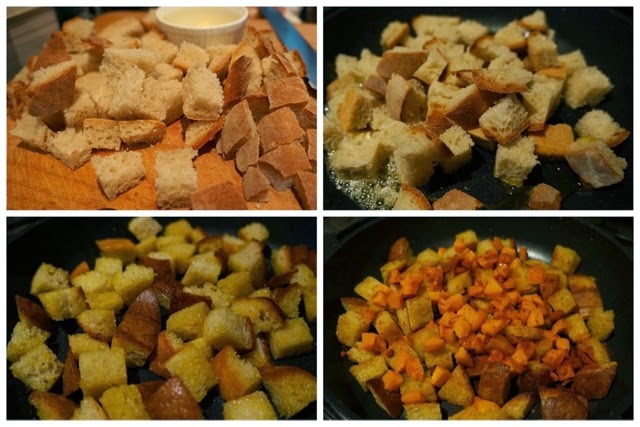

I add a sprinkle of my favourite smoky substitute flavour in place of the bacon - Paprika - and mix the squash and croûtons together, with some seasoning. They need to be piping hot when served, so I heat them slowly and gently while I prepare the eggs. This simply involves separating the whites (which are not used) from the yolks and returning the yolks to one half of the cracked shells. 

To serve, Fanny says that the Swedish pop the mixture into a bowl, make an indent in the middle and place the yolk-in-shell in the centre. So, if that's what they do in Sweden, that's what I do too. At the table, each person tips the yolk into the hot contents and stirs with a fork - creating the sauce. That's it, and that's what I do. Simple as it is, it is very tasty and really comforting - just the sort of thing I'd love after the theatre, or even a simple Sunday night supper. Clearly I am beyond forking it up in my flatlet.

Wednesday, 28 August 2013

By Special Request - First Cookery Books

This blog started because I am passionate about cooking and treasure my collection of old and new books which inspire me and guide me along. As I've been cooking my way through the very early stages of the Cradock Cookery Programme, I've often been surprised by some of the techniques and ingredients used, and I've really enjoyed discussing them on Twitter with other food-obsessives! When Foodie Quine sent out a request asking folk what their First Cookery Book was I was thrilled to reach for my well-loved Be-Ro book, which I still use today. I used to pester my Mum to let me cook things from it all the time. It's where I learnt to cook, and gained a passion for baking especially.


I felt almost guilty leafing through it again, surely Fanny would not be amused? After all, her aim was to teach me to cook with her knowledge, skills and experience as the only reference I would ever need. However, I just couldn't resist looking at the recipes I loved making the most as a child and remembering the people I baked for as well as the occasions. These were some of my favourites, although I am certain they never ended up looking quite like these!


Then my eyes were drawn to the pastry section - I've been blogging about the flours and techniques Fanny uses being so different from the ones I have grown up using and being familiar with. Fanny is currently teaching me all about Flans, and I've been surprised to see her using Self Raising Flour for pastry. Imagine my surprise when I re-read my beloved Be-Ro recipe and discover it is the same! Self Raising Flour! Have I just changed the recipe myself over the years?


Is the Be-Ro book warm and friendly just because of my memories, or was it designed to be accessible and well used? Its full of essential knowledge on 'oven management', 'weights and measures', ingredients (always Be-Ro of course - it cuts out oven doubt!) but most of all just really a wealth of homely recipes.


It's written, apparently, by Joyce Bostock from the Be-Ro Home Cookery Service, and she even urges us to contact her for any free advice on recipes and 'all home baking matters'. I wonder if I ever did?


Fanny, by contrast, feels that she needs to impart her incredible knowledge to me in weekly instalments, no need for queries or feedback. However I did also go back to have a look at Fanny's first ever cookbook, from 1958, written before she was even Fanny (Phyllis Cradock doesn't really have the same ring to it, does it?) and under the Bon Viveur pseudonym with Johnnie. This is her rationale for writing the  book. By request of course.


The recipes themselves are very similar to later ones, and bien sur, the inimitable Fanny style was there even then, requested or not! 


Thanks to Foodie Quine for inspiring this post - don't forget to check out her blog about First Cookery Books too! http://foodiequine.blogspot.co.uk/2013/08/my-first-cookbook-what-was-yours.html

Sunday, 4 August 2013

Chilled out - Una fiesta española con gazpacho, por favor?

"One of the very greatest mistakes we all make when talking in England about fine continental cookery is to confuse specific titles with generics and use generics as specifics"

Fanny's final foray (for Part One, fear not there are 79 more parts to come!) takes me to Spain, for another Dinner Party Menu, or Bill of Fare, and she's starting off with one of my favourites - Gazpacho. As before however, she also starts off in a very unfamiliar way - cooking the ingredients. Surely Gazpacho is a cold soup made from lovely raw vegetables? Or is this just my assumption? Fanny scorns me for thinking so, as everyone does in 'this' country (does she know I am in Scotland, not England though?) apparently, and points out that each region of Spain has it's own version of Gazpacho, as well as a delicious iced vegetable drink which carries 'precisely the same name'. She refers to two main Gazpachos - one of high quality served in private homes, and an enormously crude one enjoyed by peasants. Guess which one we are making? Fanny imagines that I'd LOATHE the peasant version at any rate as it contains dozens of chopped garlic cloves and pints of rather old and smelly oil. It doesn't sound great right enough, so high quality here we come!


The first ingredients are simple - tomatoes, onions and garlic. Fanny tells me to slice, chop and cover them with water and simmer 'with great gentleness' for two hours with some bacon rind. I, of course, omit the rind, and instead add a pinch of smoked paprika - surely its the smoky aroma I am aiming for here? After the two hours I strain the cooked mixture (using my ordinary sieve as ever), add a generous amount of Sherry, some wine vinegar, salt, pepper and celery salt before chilling. That's the soup base, not me. I have to chop a cucumber, some brightly coloured peppers, skin, de-seed and chop some more tomatoes and fry some bread croutons in very hot oil. Fanny gives instructions on how to eat the Gazpacho next - you definitely don't drink this fine soup. Each person takes a spoonful of the accompaniments, stirs them into the soup and enjoys. I have to say, it was rather tasty and of course very high quality.


In best Vegetarian manner, I skip over the Pork Chops cooked in Foil Parcels for main course, and head straight to the Creole Pears with Rice. Actually, being a very good student I read ahead, thankfully, and started the pears last night. Fanny asked me to - she even said please. I peeled my pears - Fanny said they should be ones of a good shape which stubbornly refuse to ripen. I popped them in an oven proof dish, poured over some melted Red Currant Jelly, a small bottle of Sweet White Wine and a little water, and left them 'on the floor' of a very low oven as I went to bed. Fanny assured me that when I came down in the morning they'd be as tender as silk, and bright pink. I daren't admit to Fanny I don't have any stairs in my flat, but nonetheless she was right! 


Next task was to reduce the lovely liquor to a sticky sauce and to cook up some pudding rice - Fanny prefers steaming so that's what I did too. Once steamed I add the zest and juice of an orange, a little sugar and heat it in a saucepan until it is very thick. Now I have to press it into a mould to set - the only one I have is a rabbit, but this seems very appropriate somehow. Fanny recommends brushing the pears with the syrup, arranging them around the moulded rice and serving this well chilled too. Thankfully it's a warm Sunday in Edinburgh, so chilled soup and chilled pudding is very welcome. And, relax.


Monday, 22 July 2013

Here comes that sinking feeling...

"If light fruit cakes, like cherry, sultana, mixed fruit, have any fear for you prepare to she'd them now..."

Fanny's next recipe accompanies a retrospective on her and Johnnie's careers - on stage (the only couple in the world who have filled the Royal Albert Hall with 6750 people for a cookery demonstration), on television (where, it says, a reluctant Fanny auditioned for the BBC, beat off 50 others and then doubled the highest ever figure for sales of any Further Education booklet) and in writing (together Fanny and Johnnie have written over 80 books). The retrospective is quick to point out that although they started off in privileged backgrounds they have both been very hard up, and of course this considerable experience, 'the best of both worlds', has led them to appreciate gardening, French cuisine and supporting struggling students to progress. Erm, of course, I see the link... So naturally, they simply must share their technique for a Cherry Cake that will NEVER sink. The cherries that is, not the cake.


Ingredients are again simple - butter (I decide to use French, Fanny would be pleased), caster sugar, lemon zest, flour, eggs and glacé cherries. Fanny seems to smirk as she's writing this one, knowing that she is right and everyone else is wrong. Someone has clearly challenged her on this topic recently.  I wouldn't question Fanny, I mean if you can fill huge, historic venues, write numerous books and become a TV sensation, you surely know how to bake a cake with cherries that don't sink. That must be the point of the career retrospective. 


I cream the butter with the lemon zest, add the sugar and whip it until it is 'creamy and very loose'. All seems familiar so far. I add in a tablespoon of my sieved flour and one egg and whip again. Picking up a pace, I am guided to add two tablespoons before the second egg and whipping, then 'repeat' with the remaining eggs and flour. My mixture should now look smooth and thick. It does, very thick. Fanny tells me that no matter what I do to the fruit it will sink to the bottom of the cake if it is made of a mixture whose texture is not strong enough to support it. Is that the key, a really heavy cake? Is that why the cherries won't sink?

I've made Cherry Cake before and my cherries have never sunk, so I think I know the next step and possibly the top tip - wash the cherries? However without a hint of a smile, Fanny smugly warns me 'Of course you do not wash the fruit' - she really has gotten into my mind lately, but now she is answering my thoughts I really am feeling fearful. Just when I am thinking 'Well what on earth do I do then?' Fanny answers with 'of course you DO turn the fruit in flour and shake off the surplus through an ordinary sieve'. Ah, thankfully my sieve is VERY ordinary.


Now I need to fold the fruit in and pop the mixture into my carefully prepared tin, levelling it off before baking. Fanny provides a 'note' here to allow me to make a choice next. A choice? Do I really want to be making my own choices at this stage? My permitted choice is crack-or-no-crack. If only Noel Edmonds had hit on this winning formula... If I am happy with a cracked top (and what home cook wouldn't be) I just need to pop the cake in the oven. However if I want to do as Professional chefs in France (and presumably nowhere else) do when they are entering cakes into competitions (do they really enter a non-sink Cherry Cake?) I should sit the cake on four folds of brown paper and cover it with a large old biscuit tin. I haven't got any brown paper, so decision is made - crack it is!


So did it work? I think so! When sliced, the cherries appeared all over the cake, although in the first slice in the picture they do look like they are at the bottom. It's not worth starting again just for the photo, so take my word for it. You see, I now even sound like Fanny. The cake itself is very light, and has a wonderful crack on top. Very homely, but don't tell the professional French chefs entering competitions. 


Finally, and most confusing I would say, Fanny tells us that she cannot imagine why anyone does not actually like the gooey pad of cherries that collect at the bottom of the cake if you do not follow her advice and the cherries sink. So quite what this recipe is all about, I do not know. Johnnie prefers it, in fact - when he was a small boy and Cook was baking, he used to sneak into the kitchen, open the oven door and give the cake a smart bang so the fruit WOULD sink to the bottom. Maybe that's the point of all this, Fanny and Johnnie - 'the best of both worlds'. 

Thursday, 18 July 2013

All trussed up, but nowhere to go

"Hang your plucked, drawn prime goose in a slight draught to crisp up the skin. Twenty four hours later, truss it"

Fanny is trying to ensure that I get a repertoire of 'basics' under my belt, and I think she's done a solid job so far with some seemingly, at least initially, strange choices. I'm trying to resist temptation to flip forward to some of the more recognisable Fanny dishes with flashy presentations, but I am here to learn and I am sure my patience will pay off. However the majority of the remainder of Part One of this glorious technicolour 80 part-work is a guide to Simple Cooking with Poultry - not essential for a vegetarian like me, but fascinating to see what Fanny thought of as 'basic', 'simple' and an 'introduction' to cooking all sorts of birds...


I'm realising that Fanny was ahead of the game in many ways, and her views on birds are no different - urging readers to only buy 'fresh, free run', even if you are thinking about 'capons' which Fanny tells us, via Noel Coward, are hens that have 'been arranged'. If you wondered what to look for in a fresh pigeon - and who doesn't? - the advice is clear - supple feet and firm vents. Is that freshly 'dead' or still wandering around? She also urges folk to buy in bulk for reasons of economy, and freeze... Only AFTER following her cooking tips of course, and NEVER freezing first, for reasons of family wellbeing. Fanny thankfully does not give more details, but you can imagine.


The 'pic-strip' comes into it's own in this guide - first and foremost we must learn to truss. Fanny has apparently simplified the process for the 'home cook' which I am sure everyone was eternally grateful. Fanny gets Peter to demonstrate, which indicates that it is so easy that 'anyone can do it, even Peter'. However, cooking whole birds in a 'mountain' of salt is something which must be shown by her own experienced hands. Peter is allowed to help out. Peter does not benefit from matching green jacket and eye shadow, sadly.


Fanny discusses the merits of roasting in aluminium foil versus in 'see through' foil - is this what we now call a roasting bag? I am thankful suddenly to be a vegetarian as Fanny instructs us to take our ordinary (sterilised) garden secateurs in hand and set about cutting chicken into neat pieces. I fear for readers fingers, but Peter is again allowed to show us how to do it, so I suppose it must be fairly straightforward and trips to Accident and Emergency free.


The recipes and techniques seem never ending, and I am confident that if I did eat poultry, I would be set for life. Fanny even has recipes for those family members who are 'regretfully placed' and need to avoid salt and fat in their diet. The answer? Roman Pots of course. If you are more fortunate you could do worse than cook a non-greasy goose or duck, surely? 


I've learnt more than I ever needed to know about buying, storing, cooking, and serving all sorts of birds in all sorts of manners. I am also learning about typography - almost ever font, style and colour has been used. Has Fanny made it simple and basic? I find it hard to say. She can't resist a flourish towards the end, of course, and showcases her Duckling a l'Orange in glorious presentation. I wonder how many readers in 1970 recreated this one, perfectly hung, trussed and prepared? 


Sunday, 14 July 2013

Menu du Jour: Le diable écossais

It's Bastille Day, and as Fanny was such a devotee of French cookery, it feels appropriate to adapt one of her recipes to suit. That's to suit me, as a vegetarian, of course. Fanny herself has adapted this particular recipe from a famous Breton Cook, Madame la Mere Poularde, who, without knowing whom she was talking to, praised the late King of the Belgians by telling him 'you have eaten and drunk well - you may consider yourself free to come again'! So what did La Mere cook for the King? Devilled Chicken with Saffron Rice seems to have been the delight he savoured... For me Poulet Diable is transformed using some Vegetarian Haggis kindly sent by Jo Macsween from Macsweens Haggis for me to try, into Le Diable écossais...


I've never made any classic French sauces, so I'm keen to see how this Devil Sauce turns out. I add my finely chopped shallots, garlic and freshly cracked pepper to some stock, and add a faggot of herbs. Fanny really does write her own jokes - but also cuts the laughter short as she translates it for me into French - bouquet garni. Phew. They simmer together for 20 minutes as the house is filled with the wonderful smells of gently cooking shallots. Mmmm. 


Once reduced I need to replenish it to it's original volume with some more stock, without explanation. Without hesitation, I do. Fanny tells me to melt some butter, add some flour and stir. I know I am making a roux, even if Fanny doesn't tell me. Am I getting ahead of myself? Adding in a little of the shallot-y stock I 'beat' it as instructed, and add in some Curry Paste (Fanny seems the one ahead of her time here) some Tomato Purée and a drop or two of Worcestershire Sauce. 


Once all the stock has been added and beaten in gradual steps, I am instructed to sieve it and retain the sauce. It looks great! Very glossy... Just feels a shame to discard those lovely shallots, but I guess they've done their work.


Next up is to cook some rice for exactly 11 and a half minutes to a 'strong simmer' with a pinch of Saffron and to fry up some slices of Vegetarian Haggis. Fanny tells me to push the hot, cooked vibrant yellow rice into Dariole moulds (it's French all the way today) and cover with a 'tent of foil' while I get everything else ready. Fanny has a glorious technicolour picture of a whole chicken sitting in a pool of sauce with neat rows of rice with olives on top. This is a step too far for me, I have a phobia against olives, but I present my dish Fanny-esque.


This sauce was devilishly easy to make, has a nice wee kick and goes so well with the Vegetarian Haggis. I am confident that the King of the Belgians, Madame la Mere Poularde, Jo Macsween and Fanny herself would be delighted to sit round my table and help me enjoy it. What a fantasy dinner party, devils and all! Bon Appetit! 


Saturday, 22 June 2013

Above all, garnish and presentation!

So where do I start? It really all started a couple of years back when I was spending a selfish day roaming around the second hand bookshops of Stockbridge, Edinburgh. I could spend hours looking for old and interesting cookbooks, I love reading recipes from years gone by and wondering if I could recreate them today. But I didn't expect that day to find my personal holy grail, a complete set of lovingly bound Fanny and Johnnie Cradock Cookery Programme part-works, released weekly in 1970/1971 in 80 parts. There should have been 91 parts, but the remaining ones were never published. Someone had taken great care to bind these 80 glorious technicolour (at time garish) cookery magazines into 5 volumes of fun, knowledge, and for me, opportunity! I didn't think twice, and bought the set... I'd seen Fanny on TV, read books about her and had always hoped to have her recipes in my hand - now I did!


I spent the next few months pouring over each and every word and picture, reading my way through the entire set and absorbing the wonderful hints, tips and techniques... My partner didn't really know what to say when I headed off to bed for some 'Fanny Fun', well, its quite hard to explain I suppose! Of course I was amazed at the sight of green mashed potatoes and pigeon pies garnished with real pigeon wings, but I learnt so much and was inspired to cook differently, I just never cooked anything from the set, why not?


I've spent the past few years wondering what I can do with all this wonderfulness, and could Fanny really teach me all she ever knew in weekly instalments? Well, here goes, I'm going to give it a try! I am a vegetarian, and reluctantly Fanny did recognise that we exist, but of course many of the recipes are very meaty, so I'm not going to slavishly work through all of them, but I will write about them even if I don't make them... 

So, according to Fanny there are 7 things I am about the learn - what to buy, methods, timings, perfect implements, working with maximum economy and, above all, garnish and presentation. Don't expect to see those pigeon wings here any time soon, but who knows what will appear!