It seems I have something very particular in common with Fanny Cradock's husband, Johnnie. It's not that I am browbeaten at home, or in the kitchen. It's not that I quiver whenever my partner barks an order at me. It's not that I am shy, retiring or in any way intimidated or fearful of daring to contradict anyone where I feel it necessary. Even Fanny. It's not even that I am partial to a monocle, cravat and a sturdy glass of port to see me through the evening. No, it's something that others find strange, often won't believe at all and quite simply cannot comprehend. I, and Johnnie, hate Rice Pudding.
For me, I still wince at the thought of the un-tearable, thick, black, leathery, tarpaulin skin that was always atop the Rice Puddings that emerged from the oven at home. I. Couldn't. Bear. To. Look. Never mind eat it. I once sat all night at the kitchen table when my Dad said I 'couldn't leave' until I'd eaten it. I won. Everyone I have ever met in life since (almost) thinks I am missing out. I always felt I was alone. There didn't appear to be a suitable support group for me to join. I just had to remain silent and get on with life. Until now. Johnnie is my saviour.
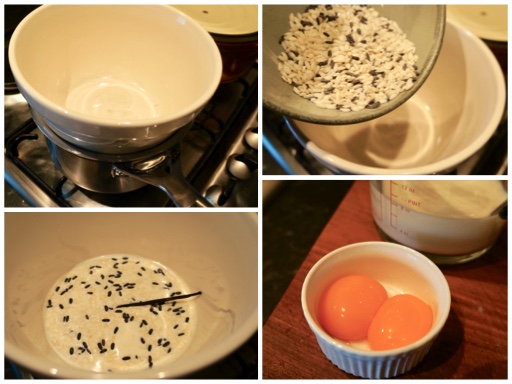
Fanny's version of Rice Pudding, is, as expected, slightly different to all others. It's an Olde English recipe which she, naturally, found in France labelled subtly as Une Recette Familiale Anglaise. It does not looks like a Rice Pudding. Good. It does not taste like a Rice Pudding. Smashing. It is made with all the same ingredients as a Rice Pudding. Oh. The key is, it is made in a totally different way. No oven. No Black tent-of-death. No sitting at the table all night. Maybe.
Fanny makes her Rice Pudding in a double-boiler on the stove-top. She uses Patna pudding rice, which I don't have. The only Rice I can find in my cupboard is Risotto. Which happens to have some Wild Black Rice mixed through it. Feel the Fear. Fanny adds milk, in stages, and a vanilla pod, while it heats. Stirring occasionally, cooking slowly, it seems just like a Risotto to me. Which is soothing. And it turns out that Black Rice is really Red Rice, and turns the whole mixture pink. Added bonus. Once all the milk is absorbed, Fanny adds in two egg yolks one at time, and continues to heat and beat gently before flinging in a little sugar, to taste, and some stiffly whipped cream.
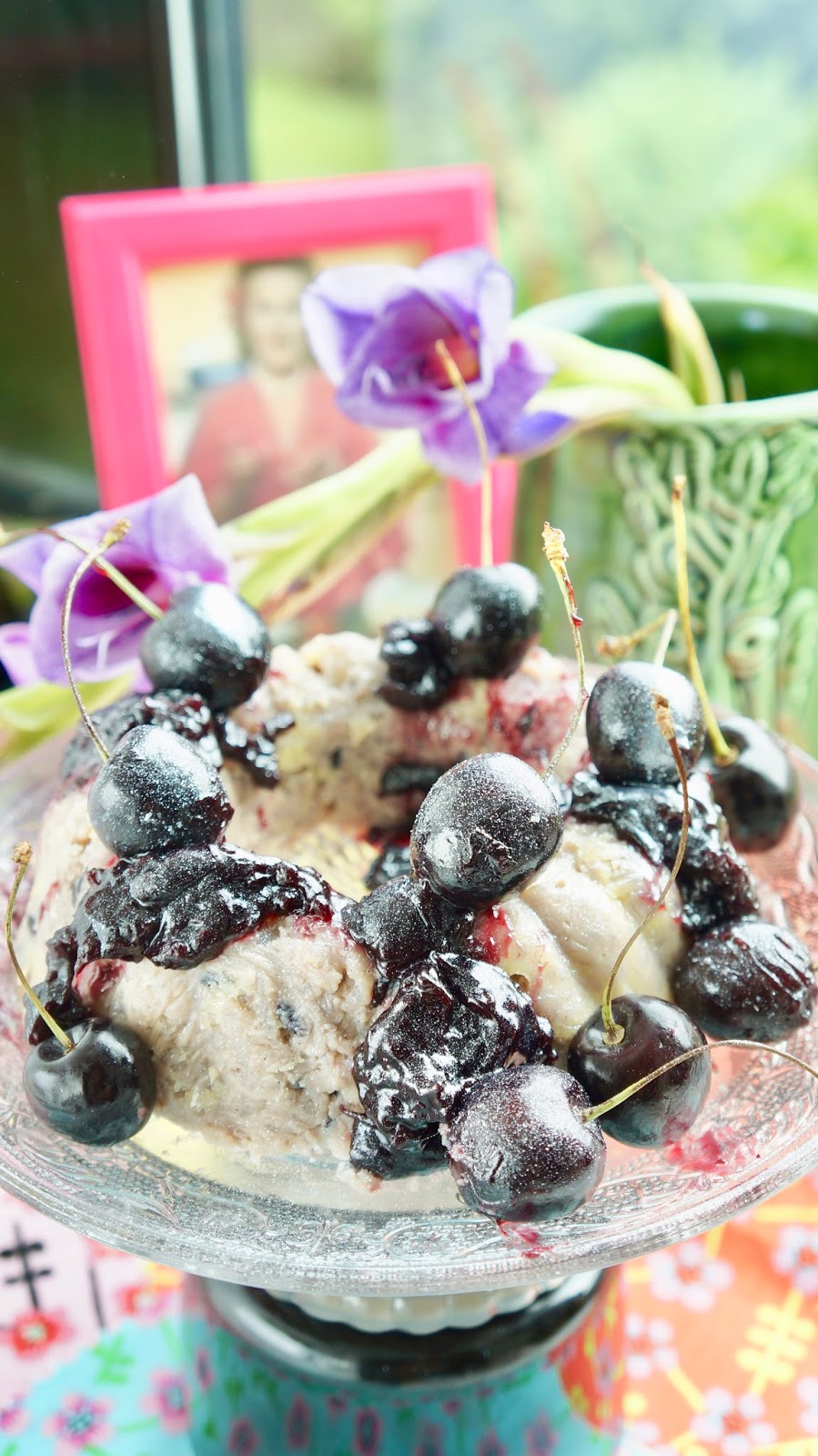
To tempt Johnnie (and me) even further, Fanny moulds the Rice Pudding and leaves it to cool in the fridge. It's hard to resist a bit of moulding. Fanny disguises it primarily to replace Johnnie's terrible memories. Decorated with seasonal fruit, I have cherries. Seemingly, when she visited him once during World War Two in the Royal Masonic Hospital where he was recovering from tonsillitis (which, Fanny notes is very serious in a grown man) she discovered Johnnie out of his bed, in his pyjamas (thankfully) pushing something down the wash basin that he didn't want the Matron to see. It was English Rice Pudding. Not Fanny's 'fantastic' French Rice Pudding, which he would never say no to. He would never say 'no' to Fanny full stop. Would you?
Showing posts with label Rice. Show all posts
Friday, 11 August 2017
Monday, 3 October 2016
Be Kind To Your Vegetables
Fanny Cradock has rules. Not guidelines. Commands. Laws. She insists that readers follow her every move, chapter and verse. No deviation. As per regulation. Especially when it comes to simple things. Like vegetables. Fanny grows her own produce, wherever possible, so she knows exactly what produces the best and worst results. Her fundamental formula for success is fairly well documented. Fanny liked to water her own garden with, erm, her own water. Madam's Tonic. Yes. A natural sprinkler system. It produced the best results.
However her criteria for vegetables need not to stretch to us modelling that. Her ruling is that, like her, we are simply able to recognise on sight the 'duds' that some shops sell. Fanny's maxim is that even at the worst greengrocers, it is hard to find leathery spinach, overgrown rhubarb and giant new potatoes. Vegetables are gorgeous in spring and early summer, Fanny says, and her only prescription for success, apart from her natural fertiliser, is that they should be cooked with kindness. Never boiled. That is a ruling. That would be cruel.
She sets a precedent with spinach, for example. It should be flung in a hot pan and wilted. The job should be done in eight minutes, by decree of Fanny. Just enough to draw out the natural water content, of which there will be much. A panful of spinach juices will run free, leaving only the smallest amount of spinach when Fanny's direction is followed. Perhaps you might want to cook it slightly longer if you picked your spinach from Fanny's garden.
Fanny serves her spinach by statute too, either 'en branche', in full leaf, or 'en purée' which is simply rubbed through a sieve. It is raised to great heights though with the addition of some cheese and a little cream, often served as a separate course by the French. They simply would not make a course from boiled vegetables, not with their palates. The French collect the juices from the spinach, as they recognise that they will contain the highest flavour. If boiled, this would mean slinging the best away. As in Fanny's bathroom regimen, presumably. Although, it may be more sanitary to boil in Fanny's case.
Fanny knows that she is always ramming French edicts down our throats. Her best guide for vegetables is English however. The Steamer. She claims it is a virtuous pastime, and valuable too if you can stack it correctly. The French may call this 'trucs' but we would simply know it as a 'tricks'. Like boiling rice in the pan, and having carrots steaming above, with cabbage leaves above that. The carrots should be mashed up and served simply, ruffled up with a fork, with a blob of cream added. The cabbage leaves will be happiest stuffed with the rice and a simple sprinkle of, erm, paprika. You were worried there, weren't you? Stick to Fanny's rules in the kitchen, if not the garden, and be kind to your vegetables.
However her criteria for vegetables need not to stretch to us modelling that. Her ruling is that, like her, we are simply able to recognise on sight the 'duds' that some shops sell. Fanny's maxim is that even at the worst greengrocers, it is hard to find leathery spinach, overgrown rhubarb and giant new potatoes. Vegetables are gorgeous in spring and early summer, Fanny says, and her only prescription for success, apart from her natural fertiliser, is that they should be cooked with kindness. Never boiled. That is a ruling. That would be cruel.
She sets a precedent with spinach, for example. It should be flung in a hot pan and wilted. The job should be done in eight minutes, by decree of Fanny. Just enough to draw out the natural water content, of which there will be much. A panful of spinach juices will run free, leaving only the smallest amount of spinach when Fanny's direction is followed. Perhaps you might want to cook it slightly longer if you picked your spinach from Fanny's garden.
Fanny serves her spinach by statute too, either 'en branche', in full leaf, or 'en purée' which is simply rubbed through a sieve. It is raised to great heights though with the addition of some cheese and a little cream, often served as a separate course by the French. They simply would not make a course from boiled vegetables, not with their palates. The French collect the juices from the spinach, as they recognise that they will contain the highest flavour. If boiled, this would mean slinging the best away. As in Fanny's bathroom regimen, presumably. Although, it may be more sanitary to boil in Fanny's case.
Fanny knows that she is always ramming French edicts down our throats. Her best guide for vegetables is English however. The Steamer. She claims it is a virtuous pastime, and valuable too if you can stack it correctly. The French may call this 'trucs' but we would simply know it as a 'tricks'. Like boiling rice in the pan, and having carrots steaming above, with cabbage leaves above that. The carrots should be mashed up and served simply, ruffled up with a fork, with a blob of cream added. The cabbage leaves will be happiest stuffed with the rice and a simple sprinkle of, erm, paprika. You were worried there, weren't you? Stick to Fanny's rules in the kitchen, if not the garden, and be kind to your vegetables.
Monday, 12 October 2015
Dont boak, it's only Gwen Troake!
Fanny Cradock never cooked with Gwen Troake, not surprising after judging her nauseating banquet menu so harshly, claiming her ideas were 'too rich' and just plainly not suitable for presentation at a professional level. For Fanny, the end of a long career on TV, for Gwen it resulted in her first, and only cookbook, endorsed by Esther Rantzen. Esther said that the nation became either pro-Troake or pro-Cradock following the showdown, but my guess is that the only winner was the book publisher, who presumably shifted a fair few copies of plainly unprofessional Gwen's Country Cookbook.
The main ingredient that made Fanny pull faces as if she was holding back a substantial slew of slurried spew was the humble Bramble. Fanny claimed on TV not to even know what one was, and continued her bile-laden disgust at Gwen for even suggesting that it would make a suitable sauce to be served with Duck at the banquet the Big Time show was built around. Game old Gwen simply chuckled at Fanny's vitriolic vomit and carried on regardless. No-one else really seemed to like her recipes, but somehow they made it into her book. This must've made Fanny retch even more.
The Bramble Sauce recipe is a peculiar one indeed. Gwen simmered Brambles in plain water for around 15 minutes before straining and pushing them through a sieve. The pulp was discarded, and the juice thickened first of all with that staple of all 70's sauces, cornflour, and then with a very un-Fanny ingredient. Shop bought lemon jelly. Fanny would heave. Gwen adds sugar to make it even sweeter, a little salt and a splash of red wine, presumably for refinement. I can see why Fanny remained on the point of gagging. Especially as an accompaniment for a savoury main course. Perhaps it was meant to be regurgitated for dessert?
In her quest to extend our rice repertoire, Fanny makes some sweet fritters and suggests serving them with 'your favourite jam sauce'. Hmmm. I bet she never thought anyone would dare to recreate Gwens creation though. I'm wicked. I know. Shoot me. Fanny binds together cold, cooked rice with an egg, some ground almonds, sugar and a generous sprinkling of cinnamon. She shapes them into little rissoles and fries them very gently in olive oil (from the chemist) until they are a nice brown colour. They don't really look like a dessert, more of a chicken nugget type of a thing, or dare I say a duck-nugget should such a thing even exist?
The resulting modern day 'collaboration' between Fanny and Gwen is a slightly more convivial combination. The crunchy, slightly sweetly spicy but otherwise plain rice 'fritters' are given a new lease of life with the overly sweet, citrusy Bramble jam sauce, which is thick and gloopy. I find myself dipping the fritters into it as if it were ketchup (not that I've ever actually eaten ketchup, the thought of it truly makes me heave) in a way that would probably increase Fannys revulsion. Perhaps they should've written a cookbook together, partly for professionals and partly for the public, instead of bickering their way into the history books. Gwen's Brambles may not have appealed to Fanny, and may have never appeared again in such a form on any table - professional banquet or otherwise. Fanny's guidance may have provoked less of a joke, croaking more a masterstroke than a choke, and revoked both their futures from hurtling towards broke. That's all folks...
The main ingredient that made Fanny pull faces as if she was holding back a substantial slew of slurried spew was the humble Bramble. Fanny claimed on TV not to even know what one was, and continued her bile-laden disgust at Gwen for even suggesting that it would make a suitable sauce to be served with Duck at the banquet the Big Time show was built around. Game old Gwen simply chuckled at Fanny's vitriolic vomit and carried on regardless. No-one else really seemed to like her recipes, but somehow they made it into her book. This must've made Fanny retch even more.
The Bramble Sauce recipe is a peculiar one indeed. Gwen simmered Brambles in plain water for around 15 minutes before straining and pushing them through a sieve. The pulp was discarded, and the juice thickened first of all with that staple of all 70's sauces, cornflour, and then with a very un-Fanny ingredient. Shop bought lemon jelly. Fanny would heave. Gwen adds sugar to make it even sweeter, a little salt and a splash of red wine, presumably for refinement. I can see why Fanny remained on the point of gagging. Especially as an accompaniment for a savoury main course. Perhaps it was meant to be regurgitated for dessert?
In her quest to extend our rice repertoire, Fanny makes some sweet fritters and suggests serving them with 'your favourite jam sauce'. Hmmm. I bet she never thought anyone would dare to recreate Gwens creation though. I'm wicked. I know. Shoot me. Fanny binds together cold, cooked rice with an egg, some ground almonds, sugar and a generous sprinkling of cinnamon. She shapes them into little rissoles and fries them very gently in olive oil (from the chemist) until they are a nice brown colour. They don't really look like a dessert, more of a chicken nugget type of a thing, or dare I say a duck-nugget should such a thing even exist?
The resulting modern day 'collaboration' between Fanny and Gwen is a slightly more convivial combination. The crunchy, slightly sweetly spicy but otherwise plain rice 'fritters' are given a new lease of life with the overly sweet, citrusy Bramble jam sauce, which is thick and gloopy. I find myself dipping the fritters into it as if it were ketchup (not that I've ever actually eaten ketchup, the thought of it truly makes me heave) in a way that would probably increase Fannys revulsion. Perhaps they should've written a cookbook together, partly for professionals and partly for the public, instead of bickering their way into the history books. Gwen's Brambles may not have appealed to Fanny, and may have never appeared again in such a form on any table - professional banquet or otherwise. Fanny's guidance may have provoked less of a joke, croaking more a masterstroke than a choke, and revoked both their futures from hurtling towards broke. That's all folks...
Thursday, 8 October 2015
Veggie Fanny
Fanny Cradock has been guiding me, teaching me and frankly scolding me for a few years now as I twist and turn her bonkers creations into meat-free celebrations, but until now she has never even muttered the V word. Not even under her breath. Not even as she wallops me with a perfectly ordinary spatula. However, today she has gone all out and labelled an entire section in the partwork as 'Vegetarian Rice Dishes'. It's all come as a huge surprise to me. Were there many vegetarians around in the 1970's? What were they eating? Was Fanny responsible for shaping restaurant menus up and down the land with that one, solitary veggie option that would stare out at us?
Ask most veggies what they hate to see on a menu and the answer invariably is Risotto. I never know why, I love it, I make it a lot and even enjoy it from time to time when out. Okay, I don't want to see it all the time, and it really is a lazy option for most restaurants, but done well can be magnificent. Fanny's first trio of vegetarian dishes is a Mushroom Risotto. Found on menus everywhere to this day. She makes it in a very traditional way, just as we all would. No strange colourings or additions at all. Perhaps Fanny wasn't so bonkers after all?
For her second dish, which she particularly recommends as a 'super dish for Facto-Vegetarians' (what had she taken?) is a mix of cooked marrow, cheese, eggs and rice in a mound and covered in butter and breadcrumbs. She calls it inelegantly 'Filling Rice and Vegetable Dish' and notes that it tastes a great deal better than it's rather ordinary and pale appearance would suggest. Or its name. Thankfully never to be seen on any menu ever. Not to worry, it's Fanny's third choice that grabs my attention. Firstly, yes, because it's another veggie cliché but then because I remember just how much I like and yet mostly forget about lentils.
Fanny refers to this dish as Pakistani Khichdi, and of course calls the lentils Dhan Dhal. She never misses an opportunity to teach us in her worldly-lingual ways. She leaves the authenticity here I think, preferring her own method of cooking the rice to the classic Pakistani way, which she says is much easier. If only everyone would just do as she says, these peskily traditional women from Pakistan included. Sweat it out. The rice technique that is. Fanny washes the rice and lentils together, then swirls them in a heavy, roomy pan of water with sliced onion, salt and turmeric. She then 'sweats until tender', which I presume is instruction for the rice (4 minutes on the stove and then finished off in the oven) and not me?
It emerges light, fluffy and smelling tremendous. It's all just the one 'turmeric' colour now. Fanny finishes it off with a slosh of vegetable oil mixed in to make it glossy and serves with her favourite sweet and hot chutneys. My favourite is not a chutney, but Chilli Burns from the ever lovely Galloway Chillis, which adds a real kick to this simple but delicious dish. I managed to scrape just enough from the bottom of my jar to drizzle, must buy some more! Who knew Fanny was aware we vegetarians even existed? Well almost, she decorates hers with borders of Prawn Toast. Small steps, we clearly can't expect miracles.
Ask most veggies what they hate to see on a menu and the answer invariably is Risotto. I never know why, I love it, I make it a lot and even enjoy it from time to time when out. Okay, I don't want to see it all the time, and it really is a lazy option for most restaurants, but done well can be magnificent. Fanny's first trio of vegetarian dishes is a Mushroom Risotto. Found on menus everywhere to this day. She makes it in a very traditional way, just as we all would. No strange colourings or additions at all. Perhaps Fanny wasn't so bonkers after all?
For her second dish, which she particularly recommends as a 'super dish for Facto-Vegetarians' (what had she taken?) is a mix of cooked marrow, cheese, eggs and rice in a mound and covered in butter and breadcrumbs. She calls it inelegantly 'Filling Rice and Vegetable Dish' and notes that it tastes a great deal better than it's rather ordinary and pale appearance would suggest. Or its name. Thankfully never to be seen on any menu ever. Not to worry, it's Fanny's third choice that grabs my attention. Firstly, yes, because it's another veggie cliché but then because I remember just how much I like and yet mostly forget about lentils.
Fanny refers to this dish as Pakistani Khichdi, and of course calls the lentils Dhan Dhal. She never misses an opportunity to teach us in her worldly-lingual ways. She leaves the authenticity here I think, preferring her own method of cooking the rice to the classic Pakistani way, which she says is much easier. If only everyone would just do as she says, these peskily traditional women from Pakistan included. Sweat it out. The rice technique that is. Fanny washes the rice and lentils together, then swirls them in a heavy, roomy pan of water with sliced onion, salt and turmeric. She then 'sweats until tender', which I presume is instruction for the rice (4 minutes on the stove and then finished off in the oven) and not me?
It emerges light, fluffy and smelling tremendous. It's all just the one 'turmeric' colour now. Fanny finishes it off with a slosh of vegetable oil mixed in to make it glossy and serves with her favourite sweet and hot chutneys. My favourite is not a chutney, but Chilli Burns from the ever lovely Galloway Chillis, which adds a real kick to this simple but delicious dish. I managed to scrape just enough from the bottom of my jar to drizzle, must buy some more! Who knew Fanny was aware we vegetarians even existed? Well almost, she decorates hers with borders of Prawn Toast. Small steps, we clearly can't expect miracles.
Monday, 5 October 2015
Researching Realistic Rice
Fanny Cradock turns her overly attentive eye to the subject of rice for part 25 (don't worry Fanny fans, we still have 55 parts to explore together...) and the many ways to cook with it. Fanny wants us to take a 'realistic' look examining its vast culinary potential. Judging by previous parts, we won't yet be cooking all those potential dishes, but merely laying down the foundations. Fanny gives a rundown of rice use throughout the globe, and reminds us readers it's very much like our potato - a basic and economical food. Thanks Fanny. She does hint that if we do proceed we will be able to make rice dishes for MIPs. Forget VIPs, for Fanny they are Most Important Personages.
Fanny tries her best to give some historical context to rice, but generally finds that every continent has claimed to be the true origin of rice at some point. So, she just goes with what she prefers... For Fanny, the 'nicest' legends come from the East, where rice is a symbol of life and fertility, hence, Fanny claims, why we throw rice at wedding couples. Not really Eastern then. One thing Fanny says is for sure is that every cook should know at least four ways to cook rice in order to elevate themselves one rung higher up the now enormous culinary ladder she has labelled 'Perfect Cookery'. I feel ready for the challenge, so let's go fourth. Erm...
Sweating. That's Fannys first foray into rice. She chooses ordinary Patna rice (she mentions it from time to time, but has only now explained this is 'common' general rice, or Long Grain as it is now known), but for super extravagance she would choose Wild Rice from the swamps of Florida. It's not clear if she forages for it herself while there. Fanny melts some butter, chops an onion, and flings them together with the rice. Stirring for exactly four minutes. She then turns it into a casserole dish, covers wth stock, slips a lid on and pops it into the oven until the liquor is absorbed, around 20 minutes. Technique two continues to cook on the stove top, adding the stock gradually, letting it absorb and adding more. We know this now as Risotto style, but Fanny calls this 'Fried Rice'. Confusing.
The 'fried' rice is sticky and gloopy, but full of flavour while the sweated version is plump and swollen. Different colours and textures. Fanny knows that this is not always desired, so gives two basic techniques for 'grain-separate' rice too. Fanny again uses Patna rice, but also says we can substitute with 'health' rice, which is brown. She haves it into rolling-boiling salted water, stirs it once and lets it simmer for exactly eleven and a half minutes. Timings are very precise for rice. That's it, it should be absolutely grain separate. It is. Technique four is to boil it for only 6 minutes, then drain it and shove it in the oven with some stock until it is absorbed. Fanny says this is ideal for serving with kebab meats on skewers. It's not as plump as the plainly boiled version. I'm not sure what the connection to kebabs is.
And there we have it - four basic techniques for rice. And, four very different results. The sweaty, swollen versions would be great with drier accompaniments, while the perfectly separate ones with wetter things. Take your choice. Once we have the techniques off pat(na), Fanny says we can reach even higher by switching up the chosen liquor as well as the chosen rice. She sometimes replaces some of the water with stock, and some of the stock with sherry, brandy and wine. It probably ends up with the rice being entirely simmered in vodka. Fanny reminds the less experienced among us that red wine should be used if serving with dark meat and white with light. Continuing to remind us to be realistic with our rice however, Fanny says these should only be tackled by highly ambitious cooks in the 'top flight' of rice cookery, and this confidence can only be gained gradually. Thankfully no MIPs or VIPs are expected anytime soon, so I can stick to the basics. Perhaps Fanny will give me a leg up that ladder sometime soon...
Sweating. That's Fannys first foray into rice. She chooses ordinary Patna rice (she mentions it from time to time, but has only now explained this is 'common' general rice, or Long Grain as it is now known), but for super extravagance she would choose Wild Rice from the swamps of Florida. It's not clear if she forages for it herself while there. Fanny melts some butter, chops an onion, and flings them together with the rice. Stirring for exactly four minutes. She then turns it into a casserole dish, covers wth stock, slips a lid on and pops it into the oven until the liquor is absorbed, around 20 minutes. Technique two continues to cook on the stove top, adding the stock gradually, letting it absorb and adding more. We know this now as Risotto style, but Fanny calls this 'Fried Rice'. Confusing.
The 'fried' rice is sticky and gloopy, but full of flavour while the sweated version is plump and swollen. Different colours and textures. Fanny knows that this is not always desired, so gives two basic techniques for 'grain-separate' rice too. Fanny again uses Patna rice, but also says we can substitute with 'health' rice, which is brown. She haves it into rolling-boiling salted water, stirs it once and lets it simmer for exactly eleven and a half minutes. Timings are very precise for rice. That's it, it should be absolutely grain separate. It is. Technique four is to boil it for only 6 minutes, then drain it and shove it in the oven with some stock until it is absorbed. Fanny says this is ideal for serving with kebab meats on skewers. It's not as plump as the plainly boiled version. I'm not sure what the connection to kebabs is.
And there we have it - four basic techniques for rice. And, four very different results. The sweaty, swollen versions would be great with drier accompaniments, while the perfectly separate ones with wetter things. Take your choice. Once we have the techniques off pat(na), Fanny says we can reach even higher by switching up the chosen liquor as well as the chosen rice. She sometimes replaces some of the water with stock, and some of the stock with sherry, brandy and wine. It probably ends up with the rice being entirely simmered in vodka. Fanny reminds the less experienced among us that red wine should be used if serving with dark meat and white with light. Continuing to remind us to be realistic with our rice however, Fanny says these should only be tackled by highly ambitious cooks in the 'top flight' of rice cookery, and this confidence can only be gained gradually. Thankfully no MIPs or VIPs are expected anytime soon, so I can stick to the basics. Perhaps Fanny will give me a leg up that ladder sometime soon...
Friday, 10 January 2014
It's All Greek To Me - Lemon Soup
Fanny says there are two ways to make this unusual (for me) soup, which vary drastically in quality. If you want your soup to taste practically like pond water, use a stock cube. If you want your soup to be delicate and delicious then it needs to be made with well seasoned and good quality stock. It doesn't seem like much of a choice does it, although for me Fannys choice of chicken stock just isn't an option. For Fanny, making this soup for an everyday occasion involves simmering the carcass of a chicken in ordinary white meat stock until it's tender. For the 'peak of perfection' Fanny suggests smashing down an 'old fowl' to a 'sad pulp', covering it with water, adding herbs, lemon and orange peel and simmering until the 'poor old hen is purged' of all flavour. For me, I decide to use some vegetable stock powder in which I steep the peel and herbs for an hour or so - will it be purged or pond water?
Fanny wouldn't be pleased with my lack of bird violence but hey ho I am fairly confident that this stock will taste great, it is well seasoned and good quality after all - nothing like a standard cube. I'm keen to taste this lemon soup - or Soúpa Avgholémono as Fanny describes it in Greek - at any rate, and I can't miss out just because I won't bash a chicken to bits. Once steeped, I strain the stock into a small pan, add some rice, and gently simmer it for around 10 minutes.
The soup is smelling sensational at this point, really fresh, vibrant and well lemon-y. Fanny has one last trick to add a bit of flourish to this otherwise simple soup - adding an egg yolk to thicken it, along with the juice and rind of some zingy lemons. I'm a bit nervous about adding the yolk, Fanny warns me it might curdle if it's too hot. However, taking the soup off the heat, I confidently add the zest and juice before flinging in the yolk and beating it in quickly. Not in a violent way.
The colour and texture of the soup changed instantly, from a somewhat (I will admit) pond water-like liquid to something much more rich and lush, if a little reminiscent of thin lemon curd. Fanny guides me to gently heat it again in a double pan. Oh, I don't have one of those, so just have to stir it carefully over a very very low heat until it thickens a little. The soup tastes fantastic despite expecting it to be sweet by look alone - it's deep, zesty and perfect for a new year zing. The rice gives it a good bit of substance. Nothing like pond water and not a smashed up, bashed in old fowl in sight.
Labels:
Egg,
Fanny Cradock,
Greek,
Lemon,
Rice,
Soup,
Soúpa Avgholémono
Location:
Edinburgh Edinburgh
Sunday, 4 August 2013
Chilled out - Una fiesta española con gazpacho, por favor?
"One of the very greatest mistakes we all make when talking in England about fine continental cookery is to confuse specific titles with generics and use generics as specifics"
Fanny's final foray (for Part One, fear not there are 79 more parts to come!) takes me to Spain, for another Dinner Party Menu, or Bill of Fare, and she's starting off with one of my favourites - Gazpacho. As before however, she also starts off in a very unfamiliar way - cooking the ingredients. Surely Gazpacho is a cold soup made from lovely raw vegetables? Or is this just my assumption? Fanny scorns me for thinking so, as everyone does in 'this' country (does she know I am in Scotland, not England though?) apparently, and points out that each region of Spain has it's own version of Gazpacho, as well as a delicious iced vegetable drink which carries 'precisely the same name'. She refers to two main Gazpachos - one of high quality served in private homes, and an enormously crude one enjoyed by peasants. Guess which one we are making? Fanny imagines that I'd LOATHE the peasant version at any rate as it contains dozens of chopped garlic cloves and pints of rather old and smelly oil. It doesn't sound great right enough, so high quality here we come!
The first ingredients are simple - tomatoes, onions and garlic. Fanny tells me to slice, chop and cover them with water and simmer 'with great gentleness' for two hours with some bacon rind. I, of course, omit the rind, and instead add a pinch of smoked paprika - surely its the smoky aroma I am aiming for here? After the two hours I strain the cooked mixture (using my ordinary sieve as ever), add a generous amount of Sherry, some wine vinegar, salt, pepper and celery salt before chilling. That's the soup base, not me. I have to chop a cucumber, some brightly coloured peppers, skin, de-seed and chop some more tomatoes and fry some bread croutons in very hot oil. Fanny gives instructions on how to eat the Gazpacho next - you definitely don't drink this fine soup. Each person takes a spoonful of the accompaniments, stirs them into the soup and enjoys. I have to say, it was rather tasty and of course very high quality.
In best Vegetarian manner, I skip over the Pork Chops cooked in Foil Parcels for main course, and head straight to the Creole Pears with Rice. Actually, being a very good student I read ahead, thankfully, and started the pears last night. Fanny asked me to - she even said please. I peeled my pears - Fanny said they should be ones of a good shape which stubbornly refuse to ripen. I popped them in an oven proof dish, poured over some melted Red Currant Jelly, a small bottle of Sweet White Wine and a little water, and left them 'on the floor' of a very low oven as I went to bed. Fanny assured me that when I came down in the morning they'd be as tender as silk, and bright pink. I daren't admit to Fanny I don't have any stairs in my flat, but nonetheless she was right!
Next task was to reduce the lovely liquor to a sticky sauce and to cook up some pudding rice - Fanny prefers steaming so that's what I did too. Once steamed I add the zest and juice of an orange, a little sugar and heat it in a saucepan until it is very thick. Now I have to press it into a mould to set - the only one I have is a rabbit, but this seems very appropriate somehow. Fanny recommends brushing the pears with the syrup, arranging them around the moulded rice and serving this well chilled too. Thankfully it's a warm Sunday in Edinburgh, so chilled soup and chilled pudding is very welcome. And, relax.
Location:
Edinburgh Edinburgh
Subscribe to:
Posts (Atom)


