Fanny Cradock loves cheese. Don't we all? Fanny says that there is nothing more frustrating to a cook or hostess than reading about delicious items which people in other parts of the world can put on their tables and which are, for one reason or another, unobtainable in Britain. Naturally then, Fanny continues to give extensive lists of cheese which at the time of writing were only available from her very favourite shops in London. She rattles of the delights of English Cheese, French Cheese, Italian Cheese, Danish Cheese, Swiss Cheese, Dutch Cheese, German Cheese, Austrian Cheese, and even a limited supply of Scottish Cheese. So basically all the unavailable cheese.
We needed worry though, Fanny has an idea. She always does. This time her idea is, if we simply cannot buy the cheese that we want, why don't we make our own? She doesn't suggest we start with Blue Vinney. She doesn't suggest we start with Pont l'Evèque. She doesn't suggest we start with Osterola. She suggests we start with cream cheese.
Fanny being Fanny, gives us a choice. We can make a 'Basic Modest' version, which is made simply from milk. We can make a 'Basic Luxurious' version which is made from milk, single cream and double cream. Or, we can make a 'Basic Sweet' version which can be 'modest' or 'luxurious' but adds in sugar and a vanilla pod. I was hoping for an 'Advanced' version, which may still be to come later on the part-work, however I am happy to plump for luxury. This should always be the choice.
The only other ingredient is rennet. Fortunately for me, with the rise in home cheese making, vegetarian rennet is now fairly easy to source. I bought mine in Lakeland. The process of luxurious cream cheese making involves heating the milk and creams together over a 'mere thread' of heat until it is really hot. Blood heat, apparently. Add the rennet, allow to cool then transfer to an ordinary sieve lined with butter muslin. Tie knots in the top and hang it somewhere (over the sink for me) to drip for 48 hours, until it stops dripping, and then a further 24 hours in a draught to firm up a little. It's quite strange to have it hanging in the kitchen for days on end...
... but so worth it in the end! Fanny informs us now that we can serve this cheese with trimmed sticks of celery for hors d'oeuvres or canapés. We can use it instead of buying Ricotta, which we probably wouldn't be able to buy at the time anyway, in baked tartlets. We can add herbs, parmesan and celery salt to make it suitably savoury if we prefer our tartlets that way. We can make an Italian gateau which Fanny says is normally made with 'Mascherpone' from the Lombardy region. It's really like the creamiest, most delicious, best ever Philadelphia you've ever tasted. So, we can also serve it simply 'forked up' and decorated with fancy pretzels, for scooping and scoffing, to impress and amaze anyone at our buffet table.
Showing posts with label Vegetarian. Show all posts
Thursday, 8 March 2018
Thursday, 15 December 2016
If You Go Down To The Woods Today...
Fanny Cradock and her husband, Johnnie, were, in their own words, persistent globetrotters. They loved nothing better than relentlessly roaming round the world (well, at least the European part of it) in search of new and interesting gastronomic delights to bring back, and of course share with those of us who were less fortunate. Not everyone could easily afford be a continual globetrotter back in the 1970s. So, we are well and truly thankful that Fanny has done a special rundown of her principal perpetual picnics from 'abroad'.
Yes, picnics. It's what you think of when you think of 'overseas cuisine' isn't it? Fanny and Johnnie have experienced a great deal of so called 'foreign' picnics as well as those, to their jaundiced eyes at least, which seem so prevalent in the British Isles. Fanny refers to these as the 'sadness of picnics'. They normally consist of a Thermos flask full-time of lukewarm, dishwater resembling tea, and some curled up fish paste sandwiches in a crumpled up brown paper bag, often eaten in lay-by with the added bonus of petrol fumes. These are not the kind of picnics that Fanny has in mind here, nor are they the kind her and Johnnie take. They are the kind of picnics I had back in the 1970s though.
Fanny is thinking more of romantic occasions like her and Johnnie had when they were 'nesting' before they became engaged, or Family picnics on the sea shore with a host of accoutrements to save sandy mishaps. Perhaps picnics that could be munched as you wander, particularly great for children, who abhor being made to sit properly in the open air. Seemingly. How about Spring Picnics which can be eaten in the car when it pours down? Fanny has suggestions for them all, so never feel stuck for a picnic idea again.
Fanny suggests that whichever picnic path you decide upon, you will need quite a car-load of 'stuff' to ensure that all goes smoothly. Don't forget a length of string to tie to your wine bottle while you keep it cool in a stream. Never leave home without a damp flannel in a small polythene bag for those grizzly, sticky and messy children's faces and hands. Pillows should be taken, but should be inflatable, so as not to take up room unnecessarily and forcing tall people in the back seat of the car to sit with their necks bent at cramp angles because they are wedged in right up to the roof. Everything that can possibly be made of plastic, should be, to bypass the bother of breakages.
Fanny does recommend all things Thermos, almost as if she has been sponsored by them. Strange. There are ones for every event. There are small ones suitable for picnics with children too. You'll need them as well as a steady supply of balls for breaking windows, cricket bats to facilitate this, fold up chairs to put things on (never for sitting on) and a radio to blast very loudly. Fanny's picnics sound so, erm, continental and not-at-all British. Doesn't it? The other essential seems to be sausage rolls. Definitely not British. No busy Mum, and certainly not British ones, wants to spend two hours making individual sausage rolls though, so Fanny recommends saving time by making long ones and chopping them up. Much more time to frolic by the sea, like the oh-so continually cooking-out Continentals do.
Monday, 1 February 2016
Quiche Me Quick
With the beginning of Lent looming later this week, Fanny Cradock is all set to rid meat, game and poultry from our diets. Oh. For some of us there is nothing to 'exclude' as we approach a period of practicing a 'little hopefully highly palatable austerity'. But hey, this means a whole partwork devoted to lenten food, and - wait for it - some special vegetarian recipes! Yahoo! She does say they are aimed at the 'less severe' lacto-vegetarians though, which perhaps clarifies her true feelings on the matter. Hang on though, before we get too excited, Fanny also warns us solemnly that this whole season of Lent can be wildly depressing gastronomically...
In an attempt to cheer us up, Fanny introduces four recipes for cod which she describes as 'dull as cold mutton'. It was known in her family as 'divorce meat'. Fanny's father considered any housewife who slipped cold mutton onto the table 'unsupported and unadorned' was providing more than adequate grounds for divorce. We are left to wonder what he thought of cold mutton 'supported and adorned'. Fanny says the same may be fairly said about her cod dishes, so we'll skip merrily over them. Fanny is particularly personally and positively despising of frozen fish fillets. She seems to like vegetarians only slightly more.
Her first suggestion is as equally palatable to her and her household - all devoted meat eaters she proudly tells us - as to her vegetarian guests. Perhaps she doesn't loath us all? Her first recipe idea is a classic one originally from Lorraine - Quiche, or Kiche - for which each local housewife has a recipe which they insist is better than their neighbours. Fanny does too. Her first vegetarian, lenten recipe contains bacon, which again perhaps displays her feelings towards both. I'll leave it out. Her first piece of respectful advice is to stick to a savoury version if serving it to someone actually from Lorraine. Who knew a sweet Quiche was even on the cards, certainly not those horrified luncheon guests who endured what Fanny herself calls a 'grim experience'.
Fanny's upholds her ominous undertones as she readies the pastry case for the Quiche. She calls it 'lining paste' which conjures up thoughts of dismal wallpapering and not cheerfully wow-ing vegetarian guests. Thiswallpaper lining paste is known as Pâté à Foncer Ordinaire and has a lower fat to flour ratio (roughly one third/two thirds) and a much higher water content, than the standard shortcrust stuff we are familiar with. It's all chopped up with knives, rolled out and used to line a suitable square tin in the usual way though. Yes, square it must be.
The pastry rolls out well. Fanny insists on blind baking with beans. If a raw pastry is used Fanny warns that the custard 'may go down and the pastry will come up in little humps and bubbles', so I'm not risking that. The filling is eggs, single cream (and/or top of the milk, every thrifty), Parmesan (or Parmesan-style for the 'more severe' than I in the vegetarian stakes) and a little seasoning. Poured into the case it is topped with thin slices of Gruyère and baked at two temperatures - first high for only five minutes then long and slow until set. This is Fannys key to success for custard which cuts creamily. The finished Quiche tastes yummily of yesteryear in all honesty, the lining paste is spectacularly crisp and flashes me straight back to childhood. Far from wildly depressing and grim, it is indeed a perfectly palatable beginning to Lenten. The wallpaper may still be ghastly, however, not everything from the 70's deserves a revival.
In an attempt to cheer us up, Fanny introduces four recipes for cod which she describes as 'dull as cold mutton'. It was known in her family as 'divorce meat'. Fanny's father considered any housewife who slipped cold mutton onto the table 'unsupported and unadorned' was providing more than adequate grounds for divorce. We are left to wonder what he thought of cold mutton 'supported and adorned'. Fanny says the same may be fairly said about her cod dishes, so we'll skip merrily over them. Fanny is particularly personally and positively despising of frozen fish fillets. She seems to like vegetarians only slightly more.
Her first suggestion is as equally palatable to her and her household - all devoted meat eaters she proudly tells us - as to her vegetarian guests. Perhaps she doesn't loath us all? Her first recipe idea is a classic one originally from Lorraine - Quiche, or Kiche - for which each local housewife has a recipe which they insist is better than their neighbours. Fanny does too. Her first vegetarian, lenten recipe contains bacon, which again perhaps displays her feelings towards both. I'll leave it out. Her first piece of respectful advice is to stick to a savoury version if serving it to someone actually from Lorraine. Who knew a sweet Quiche was even on the cards, certainly not those horrified luncheon guests who endured what Fanny herself calls a 'grim experience'.
Fanny's upholds her ominous undertones as she readies the pastry case for the Quiche. She calls it 'lining paste' which conjures up thoughts of dismal wallpapering and not cheerfully wow-ing vegetarian guests. This
The pastry rolls out well. Fanny insists on blind baking with beans. If a raw pastry is used Fanny warns that the custard 'may go down and the pastry will come up in little humps and bubbles', so I'm not risking that. The filling is eggs, single cream (and/or top of the milk, every thrifty), Parmesan (or Parmesan-style for the 'more severe' than I in the vegetarian stakes) and a little seasoning. Poured into the case it is topped with thin slices of Gruyère and baked at two temperatures - first high for only five minutes then long and slow until set. This is Fannys key to success for custard which cuts creamily. The finished Quiche tastes yummily of yesteryear in all honesty, the lining paste is spectacularly crisp and flashes me straight back to childhood. Far from wildly depressing and grim, it is indeed a perfectly palatable beginning to Lenten. The wallpaper may still be ghastly, however, not everything from the 70's deserves a revival.
Thursday, 8 October 2015
Veggie Fanny
Fanny Cradock has been guiding me, teaching me and frankly scolding me for a few years now as I twist and turn her bonkers creations into meat-free celebrations, but until now she has never even muttered the V word. Not even under her breath. Not even as she wallops me with a perfectly ordinary spatula. However, today she has gone all out and labelled an entire section in the partwork as 'Vegetarian Rice Dishes'. It's all come as a huge surprise to me. Were there many vegetarians around in the 1970's? What were they eating? Was Fanny responsible for shaping restaurant menus up and down the land with that one, solitary veggie option that would stare out at us?
Ask most veggies what they hate to see on a menu and the answer invariably is Risotto. I never know why, I love it, I make it a lot and even enjoy it from time to time when out. Okay, I don't want to see it all the time, and it really is a lazy option for most restaurants, but done well can be magnificent. Fanny's first trio of vegetarian dishes is a Mushroom Risotto. Found on menus everywhere to this day. She makes it in a very traditional way, just as we all would. No strange colourings or additions at all. Perhaps Fanny wasn't so bonkers after all?
For her second dish, which she particularly recommends as a 'super dish for Facto-Vegetarians' (what had she taken?) is a mix of cooked marrow, cheese, eggs and rice in a mound and covered in butter and breadcrumbs. She calls it inelegantly 'Filling Rice and Vegetable Dish' and notes that it tastes a great deal better than it's rather ordinary and pale appearance would suggest. Or its name. Thankfully never to be seen on any menu ever. Not to worry, it's Fanny's third choice that grabs my attention. Firstly, yes, because it's another veggie cliché but then because I remember just how much I like and yet mostly forget about lentils.
Fanny refers to this dish as Pakistani Khichdi, and of course calls the lentils Dhan Dhal. She never misses an opportunity to teach us in her worldly-lingual ways. She leaves the authenticity here I think, preferring her own method of cooking the rice to the classic Pakistani way, which she says is much easier. If only everyone would just do as she says, these peskily traditional women from Pakistan included. Sweat it out. The rice technique that is. Fanny washes the rice and lentils together, then swirls them in a heavy, roomy pan of water with sliced onion, salt and turmeric. She then 'sweats until tender', which I presume is instruction for the rice (4 minutes on the stove and then finished off in the oven) and not me?
It emerges light, fluffy and smelling tremendous. It's all just the one 'turmeric' colour now. Fanny finishes it off with a slosh of vegetable oil mixed in to make it glossy and serves with her favourite sweet and hot chutneys. My favourite is not a chutney, but Chilli Burns from the ever lovely Galloway Chillis, which adds a real kick to this simple but delicious dish. I managed to scrape just enough from the bottom of my jar to drizzle, must buy some more! Who knew Fanny was aware we vegetarians even existed? Well almost, she decorates hers with borders of Prawn Toast. Small steps, we clearly can't expect miracles.
Friday, 22 May 2015
Swanning Around The Library
If you pick up any Fanny Cradock book, you'll soon find something to be made in the shape of a swan. The partwork is crammed with all kinds of variations, whether it be swans made from choux paste or decorated eggs with pipe cleaner heads. She loved them, almost as if she had a special affinity with the richly regal birds with their plumped up plumage. Fanny and Johnnie claimed to be friends of royalty and as such were forever accepting invites to fabulous social gatherings. You do wonder where they found the time. This week I was cordially invited to attend a right royal grand opening of a new Edinburgh Afternoon Tea venue myself, and on discovering it was the Colonnades at the Signet Library, I just had to make the time!
Fanny would've swanned in all glitz and glamour with extremely full ballgown, probably a few feathers here and there, very blingy jewels and possibly a tiara. For my night out, all the glamour was reserved for the venue. Stunning. The Library has had a swanky make-over to host the most elegant tea salon of days gone by. Fanny would be right at home. I had the impression that everyone would be made to feel extra special and welcomed in. I certainly was. The evening had the best possible start - we were asked to taste a section of bespoke Edinburgh Gin and to vote for our favourite, which would become the signature sip of the Signet. Tough job, but someone had to do it. I won't spoil the surprise. Before I could hoover up all the remaining glasses, we were shown to our cosy table nestled amongst the bookcases with glasses of fizz thrust into our eager hands. What a nightmare. This evening was going to drag on and on... thankfully!
Very soon an astounding selection of savoury and sweet delights were delivered to our table by the phenomenal Laura. She made us feel oh-so-special the whole night. Too young to remember Fanny Cradock, I think she just thought I was a rude writer but she never let her smile slip. I just wanted to sing 'Tell Laura I Love Her' all night. We did. Our mirrored tables glistened with miniature works of art, peppered with endless pots of Wee Tea Company tea. Everything was absolutely breathtaking, the vegetarian selection was particularly perfect. I certainly did not feel I was missing anything from the 'normal' version at it's side. I was especially jubilant to discover they also had a gluten free menu, a grand excuse to return 'rapidement' with my Mum! (Or maybe just by myself)...
What would Fanny have made of it? The setting was spectacularly grand, but amazingly comfortable, fit for royalty, celebrity and common folk alike. The food was unbelievable, with huge attention to flavours and detail. The chefs came bouncing over to speak to us at the table, they were almost as excited to have made everything as we were to eat it. What a treat. The drinks were simply divine. Above all the service was impeccable. If there was any stress, and I doubt it, they kept it hidden, their little legs flapping away unseen under water as they sailed through the library with style and grace. All in all it was a magical night, and I've no doubt it wasn't at all for show for us, this will be de rigeur at the Signet.
Just one thing missing though, no swans. Fanny would've maximised the Signet theme by installing a swan ice sculpture or two, a choux bun swan on the savoury plates and a chocolate swan on the sweet. She even recommends serving her swans on mirrors. It was as if she knew. She provides a template for the chocolate swans in the partwork if the chefs are interested. Just a suggestion. Fanny recommends cutting them out of scraps of plastic curtain from the bathroom, which just doesn't fit the glamour feel, so I used a disposable piping bag. Smear the templates with softened chocolate, I'm using some from Charlotte Flowers which is superb, cool, peel and they are ready to assemble as a Swan with a little coloured buttercream for feathers. My attempt may look a little like Nessie instead, but I'm sure the talented bunch at the Colonnades would succeed. They just need to up their game a little, think à la Fanny instead of à la carte. And swans, we want more swans.
I was invited along to experience the new Afternoon Tea at the Colonnades, which opens on June 4th 2015, by the charming folk at Pagoda PR and was not required to write any kind of review or promotion nor to make swans out of chocolate. All my own doing.
Thursday, 16 April 2015
You can't get better than a kwik-flipped Fritter
Fanny was far from frumpy in the way she presented herself, or indeed any of the freaky food she hoped to whip us up into a frenzy with by showcasing. She was a fashion and food-trend frontrunner. No doubt she would frankly freak-out if we were to let ourselves go, either in the wardrobe department or in the ordinary domestic kitchen. We'd be a total fruitcake to get on the wrong side of Fanny, so to avoid any sort of fracas it's time to slip on our very best frocks and frolic into the kitchen for the grand finale of the 'exciting winter vegetable' frivolity.
Fanny has chosen some frisky fritters to tempt us, assorted vegetable fritters to be precise, or Beignets des Lègumes Assortis in full blown French. Don't fret, before we all frown at the very basic nature of this, Fanny senses our 'sigh' and points out that this is 'really a composite recipe' as she will give us the fritter batter, guide us how to prepare the vegetables and also provide a framework for the whole procedure. So that'll just be a recipe then. Composite seems a little fraudulent. Tsk tsk Fanny.
Fanny has chosen vegetables to fry which were fairly exotic at the time, but are positively frugal now - fresh Eggplants (Aubergines) and Baby Marrows (Courgettes). Hang on, aren't they both fruits? Don't write me nasty letters. Housewives of the 1970's would be completely frazzled and fraught with frustration trying to work out how to prepare them, but Fanny makes it simple. Slice the unskinned Aubergine thinly, arrange it on a wooden board and sprinkle it liberally with 'proper cooking salt', which is sea salt. Leave it for 30 minutes until a 'nasty brown build-up' has formed on the top. Wipe that off and then they are ready to use, free of all bitterness. I found gorgeous round courgettes which sliced wonderfully and equally with a little crinkle cut addition. Not just because I'm fancy, but to add friction to help the batter to stick better.
For the batter, Fanny takes a few spoonfuls of flour, and heads to the nearest barely dripping tap. She starts to work in a low frequency of drips with a wooden spoon, beating away and dripping some more, until the paste becomes elastic and very thick. There doesn't look like very much of it. I have faith in Fanny though. She takes a single egg white and whisks it up frenetically to a fragile but firm cloud, ready to be combined with the fraction of paste. The resulting batter is chirpy and frothy.
Once whipped together it is time to fry! Fanny suggests dipping your sliced vegetables into the batter and tossing them into slightly smoking hot oil. Then immediately turn off the heat and allow them to brown and cook through in the gradually diminishing heat. The heat should be turned up again for each subsequent batch. Fritters are drained on simple kitchen paper, and sprinkled with a little paprika, ready to be served. Fanny suggests hot cream with herbs on the side. If the herbs are dried, heat them with the cream. If they are fresh, add them once hot. The fried fitters themselves are a delight - well cooked through with a crunchy but well-ventilated fluttering of the lightest batter. Little fringed frisbees of veggie-fruitiness at the frontier of frizzy frittery-ness. I think I need a lie down.
Thursday, 9 April 2015
Stuff that Judge!
Fanny doesn't like to judge (much *cough*) but she doesn't like vegetable racks. You know the layered ones that lurk around the kitchen. She goes as far as calling them 'beastly things' that are no more than a 'tiered sieve which silts dirt onto nice clean floors or shelves'. Have a quick glance into your own kitchen, is there one there? If so, you may be one of the happy but uneducated band of housewives who are new to housekeeping and may need Fanny's help in how to judge your vegetables. Fanny is an authority and is keen as ever to critique your shopping basket and appraise the vegetables you've shamefully returned with. You clearly need help.
Cabbages should be crisp and hard to the touch - Fanny says limp leaves and pliable centres are 'eloquent of old age'. Cauliflowers too should be crisp and hard, with each floret white and tightly snuggled up to its neighbour. Celery should snap when you bend it - if it bends, move on! Please do not buy Brussel Sprouts that look like 'over-blown cabbages for Borrowers'. Fanny appears to be blushing slightly, or maybe it's me, as she discusses Brussels. She knows the French have a vulgar name for them, but she simply won't share it with us. All she will say, delicately, is that it refers to them being firm, tight and tiny. Oh my, Fanny!
Fanny likes her carrots hard, crisp, thick and stumpy. Never as long, tapering things which are inedible. Quite. Jerusalem Artichokes should not be like tired waiters' feet, just in case that was your preferred point of reference. If they are all bunions and knobbles, they are not suitable for munching on. The artichokes that is, not the waiters' feet, that is entirely your own preference. Fanny prefers hers with only tiny knobbles, which are easier to groom instead of full-on knobbles which are murder for both time and hands. Again, this applies to artichokes and not waiters. Maybe.
To prepare a range of 'crisp and hard' vegetables for the judging bench, Fanny suggests a dazzling array of canapés. Sure to impress even the fiercest of critics. Brush a mushroom with olive oil and bake it for ten minutes, before topping with carefully wilted and sieved spinach mixed with cheese, butter and seasoning. It can look fairly plain, so of course, top it jauntily with an almond. Steam a baby marrow (also known as courgette, Fanny helpfully points out), split it lengthways and scoop out the insides. Mash them and mix them up with breadcrumbs, cheese, garlic, butter and seasoning, stuff it all back into the baby marrow and bake. While the oven is on, you may as well make the most of it so scoop out a tomato and stuff it with breadcrumbs, cheese and herbs and pop it in there too.
If no only-slightly-knobbly artichokes are available, a tin will suffice. Drain them, top them with a thick cheese sauce and bubble them under the grill. A sliver of tomato is all that is required to transform your presentation. Again, jaunty is best. For the final canapé, Fanny reaches into her handbag and reveals the tool of all true professionals - the boat shaped tin. Bake scraps of pastry in them, and fill with steamed carrots chopped finely and mixed with cream and a mere 'gooseberry' of butter. Fanny judges these to be the bees-knees of canapés, little did she know in only a few years her judgements would mean the end to her career on the BBC. Just ask poor Gwen Troake who was 'judged' by Fanny to be a rank amateur. These days an online petition would call for Fanny to be reinstated à la Clarkson, but poor Fanny had to slink back to her rack-free, silt-less kitchen and convince herself that she was right, she was always right, it's the way of professionals.
Thursday, 26 March 2015
You say To-may-to, I say To-mah-to
Fanny Cradock opens Part 18 - which focuses on Exciting Winter Vegetables - with a plea. Her plea is for us to make good use of British vegetables, which are after all the finest in the world, even if they have 'suffered just a little bit by the time they reach our doors'. Fresh vegetables, local and in season is her campaign, cooked properly, naturally, which means the Cradock way. She was very big on seasonality, even producing a hanging wall chart to be hung in every kitchen as a constant reminder of the monthly expectations. Additionally Fanny begs us all (with some humility) to 'put an end to boiling' and over-cooking. Escoffier has taught us, and Fanny reminds us, that no-one can cook limp, flabby, inferior vegetables and expect to achieve perfect results.
Vegetables should be fresh and lively. Fanny gets hers down the market, but the poor barrow boys' knees must start to jitter when they see her approaching. You see, Fanny insists on fondling the merchandise, despite calls to 'not handle the goods, Madam.' How else can housewives be sure they are buying vegetables in perfect condition? Fanny is wise to the sneaky market traders trying to shovel shoddy vegetables into bags from behind the barrows, so always says 'Please show me what you want me to buy before putting it in my bag.' If they refuse, Fanny recommends walking away. I have no doubt she did on a regular basis.
So, shop local, in season, and choose well is the campaign slogan. It is odd then that the first recipe in this part that Fanny wants to share is one she chooses to showcase out of season produce. The tomato. By her own reckoning, British Tomatoes are readily available in the Summer, and only imports are available in Spring (at least in the 1970's). She ploughs on though, pairing it with an onion and some cream to really showcase it's erm, natural favour and freshness. Perhaps this was all that was in her bag on returning from the market when her requests to cop a feel were refused?
This is a favourite side dish for Fanny and she is excited to share it with us. This must be why she is so confused. Poor Fanny. Let's play along. She selects an onion, which should have a paper thin skin that 'practically rubs off' when you touch it. Any green shoots poking out, please reject it as 'old and on-the-bolt' only suitable to plant and grow for flower decorations. Slice your perfectly rubbed onion finely and add it to a pan of hot oil over a low heat. Slice your tomatoes in half and make criss-cross cuts over the sliced surfaces and place on top of the onion. Add a few sprinkles of herbs and cover the pan completely with a lid or tight fitting foil to allow the vegetables to poach and fry very gently until tender. After seven minutes, peek in and turn the tomatoes over, returning the pan to the low heat to continue cooking.
All that remains to be done is to 'swill in' some cream and allow it to heat through without boiling, before transferring the dish to the table. Fanny uses real (of course) very thick cream, I have chosen soured cream. It may be a reflection of my mood. Fanny serves this side dish with triangular croutons of bread. We've made that together in the previous part. I have to be honest, it is an odd little dish, but perfectly tasty and presentable. Hardly an 'exciting winter vegetable' to kick off a campaign though is it? Certainly not boiled and limp. In season? Doubtful. Well, at least the cream is British!
Thursday, 20 November 2014
Fanny's Flash of Festive Flesh
Unlucky for vegetarians everywhere, part thirteen of the Cradock Cookery Programme focuses very much on meat. Fanny is anxious that we all save time running up to Christmas and look at some new techniques, new ideas and as always new presentations. However to reassure the readers of the club that she hasn't gone all modern really, she calls the part Christmas Mete, as in Ye Olde, and also includes a secret from her own grandmothers recipe book. Fannys Granny. Well, none of the recipes are suitable for me, but that doesn't mean that I can't marvel at the displays. Poor vegetarians, our Christmas tables must seem so very plain.
Fanny lets us know that many fancy London stores and supermarkets have installed machines which cage meat in fine elasticated string. No one can be sure about the rest of the country. Fanny says this is all happening just in time to save even more precious moments for Christmas. And what a time saver it was! Traditionally, these meat joints had to be tied up by 'professionals' in the old-fashioned way, taking at least five minutes. But, hurrah, thanks to the machine this job is cut to a mere 3 seconds. Fantastic. I assume that Fanny hopes you'll use the 'spare' four minutes and fifty-seven seconds to arrange your joints on platters with seasonal vegetables or of course pop them straight onto your spit-roast at home. Naturally. I am missing so much fun being a vegetarian. And it is so time consuming.
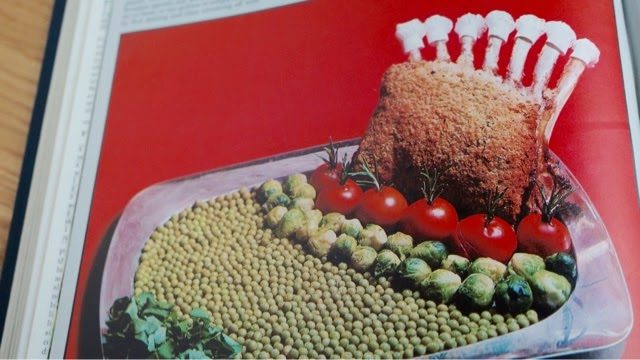
I bet you'll never have seen anything vegetarian arranged in such a splendid way as this Guard of Honour? No nut roast could ever resemble this. Fanny gets Johnnie to do the 'home butcher adventuring' to transform these ordinary but best neck ends of lamb into a show-off dish. This presumably saves Fanny even more time. Just get Johnnie to do it.
Vegetables do help create a stunning centrepiece for an otherwise lacklustre saddle of lamb, so vegetarians shouldn't despair. I'd be happy with an oven-baked tomato spruced up with a sprig of Rosemary, some Brussels and a bed of peas, wouldn't you? Fanny says that baby sprouts are the only ones worth eating, steamed, bien sur.
If you are really strapped for time over Christmas, perhaps a French Sausage Roll would appeal? It's a huge baked garlic sausage covered in puff pastry which has been brushed in mustard. French Mustard. Oh and English too. Just like Fanny (ahem) an Anglo-French alliance. With all the spare time you have, best to tiddle things up with plaits of pastry. For those fancying a different bird this Christmas, Fanny reaches into her Grandmothers notebook and produces a Pigeon Pie. Fanny loves a pigeon. Not only do they taste great but the price is low too. The biggest advantage they have though, according to Fanny, is that very few pigeons are frozen, so the chances are you'll be eating fresh flesh. I'll stick to the freshly prepared baby sprouts if you don't mind.
Labels:
Christmas,
Fanny Cradock,
Meat,
Pigeon Pie,
Vegetarian
Location:
Edinburgh Edinburgh
Tuesday, 7 October 2014
Gingerly hurtling towards Christmas
Fanny thinks that our houses should be filled with an array of tea-time treats all throughout the winter, as we are always sure to be hungry. What could be worse than a steady stream of hungry folk popping in to visit and not only the cupboards being bare, but every tin too... Worst still, imagine no-one comes round and you've got nothing to eat all by yourself to cheer you up. Just saying. Either way, it's time to get baking now just incase, and Fanny has some tea-time treats that will keep for a while, just as long as you store them properly. Actually her Gingerbread will actually improve if tucked away for a time.
With a slight chill in the air, the thought of warming ginger and snuggly treacle seems like the perfect thing. Fanny makes her Gingerbread with 'pure lard' incase we have to hibernate for several months our arteries will remain intact, but for me it's what I hope is a suitable vegetarian alternative, Trex. I've no idea if it will work the same in a cake, it's great in pastry though!
Fanny sets about preparing the gingerbread by gently heating the 'lard' and the treacle. Or the lard then the treacle, she really can't decide. This is one of those recipes, despite being tested time and time again in her very own kitchen to ensure perfection, that says both things. 'Place the lard and the treacle in a small pan over a very low heat' and 'when the lard is melted, beat thoroughly with the warm treacle'. Not being too sure which is best, I first mix some soft brown sugar with an egg, I can't go wrong there, can I?
There is clearly no time for dithering, there may just be a knock at the door at any moment, and a barrage of hungry folk will be blustering their way into my living room expecting to open my tins and be fed. Maybe. I go with option one, melting the 'lard' with the treacle, then giving it a little beat just because I'm really still not sure. Easier to fathom, I sift some flour with a few spoons of gorgeous ground ginger and sprinkle some bicarbonate of soda in a couple of tablespoons of milk. In goes the sugar and egg mix. In goes the melted 'Trex and Treacle'. In goes the gently bubbling milk. And mix.
It all comes together quickly into a slightly sweaty looking concoction, slipping around the bowl like it's having way too much fun. That'll be the lardy Trex I guess. But it smells heavenly. Fanny gives one of her 'options' here, if you feel like 'going grand'. Now, I ALWAYS feel like going grand, and you know, you never know who's going to be next to knock on your door, so you've got to be prepared, right? And hopeful. Going grand here means chopping in some glacé ginger and mixing it in well. How very grand indeed. Luckily I have a jar of Opies to hand. The gingerbread can be baked in any number of ordinary cake tins, Fanny says, but the key is to make sure they are prepared properly - by buttering and flouring them well. I do. So, after half an hour in the oven, Fanny suggests letting it cool in the tin, but will it come out? It does. Fanny says that once it's cooled it's best to wrap it thickly and securely in tin foil and storing it away for a week or so. I don't. Not being one to wait and ever hopeful that someone will come a-knocking, I set it up on my cake stand and get my knife ready. I've got a feeling I'm not going to be hungry tonight after this little beauty! All to myself...
Labels:
Black Treacle,
Christmas,
Fanny Cradock,
ginger,
Gingerbread,
Trex,
Vegetarian
Location:
Edinburgh Edinburgh
Subscribe to:
Posts (Atom)