Picture the scene. You're enjoying a fabulous dinner in a fabulous Château in a fabulous area of the fabulous Médoc in fabulous France. You're hosts are fabulous. Everything is fabulous. Of course it is, you are dining with the fabulous Rothschild wine family at their fabulous Château Rothschild. It's hard to get more blooming fabulous. Everyone is enjoying the fabulous meal. You suddenly have a fabulous idea. You'd love to recreate this fabulous dish at home. Surely you're fabulous hosts wouldn't mind sharing the fabulous recipe with you? Would they?
As you might imagine, Fanny was not shy in asking. Without any whiff of social embarrassment, she boldly asked for the recipe. I can still hear the *gasp* now. The dish she had enjoyed so much was called Gâteau Rothschild. The clue is in the name. A treasured family meal of layered late summer vegetables. Presumably goes perfectly with a large glass (or two) or red. Initially, the chef was extremely reluctant to share the recipe with Fanny. After all, it was a closely guarded family secret. And she was known for sharing them in print. For profit. The recipe is contained in their treasured private family 'receipt' book. So, probably, you'd just say 'I understand' and leave without the famous recipe. Not Fanny. She wanted that book.
Knowing the time would come when she too would want to impress a crowd, maybe of hungry vegetarians, she persisted to try and secure the secret. The chef, however, would not budge. Nothing stops Fanny as we know, so she went straight to her hosts to explain the reluctance. Not embarrassing at all. The fabulousness suddenly left the room. It worked however, and they asked the chef to prise open the old, valuable, sentimental, family cookbook and let Fanny get her hands on it. Except the chef insisted on simply verbally telling Fanny the recipe making her use all her powers of memory to retain it until she had a chance to jot it down.
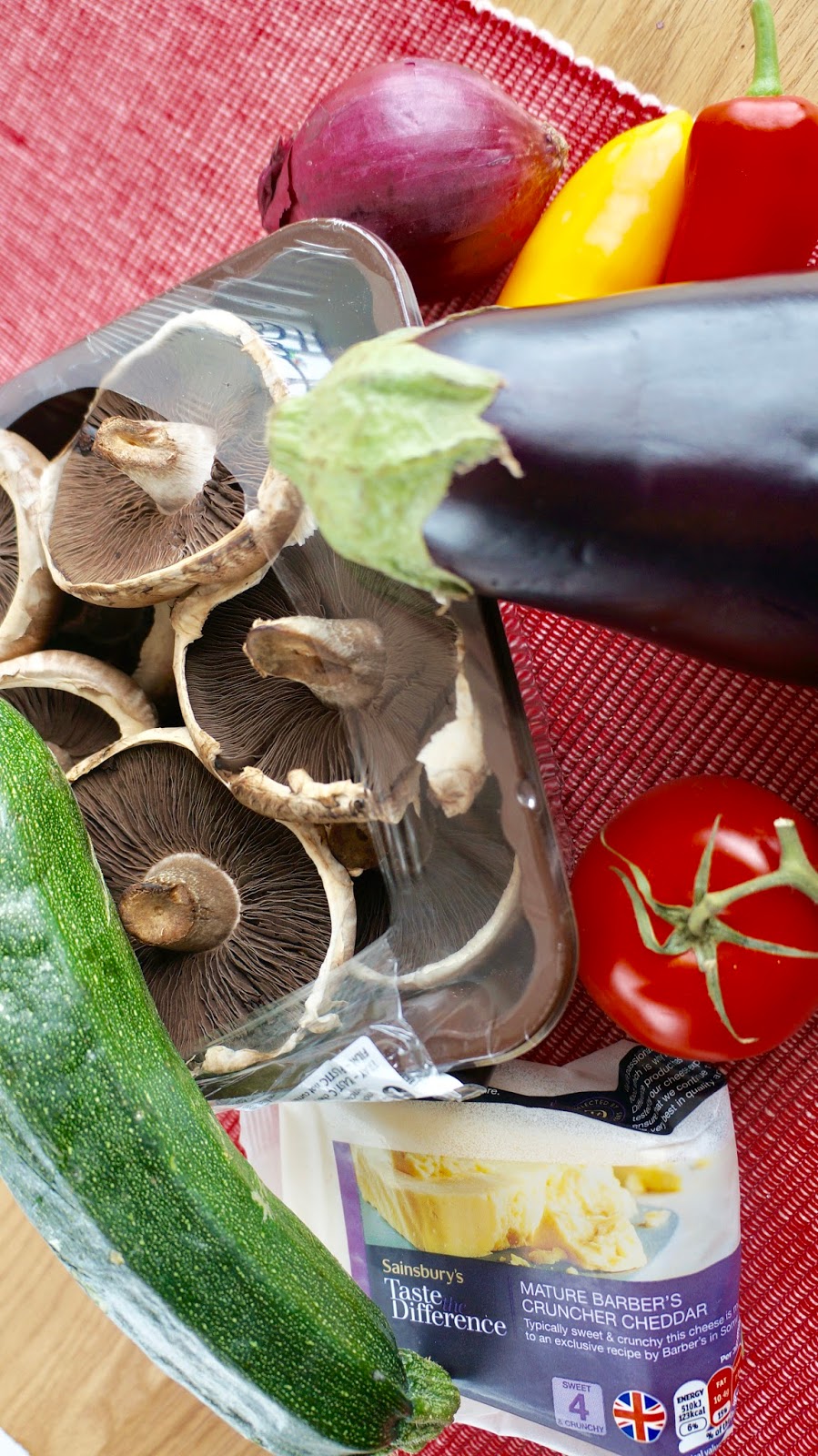
She did though, and then shared it with us all. Naturally. How kind of her to lay bare the family showstopper. It is essentially a layered bake with seasonal vegetables. Courgettes. Onions. Tomatoes. Peppers. Mushrooms. Fanny says it is one of the most delicious and rather time demanding vegetable 'assembly' dishes that she knows of. Clearly not suitable for general family meals (unless you happen to be the Rothschilds) but entirely suitable for entertaining. I take some shortcuts though as time is tighter and it's the chefs night off...
I think Fanny, and perhaps even the Rothschilds themselves, would approve. Fanny laboriously cooks each vegetable separately in pans of foaming butter. Very French. It's important to keep them all separate for the presentation. I slice them thickly, pop them on a tray and roast them in the oven. Once baked, I layer them in a metal ring with alternate layers of a mix of cheese and breadcrumbs, before baking again. Fanny is very particular on the assembly. It must be onion first, then tomato, peppers and finally courgettes. In that order. My final rebellion is to include Aubergine, which I put first. Then, bake again and serve with a tomato sauce, which Fanny calls a fondue. This is how the Rothschild Family served it, and so must we. It was indeed fabulous. I don't imagine, however, that Fanny was ever invited to the Château for Gâteau again.
Showing posts with label vegetables. Show all posts
Thursday, 7 September 2017
Monday, 3 October 2016
Be Kind To Your Vegetables
Fanny Cradock has rules. Not guidelines. Commands. Laws. She insists that readers follow her every move, chapter and verse. No deviation. As per regulation. Especially when it comes to simple things. Like vegetables. Fanny grows her own produce, wherever possible, so she knows exactly what produces the best and worst results. Her fundamental formula for success is fairly well documented. Fanny liked to water her own garden with, erm, her own water. Madam's Tonic. Yes. A natural sprinkler system. It produced the best results.
However her criteria for vegetables need not to stretch to us modelling that. Her ruling is that, like her, we are simply able to recognise on sight the 'duds' that some shops sell. Fanny's maxim is that even at the worst greengrocers, it is hard to find leathery spinach, overgrown rhubarb and giant new potatoes. Vegetables are gorgeous in spring and early summer, Fanny says, and her only prescription for success, apart from her natural fertiliser, is that they should be cooked with kindness. Never boiled. That is a ruling. That would be cruel.
She sets a precedent with spinach, for example. It should be flung in a hot pan and wilted. The job should be done in eight minutes, by decree of Fanny. Just enough to draw out the natural water content, of which there will be much. A panful of spinach juices will run free, leaving only the smallest amount of spinach when Fanny's direction is followed. Perhaps you might want to cook it slightly longer if you picked your spinach from Fanny's garden.
Fanny serves her spinach by statute too, either 'en branche', in full leaf, or 'en purée' which is simply rubbed through a sieve. It is raised to great heights though with the addition of some cheese and a little cream, often served as a separate course by the French. They simply would not make a course from boiled vegetables, not with their palates. The French collect the juices from the spinach, as they recognise that they will contain the highest flavour. If boiled, this would mean slinging the best away. As in Fanny's bathroom regimen, presumably. Although, it may be more sanitary to boil in Fanny's case.
Fanny knows that she is always ramming French edicts down our throats. Her best guide for vegetables is English however. The Steamer. She claims it is a virtuous pastime, and valuable too if you can stack it correctly. The French may call this 'trucs' but we would simply know it as a 'tricks'. Like boiling rice in the pan, and having carrots steaming above, with cabbage leaves above that. The carrots should be mashed up and served simply, ruffled up with a fork, with a blob of cream added. The cabbage leaves will be happiest stuffed with the rice and a simple sprinkle of, erm, paprika. You were worried there, weren't you? Stick to Fanny's rules in the kitchen, if not the garden, and be kind to your vegetables.
However her criteria for vegetables need not to stretch to us modelling that. Her ruling is that, like her, we are simply able to recognise on sight the 'duds' that some shops sell. Fanny's maxim is that even at the worst greengrocers, it is hard to find leathery spinach, overgrown rhubarb and giant new potatoes. Vegetables are gorgeous in spring and early summer, Fanny says, and her only prescription for success, apart from her natural fertiliser, is that they should be cooked with kindness. Never boiled. That is a ruling. That would be cruel.
She sets a precedent with spinach, for example. It should be flung in a hot pan and wilted. The job should be done in eight minutes, by decree of Fanny. Just enough to draw out the natural water content, of which there will be much. A panful of spinach juices will run free, leaving only the smallest amount of spinach when Fanny's direction is followed. Perhaps you might want to cook it slightly longer if you picked your spinach from Fanny's garden.
Fanny serves her spinach by statute too, either 'en branche', in full leaf, or 'en purée' which is simply rubbed through a sieve. It is raised to great heights though with the addition of some cheese and a little cream, often served as a separate course by the French. They simply would not make a course from boiled vegetables, not with their palates. The French collect the juices from the spinach, as they recognise that they will contain the highest flavour. If boiled, this would mean slinging the best away. As in Fanny's bathroom regimen, presumably. Although, it may be more sanitary to boil in Fanny's case.
Fanny knows that she is always ramming French edicts down our throats. Her best guide for vegetables is English however. The Steamer. She claims it is a virtuous pastime, and valuable too if you can stack it correctly. The French may call this 'trucs' but we would simply know it as a 'tricks'. Like boiling rice in the pan, and having carrots steaming above, with cabbage leaves above that. The carrots should be mashed up and served simply, ruffled up with a fork, with a blob of cream added. The cabbage leaves will be happiest stuffed with the rice and a simple sprinkle of, erm, paprika. You were worried there, weren't you? Stick to Fanny's rules in the kitchen, if not the garden, and be kind to your vegetables.
Thursday, 16 April 2015
You can't get better than a kwik-flipped Fritter
Fanny was far from frumpy in the way she presented herself, or indeed any of the freaky food she hoped to whip us up into a frenzy with by showcasing. She was a fashion and food-trend frontrunner. No doubt she would frankly freak-out if we were to let ourselves go, either in the wardrobe department or in the ordinary domestic kitchen. We'd be a total fruitcake to get on the wrong side of Fanny, so to avoid any sort of fracas it's time to slip on our very best frocks and frolic into the kitchen for the grand finale of the 'exciting winter vegetable' frivolity.
Fanny has chosen some frisky fritters to tempt us, assorted vegetable fritters to be precise, or Beignets des Lègumes Assortis in full blown French. Don't fret, before we all frown at the very basic nature of this, Fanny senses our 'sigh' and points out that this is 'really a composite recipe' as she will give us the fritter batter, guide us how to prepare the vegetables and also provide a framework for the whole procedure. So that'll just be a recipe then. Composite seems a little fraudulent. Tsk tsk Fanny.
Fanny has chosen vegetables to fry which were fairly exotic at the time, but are positively frugal now - fresh Eggplants (Aubergines) and Baby Marrows (Courgettes). Hang on, aren't they both fruits? Don't write me nasty letters. Housewives of the 1970's would be completely frazzled and fraught with frustration trying to work out how to prepare them, but Fanny makes it simple. Slice the unskinned Aubergine thinly, arrange it on a wooden board and sprinkle it liberally with 'proper cooking salt', which is sea salt. Leave it for 30 minutes until a 'nasty brown build-up' has formed on the top. Wipe that off and then they are ready to use, free of all bitterness. I found gorgeous round courgettes which sliced wonderfully and equally with a little crinkle cut addition. Not just because I'm fancy, but to add friction to help the batter to stick better.
For the batter, Fanny takes a few spoonfuls of flour, and heads to the nearest barely dripping tap. She starts to work in a low frequency of drips with a wooden spoon, beating away and dripping some more, until the paste becomes elastic and very thick. There doesn't look like very much of it. I have faith in Fanny though. She takes a single egg white and whisks it up frenetically to a fragile but firm cloud, ready to be combined with the fraction of paste. The resulting batter is chirpy and frothy.
Once whipped together it is time to fry! Fanny suggests dipping your sliced vegetables into the batter and tossing them into slightly smoking hot oil. Then immediately turn off the heat and allow them to brown and cook through in the gradually diminishing heat. The heat should be turned up again for each subsequent batch. Fritters are drained on simple kitchen paper, and sprinkled with a little paprika, ready to be served. Fanny suggests hot cream with herbs on the side. If the herbs are dried, heat them with the cream. If they are fresh, add them once hot. The fried fitters themselves are a delight - well cooked through with a crunchy but well-ventilated fluttering of the lightest batter. Little fringed frisbees of veggie-fruitiness at the frontier of frizzy frittery-ness. I think I need a lie down.
Fanny has chosen some frisky fritters to tempt us, assorted vegetable fritters to be precise, or Beignets des Lègumes Assortis in full blown French. Don't fret, before we all frown at the very basic nature of this, Fanny senses our 'sigh' and points out that this is 'really a composite recipe' as she will give us the fritter batter, guide us how to prepare the vegetables and also provide a framework for the whole procedure. So that'll just be a recipe then. Composite seems a little fraudulent. Tsk tsk Fanny.
Fanny has chosen vegetables to fry which were fairly exotic at the time, but are positively frugal now - fresh Eggplants (Aubergines) and Baby Marrows (Courgettes). Hang on, aren't they both fruits? Don't write me nasty letters. Housewives of the 1970's would be completely frazzled and fraught with frustration trying to work out how to prepare them, but Fanny makes it simple. Slice the unskinned Aubergine thinly, arrange it on a wooden board and sprinkle it liberally with 'proper cooking salt', which is sea salt. Leave it for 30 minutes until a 'nasty brown build-up' has formed on the top. Wipe that off and then they are ready to use, free of all bitterness. I found gorgeous round courgettes which sliced wonderfully and equally with a little crinkle cut addition. Not just because I'm fancy, but to add friction to help the batter to stick better.
For the batter, Fanny takes a few spoonfuls of flour, and heads to the nearest barely dripping tap. She starts to work in a low frequency of drips with a wooden spoon, beating away and dripping some more, until the paste becomes elastic and very thick. There doesn't look like very much of it. I have faith in Fanny though. She takes a single egg white and whisks it up frenetically to a fragile but firm cloud, ready to be combined with the fraction of paste. The resulting batter is chirpy and frothy.
Once whipped together it is time to fry! Fanny suggests dipping your sliced vegetables into the batter and tossing them into slightly smoking hot oil. Then immediately turn off the heat and allow them to brown and cook through in the gradually diminishing heat. The heat should be turned up again for each subsequent batch. Fritters are drained on simple kitchen paper, and sprinkled with a little paprika, ready to be served. Fanny suggests hot cream with herbs on the side. If the herbs are dried, heat them with the cream. If they are fresh, add them once hot. The fried fitters themselves are a delight - well cooked through with a crunchy but well-ventilated fluttering of the lightest batter. Little fringed frisbees of veggie-fruitiness at the frontier of frizzy frittery-ness. I think I need a lie down.
Thursday, 26 March 2015
You say To-may-to, I say To-mah-to
Fanny Cradock opens Part 18 - which focuses on Exciting Winter Vegetables - with a plea. Her plea is for us to make good use of British vegetables, which are after all the finest in the world, even if they have 'suffered just a little bit by the time they reach our doors'. Fresh vegetables, local and in season is her campaign, cooked properly, naturally, which means the Cradock way. She was very big on seasonality, even producing a hanging wall chart to be hung in every kitchen as a constant reminder of the monthly expectations. Additionally Fanny begs us all (with some humility) to 'put an end to boiling' and over-cooking. Escoffier has taught us, and Fanny reminds us, that no-one can cook limp, flabby, inferior vegetables and expect to achieve perfect results.
Vegetables should be fresh and lively. Fanny gets hers down the market, but the poor barrow boys' knees must start to jitter when they see her approaching. You see, Fanny insists on fondling the merchandise, despite calls to 'not handle the goods, Madam.' How else can housewives be sure they are buying vegetables in perfect condition? Fanny is wise to the sneaky market traders trying to shovel shoddy vegetables into bags from behind the barrows, so always says 'Please show me what you want me to buy before putting it in my bag.' If they refuse, Fanny recommends walking away. I have no doubt she did on a regular basis.
So, shop local, in season, and choose well is the campaign slogan. It is odd then that the first recipe in this part that Fanny wants to share is one she chooses to showcase out of season produce. The tomato. By her own reckoning, British Tomatoes are readily available in the Summer, and only imports are available in Spring (at least in the 1970's). She ploughs on though, pairing it with an onion and some cream to really showcase it's erm, natural favour and freshness. Perhaps this was all that was in her bag on returning from the market when her requests to cop a feel were refused?
This is a favourite side dish for Fanny and she is excited to share it with us. This must be why she is so confused. Poor Fanny. Let's play along. She selects an onion, which should have a paper thin skin that 'practically rubs off' when you touch it. Any green shoots poking out, please reject it as 'old and on-the-bolt' only suitable to plant and grow for flower decorations. Slice your perfectly rubbed onion finely and add it to a pan of hot oil over a low heat. Slice your tomatoes in half and make criss-cross cuts over the sliced surfaces and place on top of the onion. Add a few sprinkles of herbs and cover the pan completely with a lid or tight fitting foil to allow the vegetables to poach and fry very gently until tender. After seven minutes, peek in and turn the tomatoes over, returning the pan to the low heat to continue cooking.
All that remains to be done is to 'swill in' some cream and allow it to heat through without boiling, before transferring the dish to the table. Fanny uses real (of course) very thick cream, I have chosen soured cream. It may be a reflection of my mood. Fanny serves this side dish with triangular croutons of bread. We've made that together in the previous part. I have to be honest, it is an odd little dish, but perfectly tasty and presentable. Hardly an 'exciting winter vegetable' to kick off a campaign though is it? Certainly not boiled and limp. In season? Doubtful. Well, at least the cream is British!
Vegetables should be fresh and lively. Fanny gets hers down the market, but the poor barrow boys' knees must start to jitter when they see her approaching. You see, Fanny insists on fondling the merchandise, despite calls to 'not handle the goods, Madam.' How else can housewives be sure they are buying vegetables in perfect condition? Fanny is wise to the sneaky market traders trying to shovel shoddy vegetables into bags from behind the barrows, so always says 'Please show me what you want me to buy before putting it in my bag.' If they refuse, Fanny recommends walking away. I have no doubt she did on a regular basis.
So, shop local, in season, and choose well is the campaign slogan. It is odd then that the first recipe in this part that Fanny wants to share is one she chooses to showcase out of season produce. The tomato. By her own reckoning, British Tomatoes are readily available in the Summer, and only imports are available in Spring (at least in the 1970's). She ploughs on though, pairing it with an onion and some cream to really showcase it's erm, natural favour and freshness. Perhaps this was all that was in her bag on returning from the market when her requests to cop a feel were refused?
This is a favourite side dish for Fanny and she is excited to share it with us. This must be why she is so confused. Poor Fanny. Let's play along. She selects an onion, which should have a paper thin skin that 'practically rubs off' when you touch it. Any green shoots poking out, please reject it as 'old and on-the-bolt' only suitable to plant and grow for flower decorations. Slice your perfectly rubbed onion finely and add it to a pan of hot oil over a low heat. Slice your tomatoes in half and make criss-cross cuts over the sliced surfaces and place on top of the onion. Add a few sprinkles of herbs and cover the pan completely with a lid or tight fitting foil to allow the vegetables to poach and fry very gently until tender. After seven minutes, peek in and turn the tomatoes over, returning the pan to the low heat to continue cooking.
All that remains to be done is to 'swill in' some cream and allow it to heat through without boiling, before transferring the dish to the table. Fanny uses real (of course) very thick cream, I have chosen soured cream. It may be a reflection of my mood. Fanny serves this side dish with triangular croutons of bread. We've made that together in the previous part. I have to be honest, it is an odd little dish, but perfectly tasty and presentable. Hardly an 'exciting winter vegetable' to kick off a campaign though is it? Certainly not boiled and limp. In season? Doubtful. Well, at least the cream is British!
Monday, 11 August 2014
Is Aspic still aspirational?
Fanny says I'm not ready to learn about the delights of 'real' Aspic just yet. What could it be about this savoury jelly used to suspend all sorts of vegetables and salads to protect them from exposure to the nasty air, that I'm not ready for? Yes, salads. I'm not absolutely sure I'm ready to learn about Aspic at all if the truth be told. Perhaps it's one of the long forgotten culinary arts that should remain in history? Fanny insists though that this particular 'branch' of garnish and presentation (after all, there is nothing more important) should be learnt properly to avoid savoury jellies which taste of nothing at all, or at best like a cross between cold tea and sea water. Imagine the shame when the well-to-do guests dive into the lovingly created buffet table only to gag in horror if the aspic tastes gruesome?
It's almost as if Fanny is tempting us in with the promise that if we first master the 'simple' stuff, she will reveal how to whip up the 'real' Aspic in a later partwork. When we are ready for such elaboration. The simple version is a mix of stock, egg white, eggshell (indeed), wine vinegar, sherry and seasoning. Oh and gelatine. Will a vegetarian version work? I'm assuming that the ingredients have some sort of magical chemical reaction which makes them taste sensational when set. Will agar powder cut it?Maybe I'm focusing on the wrong thing - instead of wondering if it will set, I really should be wondering why the heck?
Most of the ingredients need to simply mingled together in a pan, but first I have to wash the eggshell and 'pare away' the inner skin. It must ruin everything or something, Fanny doesn't say. The washed, crushed shells go into the pan to be heated up, moderately. Once the agar powder has dissolved, Fanny says to whisk it (although you understand she is talking about gelatine powder really) vigorously until a scum appears on the top. I clearly should've paid more attention during science at school, it was fascinating to see it change colour completely before my eyes, and 'scum up' just as Fanny said. The next instruction is to then allow the mixture to reach boiling without touching it before lowering the heat to the lowest possible setting. Fanny says to draw the pan to the side of the burner so that it just puffs and heaves.
Ten minutes later, the pan comes off the heat to sit for a further three minutes. I'm remembering now why I didn't pay that much attention in science class, the fascination is wearing thin. All this precision and concentration is a little boring. Sorry. Fanny says to strain the mixture through a jelly bag, but I don't have one, so I improvise with some muslin and a small sieve. Fanny says the Aspic that runs through will be pale, clear and modest. Erm. Mine is a bit cloudy, but I reckon that my stock was more cloudy to begin with than the bone stock Fanny used herself. Maybe I should've made my own veggie stock, that'll teach me.
So, the reason for making this Aspic in the first place is to produce an engraved presentation for the aforementioned buffet. I was more into art than science at school, so this is appealing again. Fanny says to swirl a small amount of Aspic into an ordinary pudding bowl, and then to quickly place little scraps of vegetable into a pattern she shows which she suggests is appealing. Once set in place they are secured with little spoonfuls of Aspic before filling the bowl and leaving to set entirely. As if this is not enough to drive my buffet guests giddy, Fanny shows me how to make Salad Flowers from cucumber and tomato. It's essentially taking strips off the cucumber, assembling five thin slices in a circle, adding little crescents of tomato flesh and stem and leaf details. I kind of like it though. Above all, garnish and presentation. As for the Aspic? It looks good actually, and certainly tastes of stock, sherry and vinegar with little bits of vegetable suspended in it. Not a whiff of cold tea or the sea. Possibly I'm never going to be sold completely but we'll see what reaction I get from my buffet guests and let that be the decider.
Labels:
Aspic,
Buffet,
eggshells,
Fanny Cradock,
Savoury Jelly,
sherry,
stock,
vegetables,
Vegetarian,
vinegar
Location:
Edinburgh Edinburgh
Subscribe to:
Posts (Atom)


