Showing posts with label Cabbage. Show all posts

Monday, 3 October 2016

Be Kind To Your Vegetables

Fanny Cradock has rules. Not guidelines. Commands. Laws. She insists that readers follow her every move, chapter and verse. No deviation. As per regulation. Especially when it comes to simple things. Like vegetables. Fanny grows her own produce, wherever possible, so she knows exactly what produces the best and worst results. Her fundamental formula for success is fairly well documented. Fanny liked to water her own garden with, erm, her own water. Madam's Tonic. Yes. A natural sprinkler system. It produced the best results.

Fanny Cradock Spring Vegetables

However her criteria for vegetables need not to stretch to us modelling that. Her ruling is that, like her, we are simply able to recognise on sight the 'duds' that some shops sell. Fanny's maxim is that even at the worst greengrocers, it is hard to find leathery spinach, overgrown rhubarb and giant new potatoes. Vegetables are gorgeous in spring and early summer, Fanny says, and her only prescription for success, apart from her natural fertiliser, is that they should be cooked with kindness. Never boiled. That is a ruling. That would be cruel.

Fanny Cradock Spring Vegetables

She sets a precedent with spinach, for example. It should be flung in a hot pan and wilted. The job should be done in eight minutes, by decree of Fanny. Just enough to draw out the natural water content, of which there will be much. A panful of spinach juices will run free, leaving only the smallest amount of spinach when Fanny's direction is followed. Perhaps you might want to cook it slightly longer if you picked your spinach from Fanny's garden.

Fanny Cradock Spring Vegetables

Fanny serves her spinach by statute too, either 'en branche', in full leaf, or 'en purée' which is simply rubbed through a sieve. It is raised to great heights though with the addition of some cheese and a little cream, often served as a separate course by the French. They simply would not make a course from boiled vegetables, not with their palates. The French collect the juices from the spinach, as they recognise that they will contain the highest flavour. If boiled, this would mean slinging the best away. As in Fanny's bathroom regimen, presumably. Although, it may be more sanitary to boil in Fanny's case.

Fanny Cradock Spring Vegetables

Fanny knows that she is always ramming French edicts down our throats. Her best guide for vegetables is English however. The Steamer. She claims it is a virtuous pastime, and valuable too if you can stack it correctly. The French may call this 'trucs' but we would simply know it as a 'tricks'. Like boiling rice in the pan, and having carrots steaming above, with cabbage leaves above that. The carrots should be mashed up and served simply, ruffled up with a fork, with a blob of cream added. The cabbage leaves will be happiest stuffed with the rice and a simple sprinkle of, erm, paprika. You were worried there, weren't you? Stick to Fanny's rules in the kitchen, if not the garden, and be kind to your vegetables.

Fanny Cradock Spring Vegetables

Monday, 20 July 2015

Seventies Salad

I'm going to ask you to close your eyes in a moment. Just warning you. However you'll need to read on just for a little bit to find out why on earth I would ask you to do so. Don't worry, I'm not going to flash up a photo of yet another crazy creation from Fanny Cradock, well not just yet. No, I want you to shut your peepers and think of your childhood salad. Oh dear, I should've said that once you've thought of it you need to open them again and continue reading. I do hope you've worked that bit out all for yourselves...

Fanny Cradock Egg Salad

What did you see? I'd hazard a guess if you saw a boiled egg on your plate that you, like me, are a child of the seventies, or before. No salad was complete in our house without one. A little bit of lettuce, maybe some cucumber for special occasions, some pickled beetroot from a jar (which I never touched), perhaps a spring onion but always a hard boiled egg. Fanny too thinks that eggs are ideal for a summertime salad. She lived in a time before 'salad' meant pre-packed pillows of Frisee, Radicchio and Wild Rocket.

Fanny Cradock Egg Salad

Fanny, years before dearly beloved Delia, first of all ensures that we know how to boil an egg. She brings a small pan of very ordinary domestic tap water to a fairly fast boil. Eggs should then be lowered in on a tablespoon to avoid cracking and cooked for eggsactly (sorry) seven minutes. Drain down the sink (just incase you had other ideas). Fanny then turns on the cold tap and runs it over the boiled eggs still in the pan until they themselves are cold. Tap the eggs very gently all around against the side of the sink to peel away the shells in seconds without 'unsightly fingernail marks.' Quite.

Fanny Cradock Egg Salad

This technique from Fanny also means that the yolk will not be black against the white inside, which, Fanny says, frequently results from not chilling the egg instantly. Check it for yourself, slice the eggs in half lengthways and arrange them in the centre of the plate to begin the salad. No black. Fanny first surrounds the eggs with a 'ring of carrots' which can be either cut by hand laboriously or with ease and speed with a mandoline. Fanny always gives unbiased choices. Fingers must be kept out the way when using the mandoline. I have a guard on mine. Fanny had assistants.

Fanny Cradock Egg Salad

Fanny shreds some white cabbage for an additional ring and skins tomatoes to make petal shapes for added decoration. For maximum appeal, Fanny flavours some mayonnaise with the juice of an orange and pipes it into rosettes in-between. Fanny does say that this is only when she is feeling grand and leisurely, otherwise she'd just plonk the mayonnaise down in a bowl separately. It's essentially a deconstructed coleslaw with a boiled egg, but Fanny makes it seem much grander, in a leisurely way. Using the mandolin keeps the carrots crisp and crunchy, and the whole salad is quite lovely. Did you have hard boiled eggs in your salad? Oh I do hope you've opened your eyes again ready to enjoy the full effect.

Fanny Cradock Egg Salad

Sunday, 21 September 2014

Fannys Freeze Expertise for Canadian Fleas and Portuguese Soup devotees

Fanny Cradock's didn't use her weekly Cookery Programme partwork to update any of her recipes or styles for the modern age of the 1970's. Instead she reinforced her traditional, unwavering sense of 'proper' cooking and presentation, with little regard for how people were living or eating at the time. The partwork was her opportunity to collect together everything she knew and to show off to her readers her years of experience and skill, so that they too could in turn show off to their neighbours and husbands bosses. If ordinary housewives wanted to learn to cook then they should learn the Fanny way, and be grateful. However, some eight years after the series was published, Fanny released a book of freezer recipes in line with the then current boom in availability of home freezers. The recipes for Portuguese Potato Soup and Canadian Raisin Pie from the Bill of Fare, or menu, for the Jelly partwork appeared again.


The freezer cookbook, 'Cook First, Freeze Afterwards', aimed to do what Fanny had never done before - modernise. Fanny even proclaims within the pages that 'housewives' may be of either sex! Progress! It's a fascinating book. Not just for the recipes, but for the endless narrative that accompanies them. It doesn't appear as if Fanny had an editor, or anyone willing to cut a word out. On almost every page she spits out venom at the frozen food company that had engaged her to research and produce a range of meals for them, only, after several years and great personal expense, to renege on the deal. Fanny tells the readers that this resulted in her losing an annual income for £50,000 - a significant amount back then. But fear not, as Fanny has not wasted the endless rehashing and freezing of her recipes, they appear collected in the book of course.


The Portugeuse Soup, or Calde Verde, is a simple affair, using a technique I hadn't heard of before. The recipe calls for the juice of a small onion. Fanny doesn't bother with any instructions to obtain this juice, so I assume I should grate it, place it in muslin and squeeze the juice through. All I need is one teaspoonful which a small shallot seems to yield. It's a bit fiddly, so better be worth it.


Other than that, the soup, which even Fanny refers to as 'sounding dull', is made from simmering three large, old potatoes in a pot of stock until tender. The onion juice is added and stirred through, before hairlike slithers of cabbage are plonked in. The heat should then be raised to a fierce, noisy, bubbling boil, for only three minutes before serving. In the freezer book, the instructions don't vary too much - but the soup is frozen before the cabbage is added. Cabbage, says Fanny, does not like life in the deep freeze and is best added fresh once the soup is defrosted and reheated. So there you go, years of research led to this, and a small fortune lost.


Fanny tends to use the Bill of Fare that ends each partwork to introduce recipes from foreign lands that would no doubt wow even the most staid of dinner guests. The Canadian Raisin Pie is one of these. In Scotland, we'd call this a Flea Cemetery, but that wouldn't be nearly as exotic or sophisticated sounding enough. The raisins are cooked in water, with lemon juice, lemon zest and brown sugar until they are plump. Then a little bit of magic is added. Potato Flour. Fanny mixes it with a little water and instructs it to be stirred 'like mad' after which time the raisins will be swimming in a thickened, clear sauce. It's actually like a raisin jam, all gooey and sweet.


While the raisins are left to cool, I make some sweet shortcrust paste to line a pie dish, and a lid. I even have enough paste leftover to fashion (by hand) a Maple Leaf. How fancy, who wouldn't be impressed by that? The raisin mixture is piled into the pie dish, topped with the pastry lid, dusted liberally with icing sugar and baked for 30 minutes. The version in the freezer book is no different at all, Fanny just adds the instruction that it can be frozen after baking. Years of research. Bank accounts emptied. Freezers full. Both dishes are packed with flavour despite their sparse ingredients - the trickle of onion juice transforms the soup and the magical potato flour shifts the gears of the otherwise simple pie. I'll freeze some and see if Fanny is right. How wonderful would it have been to delve into the freezer aisle of the local supermarket and pick up some Fanny Cradock ready meals though - you can imagine the elaborate creations with lurid colours and ingredients. Forget Lasagne or Cottage Pie, Fanny would've given us rich Casseroles with Green Duchess Potatoes and a range of her famous filled savoury and sweet omelettes. I can't imagine why the frozen food manufacturer decided against it in the end!

Thursday, 23 January 2014

Back in the USSR - a Revolutionary Russian Repast

Fanny travels behind the Iron Curtain for her first Bill of Fare in this part, and conjurs up a traditional Russian meal using simple and colourful ingredients. It's maybe just me, but I always think of Boney M when I think of Russia, so I pop on a bit of Rasputin as I head into the kitchen and set of work on the starter of Borstch - or Bortch as Fanny refers to it. In between some nifty cossack moves I get the ingredients prepared.


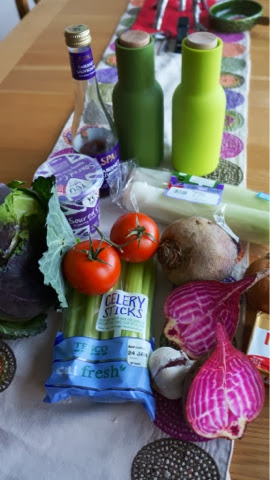
Fanny requires the Beetroot and onion to be finely grated. Can I say that I've always found Beetroot to be really scary, I am properly terrified of touching it, but I love the taste. I've found some gorgeous candy stripe beets to use here, which don't worry me so much, but I still use my food processor to do the grating. No touching required. After heating some oil and butter, Fanny encourages me to fling in the grated vegetables with chopped celery, leek, cabbage and a splash of red wine vinegar and fry them for 8 minutes over a low heat, before adding the other ingredients. 


This just now need to come to the boil and simmer gently for two whole hours, which gives me plenty of time to perfect my dance moves. Fanny suggests straining it before serving and adding a dollop of soured cream, but it seems a pity to lose all those lovely vegetables, so I defiantly don't strain! The colour is more subdued perhaps than if I'd used 'proper' Beetroot, but I like it and it tastes really deep and earthy. The revolution has started! 


Fanny recommends a Beef Stroganoff for a delightful main, but of course I skip over this in favour of pudding. Fanny refers to this as an 'unusual' Russian Cheese Pudding, and the main ingredient, cottage cheese, doesn't immediately scream 'dessert' to me either. Am I ready for this type of unusual? However the oranges seem reassuringly pud to me, and I've found some lovely blood oranges which seem very fitting for the revolution theme. 


Fanny guides me to cream some butter until it is 'white and very loose' then add some caster sugar, creaming again, before adding half the amount of cottage cheese and a whole egg. Beating thoroughly, I add some mixed peel, juice from the blood orange - which turns everything a lovely pink - some orange flower water and then the remaining cottage cheese. Next in Fannys list is to to pop it into a muslin lined cheese mould and drain it over night. I don't have one (does anyone?) so improvise with a small sieve and just keep my fingers crossed.


The mixture is quite wet at first, but sure enough by the next day most of the moisture has drained off leaving a firm, rich 'cake' which smells so orange-y. Fanny says herself that a little goes a long way of this 'quick-to-assemble-pudding-without-cooking' and is perfect served with those 'irrestible biscuits known as vanilla sticks'. I'm not sure as ever what they are, but this very unusual cheese pudding is tasty indeed with a plain digestive biscuit. Hard to believe it's made from cottage cheese. Now, what's next on my Boney M playlist?