Showing posts with label Lemons. Show all posts

Tuesday, 2 December 2014

Glögg, Glögg, Glögg

I should've had more faith in Fanny, she does have some favourite alcoholic cocktails to share for Christmas after all. Poor old Johnnie isn't a fan however. Despite teaching Fanny 'all she knows' about wine, he defines a cocktail as 'a number of good ingredients ruined by being mixed together.' Fanny is keen to surprise him though, and reaches into the depths of history to uncover some long forgotten, erm, classics, as well as some new wonders borrowed from around the world. Fanny must've picked up that I'm feeling a little under the weather this week, as most of the festive favourite are hot, hot, hot! I've been supping on some Galloway Chilli Jam Hot Toddies to try and scare the bugs off, but I'm willing to try some of Fannys specialities too. It might help. It's kind of research.


Before I get to the hot cocktails though, Fanny suggests a cold one. Made with milk. Stored for a few weeks before drinking. I dare say if I wasn't feeling too hot already, this would surely finish me off, but it's worth a go isn't it? For the Cold Milk Punch (which Fanny also calls Old Milk Punch, I can't work out if it's a typo or not) I need to soak lemon peel in rum for 24 hours, before adding brandy, the lemon juice, cinnamon, nutmeg and sugar. After a quick stir to dissolve the sugar, Fanny gets me adding boiled milk. She does warn that the mixture will curdle, and it does. I'm glad I did this in advance whilst feeling brighter. Adding some boiling water doesn't help. Fanny recommends leaving it for 24 hours covered with a cloth before straining and bottling and leaving it somewhere safe for a few weeks. I wish I'd forgotten where I'd stored it in all honesty, not even the rum, brandy and spices couldn't save me from 'old milk'.


In need of something warm and soothing I'm pleased not see that Fanny recommends a Churchwarden. Much more like it. It's a mix of lemon, cloves, red wine and tea. Perfect for this time of year and a real tonic after weeks-old milk. Fanny stabs cloves into a lemon and pops it into a cool oven until the lemon turns light brown. The smell is amazing, certainly clearing my poor sinuses. While the lemon is baking, heat the wine and get ready some scalding hot tea. Fanny says ideally should be green and from Mr Laity's shop in St Ives, Cornwall. This seems very specific to me (does it even still exist?), and quite a trip, so I reach for a TeaPigs instead. The roasted lemon is immersed in the hot wine, and hot tea poured on top with a little sugar. Yahoo for the Churchwarden, it's lovely. I expect it'd be even lovelier if I had the  right tea. Sorry Fanny. Sorry St Ives.


My cold isn't quite lifting yet, so I'd better bash on with more 'remedies'... Fanny has a richly sweet one for me next, it's called a Negus. Unusually Fanny doesn't give any explanation why, it just is. It's a classic. It's made with Port, although Fanny does say you can substitute Red Wine if wishing to be more economical. This is no time for economy though, what could be more import at than my health? The port is heated, but not boiled, and added to a jug with sugar, lemon rind, lemon juice and grated nutmeg. Again, it's a treat for my nasal passages. Fanny says I should stand the jug near a fire, I don't think she had my radiators in mind, and pour on some boiling water. The mixture then needs to be stirred for 30 minutes while keeping it warm before serving up. It really is lovely, but without the benefit of a roaring hearth I had to reheat it before swigging it back.


Finally for today, Fanny wants to introduce a traditional recipe she has 'borrowed' from Sweden, which she says is traditionally made with Sherry but she finds a red wine works equally well. Its Glögg but Fanny says it's sort of pronounced Glurg. It's also got brandy, so can't be wrong can it? The brandy is warmed gently with sugar, cloves, cinnamon sticks, almonds and raisins until it's too hot to touch comfortably. The only way to test this is to keep sticking your finger in until it hurts. Ouch. Then I wonder if Fanny is losing it. She sets light to it. This is a fire hazard, and I already have Casualty on speed dial after the finger-scalding test. Once the flames die down, phew, it's added to the gently warming red wine, stirred and served. It's stunning, a real winner for me. The almonds and raisins add so much. I do wonder if essentially burning off the brandy alcohol was necessary though. I reckon several of these will shift my lungs no problem. Oh hang on, Fanny suggests bottling left-overs to be reheated for next time. Left-overs? 

Sunday, 21 September 2014

Fannys Freeze Expertise for Canadian Fleas and Portuguese Soup devotees

Fanny Cradock's didn't use her weekly Cookery Programme partwork to update any of her recipes or styles for the modern age of the 1970's. Instead she reinforced her traditional, unwavering sense of 'proper' cooking and presentation, with little regard for how people were living or eating at the time. The partwork was her opportunity to collect together everything she knew and to show off to her readers her years of experience and skill, so that they too could in turn show off to their neighbours and husbands bosses. If ordinary housewives wanted to learn to cook then they should learn the Fanny way, and be grateful. However, some eight years after the series was published, Fanny released a book of freezer recipes in line with the then current boom in availability of home freezers. The recipes for Portuguese Potato Soup and Canadian Raisin Pie from the Bill of Fare, or menu, for the Jelly partwork appeared again.


The freezer cookbook, 'Cook First, Freeze Afterwards', aimed to do what Fanny had never done before - modernise. Fanny even proclaims within the pages that 'housewives' may be of either sex! Progress! It's a fascinating book. Not just for the recipes, but for the endless narrative that accompanies them. It doesn't appear as if Fanny had an editor, or anyone willing to cut a word out. On almost every page she spits out venom at the frozen food company that had engaged her to research and produce a range of meals for them, only, after several years and great personal expense, to renege on the deal. Fanny tells the readers that this resulted in her losing an annual income for £50,000 - a significant amount back then. But fear not, as Fanny has not wasted the endless rehashing and freezing of her recipes, they appear collected in the book of course.


The Portugeuse Soup, or Calde Verde, is a simple affair, using a technique I hadn't heard of before. The recipe calls for the juice of a small onion. Fanny doesn't bother with any instructions to obtain this juice, so I assume I should grate it, place it in muslin and squeeze the juice through. All I need is one teaspoonful which a small shallot seems to yield. It's a bit fiddly, so better be worth it.


Other than that, the soup, which even Fanny refers to as 'sounding dull', is made from simmering three large, old potatoes in a pot of stock until tender. The onion juice is added and stirred through, before hairlike slithers of cabbage are plonked in. The heat should then be raised to a fierce, noisy, bubbling boil, for only three minutes before serving. In the freezer book, the instructions don't vary too much - but the soup is frozen before the cabbage is added. Cabbage, says Fanny, does not like life in the deep freeze and is best added fresh once the soup is defrosted and reheated. So there you go, years of research led to this, and a small fortune lost.


Fanny tends to use the Bill of Fare that ends each partwork to introduce recipes from foreign lands that would no doubt wow even the most staid of dinner guests. The Canadian Raisin Pie is one of these. In Scotland, we'd call this a Flea Cemetery, but that wouldn't be nearly as exotic or sophisticated sounding enough. The raisins are cooked in water, with lemon juice, lemon zest and brown sugar until they are plump. Then a little bit of magic is added. Potato Flour. Fanny mixes it with a little water and instructs it to be stirred 'like mad' after which time the raisins will be swimming in a thickened, clear sauce. It's actually like a raisin jam, all gooey and sweet.


While the raisins are left to cool, I make some sweet shortcrust paste to line a pie dish, and a lid. I even have enough paste leftover to fashion (by hand) a Maple Leaf. How fancy, who wouldn't be impressed by that? The raisin mixture is piled into the pie dish, topped with the pastry lid, dusted liberally with icing sugar and baked for 30 minutes. The version in the freezer book is no different at all, Fanny just adds the instruction that it can be frozen after baking. Years of research. Bank accounts emptied. Freezers full. Both dishes are packed with flavour despite their sparse ingredients - the trickle of onion juice transforms the soup and the magical potato flour shifts the gears of the otherwise simple pie. I'll freeze some and see if Fanny is right. How wonderful would it have been to delve into the freezer aisle of the local supermarket and pick up some Fanny Cradock ready meals though - you can imagine the elaborate creations with lurid colours and ingredients. Forget Lasagne or Cottage Pie, Fanny would've given us rich Casseroles with Green Duchess Potatoes and a range of her famous filled savoury and sweet omelettes. I can't imagine why the frozen food manufacturer decided against it in the end!

Monday, 15 September 2014

Zest for Life - Fanny Cradock's Lemon Soufflé Jelly Cake

Fanny says that you can make a jelly out of any fruits you might happen to have lying around the house. She even recommends replacing sweet wine wine for any water when making a jelly, for adults only, I like that. Alcoholic jellies always seem like a naughty treat. For this final creation in the Jelly partwork Fanny gives the humble lemon centre stage. I've been learning a lot about Agar Agar as a replacement for gelatine over the past few weeks as I turn all Fannys jellies vegetarian, and the main thing to learn is that it doesn't mix well with acid, in particular citrus fruits. I wonder though how it would react to that Italian Lemon liqueur, Limoncello, often found lurking at the back of even the most respectable cocktail cabinet. Certainly in mine. So, would an alcoholic Limincello Soufflé Cake be fitting of a finale (for now) for Fannys jellies?


Fanny whips eggs, extra yolks and icing sugar together until they are thick and almost white. Fanny does warn that the mixture needs to be whipped for a VERY long time in a very large bowl. My KitchenAid Mixer, Sarah, comes in super handy for this task. I click my fingers, give her a very fake smile and she sets to work while I get on with the rest of the cake. Well actually, when I say cake I really mean assembly of the cake. Fanny suggests making a sponge, but I've bought a Madeira cake in the supermarket. Shoot me. 


Fanny says that this cake can have two presentation styles - individual or party for very special occasions. I think it might be fun to combine the two and have an 'individual party' - I'm celebrating the last of the jellies after all! So while Sarah works away without complaint, such a dedicated assistant, I exhaust myself by cutting two semi circles from the cake, which will make a full circle base. I really should've bought a bigger cake, or maybe used a smaller cutter, it's all too strenuous. 


Sarah does a marvellous job of whipping the eggs and sugar. Unfortunately I need to prepare the lemon jelly all by myself, but it's all the usual way so I am well rehearsed. The Agar flakes go into cold Limoncello (replacing the lemon juice and grated rind) brought to the boil then simmered for a few minutes until the flakes are all dissolved and mingled in nicely. Sarah continues to assist to whip the mixture as I add the hot lemony jellied Limoncello slowly. Fanny warns that the light mixture will collapse a lot as it combines, and sure enough it does. At this stage some double cream is blended in before heading straight into a pot, which is the same size as my cake base, to set. At least I hope it will.


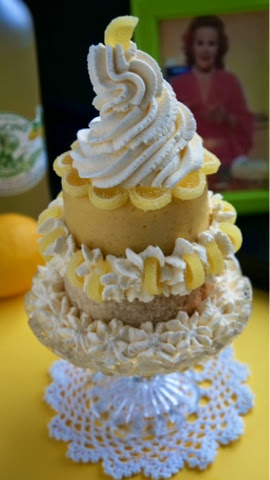
I needn't have worried, after around an hour the Souffléd Lemon Creamy Jelly is set with still a good quiver evident when it's released from the mould. It comes away easily, as I wetted it before adding the mixture, naturally. Fanny assembles her party cake in layers and pipes cream stars. So do I. Almost apologetically she urges me to rush to the supermarket again to buy some candied lemon slice decorations. She's apologising because she simply doesn't have time to teach me how to make my own just yet, that will be saved for a future partwork. I don't have time to learn either, it's my party and I'll continue to add shop bought ingredients if I want to. The finished cake is really tasty, quite zingy and a more than a little bit naughty. I'm a little bit sad and a little bit happy to be saying goodbye, for now, to the wonderfully wibbly wobbly world of jellies, but this is a great send off. 

Tuesday, 4 February 2014

The Mysterious Mrs Marshall and the Case of the Curious Potato Pudding

Fanny wants to play a game with us again. She played it herself, supported by Johnnie of course, in 1963 on the corner of Piccadilly Circus. They stopped random passers-by and asked them 'Who was Agnes Bertha Marshall?' but sadly no-one guessed correctly. Did you, blog passers-by? She was of course the greatest woman cook ever known in Britain, a cook who knew everything the great Escoffier knew, a friend of Royalty, a cook taught others to achieve greatness, a cook who had her own food magazine and a cook who when she died her notoriety diminished. Remind you of anyone? Fanny became obsessed with her, and was busy researching her story for a book. Mrs Marshall, Fanny claimed, was everything that Mrs Beeton was not, and she was determined to restore her memory. The book was never completed, as far as I know, but Fanny did resurrect some of her recipes under the disguise of Mrs Hudson in the Sherlock Holmes Cookbook, as well as throughout the partwork. It really all gets rather strange.

Fanny Cradock

In the first of this new partwork dedicated to 'Surprising you with Potatoes' Fanny does exactly that. It's a traditional recipe that Mrs Marshall sent to her which was published in 1917 in the 1637th edition of her own magazine The Table. It's for a potato pudding. That's a sweet pudding made from potato. Various vegetable creations are all the rage these days with cakes made from carrots, courgettes and beetroot, but I'm not sure even my dear blogging friend Veggie Desserts would use a potato for a pudding. The other ingredients are flour, baking powder, lemon juice and rind, golden syrup, an egg and some butter. The cooked pudding is served with a chocolate sauce. Surprise! 


Fanny insists that potatoes are steamed, never boiled. Ever. More on that to come. They then need to be sieved finely to produce a very soft and fluffy mash, just with an ordinary household sieve of course. It does make the potato very fine and pillowy. Add some melted butter, beat in the egg, lemon juice and rind. Add the golden syrup, flour and baking powder. 


The mixture is then turned into a buttered soufflé dish and baked in a moderate oven for an hour, while the sauce is made. It's a fairly simple sauce made by heating  and dissolving golden syrup, cocoa powder and water together. 


As I am making this, I can't help but wonder if it really will be a treat. Fanny tries hard to convince me, saying if it was good enough for Mrs Marshall, and good enough for the shortages of the First World War, then it should please families today. Clearly. Once baked it has risen just like a soufflé but the texture of mashed potato remains. Adding the chocolate sauce only adds to the 'surprise' when tasting - I just can't get the notion that it's 'potato and gravy', as it looks, out my mind. It tastes sweet, lemony and very much still of mashed potato. It certainly was a surprise for me, and I am sure would be a surprise to Holmes and Watson. Perhaps I should take to the streets and surprise people with a taste? Is the real surprise that still no one remembers dear old Mrs Marshall?