Showing posts with label Potatoes. Show all posts

Monday, 11 January 2016

Feel the Appeal of the un-Real Meal

Fanny often wants to convince us that she is the undeniable, bona fide, irrefutable real deal when it comes to recipes, techniques, knowledge and skill. This is the entire basis of the partwork series, she is sharing her veritable gifts with us. At times she is blatantly blunt in telling us that her way is the right way. Other times she is, honestly, a little more subtle but absolutely as concrete in her message. For a simple dish of Shepherds Pie she takes us back in time to Old England to discover what this traditional pie meant to our ancestors, but makes it evident that we have been making it wrongly all these years by the simple addition of a single word. This is Fannys' Real Shepherds Pie.

Fanny Cradock Real Shepherds Pie

Well it would be if I wasn't insistent on fiddling with the recipe, twiddling out the meat and tiddling it up for vegetarians. Fanny uses a tangible mixture of cold, cooked lamb or mutton and finely minced lean gammon as the base for her pie, I use a packet of ready cooked Puy Lentils. So handy, and I think still valid, still in the spirit of the dish - a quick transformation of so-called leftovers and cupboard staples. It happens to be International Year of Pulses too, whoever knew that such a thing should exist. If Fanny were here in 2016 I am sure she'd celebrate with a special book. Or two. Or three.

Fanny Cradock Real Shepherds Pie

Fanny mixes her meat with a grated onion, freshly milled parsley, a little stock and seasoning, so do I with the newly elevated, internationally celebrated, legitimate lentils. I was clearly 'keeping it real' during the preparation too, as the grating of the onion resulted in streams of actual tears in the kitchen that simple chopping alone would not have uncovered. It seems a little odd to grate them in the first place and not cook them, but was we know Fanny is indubitable, so I don't question it.

Fanny Cradock Real Shepherds Pie

It's all seemingly fairly standard so far, no hints of the 'real' nature that Fanny promised with the pie. The filling goes into a dish and Fanny urges us to get on with the topping. Surely just mashed potato? Everyone knows that a Shepherds Pie is topped with mashed potato, don't they? Think again, authentic fans, Fanny has some flour up her sleeve. She does mash up her pre-prepared steamed (of course, never boiled) potatoes, adds some butter and boiling milk. Then she beats to a smooth paste before working in the flour to create a pastry paste consistency. She rolls it out and tops the pie with it. I was hoping for piping.

Fanny Cradock Real Shepherds Pie

Fanny calls this Potato Crust. She finishes it off by marking it in a criss cross fashion with a hot, wet knife in trellis lines. Then a quick brush with egg wash before the oven. The pie emerges well risen, and quite, well, crusty looking. It's an original texture, both fluffy and crispy and tucked underneath are the simply flavoured pulses, shining and singing among the parsley and the sweet grated onions. All-in-all it's a delightful pie. We only have Fannys word that this is the truly defacto real deal. I'm happy to just enjoy the pie. Who would question Fanny anyway?

Fanny Cradock Real Shepherds Pie

Saturday, 1 March 2014

Petite Pommes Anna and a Poem about Potato Salad

Just for our amusement, Fanny 'tucks in' a poem about an antique recipe for potato salad, from a cleric who 'undoubtedly had a great addiction to his tum'. The poem is intended to introduce some serious final points as we leave potatoes behind for a while - but fear not - Fanny reassures us that we shall pick up the potato story soon by introducing a mandoline, a Parisienne cutter and various other gadgets (perhaps we can buy them from Fanny too?) which will open up a wide range of potato recipes for us. It all sounds very dangerous and chef-y. I can't wait. But, meantime...

Two large potatoes passed through a kitchen sieve,
Smoothness and softness to a salad give.
Of Modern mustard add a single spoon, 
Distrust the condiment that bites too soon,
And deem it not, thou man of herbs, a fault
To add a double quantity of salt.
Four times the spoon with the oil of Lucca crown,
And twice with vinegar procured from town,
True flavour needs it, and your poet begs,
The pounded yellow of two well boiled eggs.
Let onion atoms lurk within the bowl,
And, scarce suspected, animate the whole.
And lastly in the flavoured compound toss
A magic spoonful of anchovy sauce.
Oh! Great and Glorious, Oh! Herbaceous heat,
'Twould tempt the dying Anchorite to eat;
Back to the world he'd turn his weary soul,
And plunge his fingers in the salad bowl.

No, I'm not sure either, but Fanny thought it funny.

Fanny Cradock

After the light hearted interlude, Fanny returns to her greatest love - the great, wise and wonderful French Chef Escoffier. He apparently invented a simple, quick and individual version of the classic Pommes Anna. Fanny shares both versions with us, but it's the individual ones I am making today. Fanny gives a very severe warning however for me to pay attention, recommending that I read through things very carefully before I begin. Of course, I always do. Well, mostly. Fanny assures me that I will find it very exciting for serving when entertaining, so I am paying particular attention. I wouldn't want to let any potential dinner guests down, although I am sure any ballgown I'd be wearing would be exciting enough.


As Fanny has yet to introduce the mandoline, she suggests using an ordinary cucumber slicer to cut very thin slices of peeled potatoes to transparent thinness. I'm hoping this is the part on the side of my box cheese grater than I certainly have always used to slice cucumbers, never really sure if that's what it was intended for. It slices the potato as described though, so that's good enough for me. They need to be patted very dry and seasoned with salt and pepper before being pushed firmly into buttered moulds.


This next step is the part Fanny wants me to pay particular attention to - health and safety alert. The individual moulds should be placed in cheap bun tins and then surrounded by extremely hot oil. Fanny says not to worry too much about the science here - and stresses that PLEASE do not write and ask her why this works, it just does. The potatoes are baked in a bath of oil. She wants us to focus on safety however as 'carting hot oil' around the kitchen is not recommended. It can cause tragedies. Fanny knows this all too well herself as she burnt herself extremely badly several years previously through being an idiot. Presumably this was before forcing her poor assistants to do all the work.


So, with the moulds sitting safely in their bath of scalding oil, they need to be baked uncovered in a very hot oven for just 35 minutes. Fanny recommends just forgetting about them. When they come out they are richly dark and crisp looking, with soft centres. Fanny says they should look like the sandcastles which she used to make with tin buckets on the beach. They are gorgeous though, the pepper shines through and they are soft and creamy tasting, not a hint of oil or moisture in them. Not sure anyone would ever write a poem about them, but they would be perfect of course at any respectable dinner party. Please do be careful with them though, no dinner party tragedies please.

Sunday, 23 February 2014

One Potato, Choux Potato, Three Potato, more...

Fanny has a potato top tip for me, which seems appropriate as I've been away travelling with work far too much lately. If only I'd read this first. Fanny suggests on 'high days and holidays' you should peel enough potatoes for three days and sling them in a bucket, sprinkle them with sea salt and cover in cold water. The water needs to be changed every day, which would've been tricky for me while away I suppose, but Fanny insists that the potatoes will not go slippery and slimy as they would simply peeled in a bowl of water on the day. She's full of the tips really - don't slice all your potatoes at once for home-made crisps or chips, they'll only discolour. And if you want to save your new potatoes for a Christmas Feast, pop them in a large biscuit tin with sawdust in it, add a layer of potatoes and cover with more sawdust. Continue layering, being very careful that the potatoes don't touch each other. Seal the tin with tape and bury it in the garden, of course. Fannys only request is that you mark where it's buried, as there is nothing worse than digging up the whole garden in search of them come December, when the ground is likely to be frozen. There, she warned you.

Fanny Cradock

No such trouble for me, just a quick trip to the local supermarket. Just as well, I couldn't be bothered with all that digging this weekend. Fanny is keen for me to learn the wonders of Potato Puffs, or Beignets or even Armandines - she can't quite make up her mind what the heck to call them. They sound perfect for this weekend though - a mixture of potato and her beloved choux paste, and then deep fried in balls. 


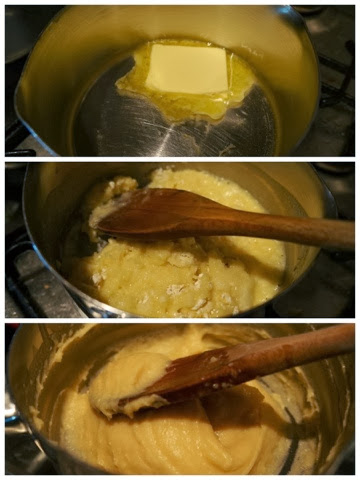
Fanny gives the recipe for Choux paste twice on the same page, right next to one another - presumably because it SO important to her. So I take it very seriously, melting my butter gently in water then 'shooting' in the flour, mixing and allowing it to 'foam' in the pan a little. Off the heat, I beat and beat it before adding the eggs and beating again. Fanny absolutely insists that the mixture is left to get cold at room temperature with a plate over it before I go any further. Of course, I obey. Fanny says that on no account should I be tempted to refrigerate the mixture as it will ruin. It's fine Fanny, I'll take a seat and have a cup of tea.


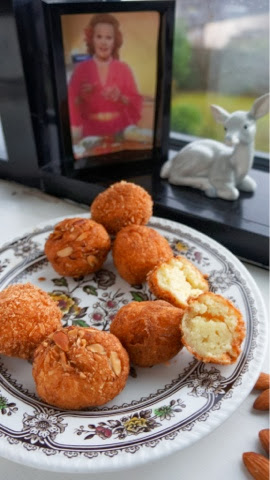
Fanny gives three variations for these beignets, but they all start with steamed potatoes which are sieved and dried as before. Once the choux paste is cold, Fanny asks me to combine double the weight of sieved, stiff potato to make a paste. From the paste, walnut sized balls should be rolled. I leave a third of them as they are, roll a third in breadcrumbs (Fanny suggests very fine ones, but as always I feel the need to rebel a little so I use Panko) and the final third are rolled in finely chopped almonds. All that's left to do is fry them gently in some oil until they are golden brown. They all change to slightly different shades of golden, and the end result is fantastic. They are light and puffy, tasty and crisp. The almonds in particular add something really special. I made some French Onion Soup to have  these perfectly puffed potatoes with - not slippery, not slimy, not discoloured and not rescued from deep within the garden...

Sunday, 16 February 2014

Nicky Gnocchi Noo

Fanny loves a bit of history, but she also loves nothing more than re-writing the past or setting the record straight. Her truth is always THE truth, I am learning. She has been thoroughly researching the origin of the potato in England, and proclaims that Sir Walter Raleigh has told a whopper. The reference Fanny gives for her revelation is the Encyclopedia Americana. Potatoes, it seems, were first cultivated on high ground in South America over 1800 years ago and not introduced from there until the second half of the 16th Century. No Indians in North America were growing potatoes in 1587 when Raleigh made his trip home for Queen Elzabeth. Tut tut. Fanny decides that we should all forgive the 'Naughtie Knight' and instead celebrate the humble spud. Consider it done. Fanny herself chooses this point in the partwork to introduce her favourite Italian potato dish to us - Gnocchi Di Patate.

Fanny Cradock

I'm becoming so used to steaming my potatoes now I set to work before even reading Fanny's instruction. It really does make such a difference to the finished mash. I've got some lovely red skinned potatoes which I am sure are neither from Peru, America nor Italy, but I'm hopeful they will do the trick. Fanny despairs of potatoes sold in polythene bags, oops, these were. She tells me to immediately rip open the bag as soon as I am home to avoid them being sweaty, flabby and starting to rot. Worry not Fanny, they seem fine. Fanny tells me if they are not I can take them back to the store for my money back. Can you imagine if I did and said 'Fanny told me my rights'? Once they are steamed, it's back out with the sieve to get them lovely and fluffy before adding egg yolks, butter, seasoning and some flour. Fanny also suggest adding a grating of fresh nutmeg, which I love. Maybe it's partly due to the fact that I love using my teeny weeny tiny nutmeg grater too. Just maybe.


Fanny instructs me to beat the mixture together and work it almost to a dough. It comes together really well actually, must be the lovely yolks. I do start off following Fanny to the letter when she tells me to weigh out 1/2 oz pieces of the mixture and to roll them into balls, but I eventually just do it by eye. Just as easy really, and who wants perfectly sized Gnocchi anyway? 'Naughtie' me...


The balls need to be flattened slightly, indented with a fork and flung into plenty of salted simmering water. Fanny emphasises of course that they should be removed from the water AS SOON as they rise to the surface, so I am glad I have my heat resistant dish ready buttered and waiting. This was Fanny's next instruction - you see I am not that 'naughtie' really. 


The little Gnocchis are layered up in the dish with small spots of butter and grated cheese. Fanny suggests her favourites Gruyère or Emmenthal - but I have neither so instead use Parmesan. I realise I am going to sound JUST like Fanny here, but please do not write in to tell me that Parmesan is NOT vegetarian, I know... I prefer to use it but, as Fanny might've said direct to camera with a slightly ruffled nose, if you are a vege-terrorist then please just substitute for your approved cheese of choice. Simple. Once all the layers are done, it's into the oven for half an hour to bake. The finished dish looks lovely, and tastes smashing too. The Gnocchis themselves are very light and puffy, some are crispy, some still soft. And all very cheesy. Whoever brought the potato to this country and in whatever year, and also to Italy of course, I for one am grateful. 

Friday, 7 February 2014

The Green Duchess - Perfectly Piped Puréed Potatoes

Fanny is remembered for a few key dishes, not always favourably, but most of all it's her 'green mashed potato' that is mentioned often. And she takes it very seriously indeed. Fanny sees it as a basic skill, one that she comes back to time and time again. And it's no ordinary mash either, but the quite superior Duchess Potato that she favours, which can be used to top any dish of leftovers, including as she says 'that dreadful English traditional cottage pie'. Fanny is, of course, scornful of the way that potatoes are treated in this country - which she notes is normally 'boiling the wretched things to death'. According to the rulings of classic cookery there are 450 ways to treat a potato, but of course Fanny says the only way is to steam them.

Fanny Cradock

For these delightful Duchesses there is much to learn before the steaming commences however, and it's mostly about piping. Fanny demonstrates her piping technique, and shows pictures of her poor assistants, and even Johnnie, in action with the bag and nozzle. The assistants are forced to wear matching outfits and have strict instructions never to look at the camera.


The basic mix is made from steamed potatoes that are then sieved and heated gently in a completely clean dry pan until all the mixture is really dry. This is the key to successful Duchess, moisture is not a friend. Fanny says you may get 'bored bandy' sieving the potatoes, but reassures that it is essential for a good effect. The flabbier the potato if overloaded with moisture, the more frustrated you'll be with your failed piped shapes. Fanny says it's like icing a cake, you must start right from scratch. Far from being bored, I find it quite therapeutic.


To the steamed, sieved, dried potato, seasoning is added, a small amount of softened butter and an egg yolk. I coloured the egg yolk with green gel paste colouring from Wilton's first. Then it's on to shaping! Fanny gives separate and detailed instructions for Gallettes, Doights (fingers), Petits Pyramides, Petits Pains, Brioches, Rosettes Longues and Couronnes. I prefer the piped ones, especially the little pyramids, but try them all. I even add in my own shape (what on earth would Fanny say) in preparation for Valentines Day. Obviously, nothing says 'I Love You' quite like a green mashed potato heart.


Before baking, the piped potatoes need to be brushed with a glaze Anglais. This is strained egg which is beaten with olive oil (I used rapeseed though, I clearly just can't follow Fannys instructions), salt and white pepper. Fanny says this mixture imparts a fine, rich glaze to any savoury substance which needs one. Perfect. All that's left to do is bake until a nice rich brown colour. And still green of course.


They come out looking sensational - at least I think so! Has Fanny finally gotten to me? Will my potatoes forever be green? They look so cheery and colourful, and the piped ones especially just simply made me smile. Definitely no ordinary potato, the Duchess is surely a perfect way to remember Fanny and celebrate her style - go on, grab your food colouring and get piping!

Sunday, 8 December 2013

Seven Swans a-Swimming

Televisions across the globe are already full of Christmas cooking shows old and new, but sadly it seems that the brilliant Cradock Cooks for Christmas don't feature in the UK schedules this year. To console myself I am armed with my trustee booklet and will be sharing a series of special posts showcasing their creations. To get us all in the Christmassy mood, as if we need any motivation, Fanny shares another fun idea to get the young ones involved - Edible Swans. Presumably creations based on the other 11 Days of Christmas would push us all over the edge.


The small fry are still not trusted to do any actual cooking of course, it is all about garnish and presentation naturally. Ingredients are eggs and potatoes, all cooked by the parents perhaps? Fanny does urge the young ones to 'go to work on a hard boiled egg' though - by which she isn't echoing the famous advertising slogan but instead wants them to SAFELY do a spot of slicing. Just a sliver from the base lengthwise so that it stands 'steadily' is all that is required at first, followed by two small slices from each side, also lengthwise. Then it's the potatoes. As it's Fanny, she wants them mashed and coloured with harmless food colouring - green of course.


Once they are a lovely, ahem, shade of green they need to go into a piping bag ready for the assembly.


Fanny reassures the young folk if they aren't keen on piping that they can 'fork up' the seasoned mashed potatoes instead, but either way they need to cover the 'saddle' of the swan and start to come down over the cut sides before sticking in the cut bits to make the wings. Another smaller piece of egg slice makes the tail and these little swans are almost ready to swim off. Fanny gives a template for the head and neck, but it's really just a bit of a pipe cleaner shaped like a '2' and pushed into the end of the egg. And there we have it, swans ready to swim and present to your parents while you sing along - and they actually look quite cute. Let's hope no-one asks why on earth they have green feathers...


Wednesday, 18 September 2013

Lattice not be De-Terre'd

It's quite a relief to be given another savoury flan from Fanny at this point, there are only so many tartes du jour I can consume! I don't think Fanny thought this through when compiling this part-work, either that or she never reckoned on some crazy cook working their way through each recipe 40 years later. This one is fairly humble - avoiding all possible pie puns is not easy - using Potato, Onion, cream, eggs and cheese really. Of course Fanny encourages me to fancy it up a little.


Fanny insists that I steam my potatoes - never, ever boil them - and fill my raw savoury flan case with grated onion. The grating seems to make them very wet, and ever fearful of that soggy bottom I am cautious, but willing to go with Fanny's flow as before. Usual compiling rules apply here - on top of the grated onion Fanny asks for some smoked bacon, which I substitute for smoked Paprika, then layers of seasoned, sliced, steamed potatoes, the cream and egg mixed together and top off with slices of Gruyere cheese. Fanny has thoroughly modern tastes really.


Fanny says I can now either cover with a plain pastry top (so it is a pie?) or if I am feeling confident I could try a lovely trellised lattice top using a thoroughly modern kitchen gadget to create it. At first I think I'm going to have to go with the pastry top, having never seen the lattice-trellis-maker-thingy Fanny recommends. However a quick search on eBay uncovers the exact one Fanny features - result! Shopping Cart updated, checkout complete.


It seems quite a length to go to to get this trellised top, but it looks pretty and Fanny provides a pic-strip to guide me - so it'd be rude not to. I really I just need to lay some pastry on top, roll over with a rolling pin, pop out the tiny squares and magically a lattice will appear... Easy.


With the trellis firmly in place on top of the onions, potatoes and cheese it's in the oven with it, with the usual instruction to remove it when it's baked. Fanny gives a picture of the finished flan so I keep checking until it is lovely and golden. Fanny tells me I can serve it hot or cold, and recommends this one as a particularly good idea cold for picnics. Fanny tells me if I have left it too late for picnic weather I can save it for 1971 - the following year. I am pretty sure she means saving the recipe and not the actual Tarte aux Pommes de Terre I am carefully removing from the oven - but, as I am learning, with Fanny you never know...