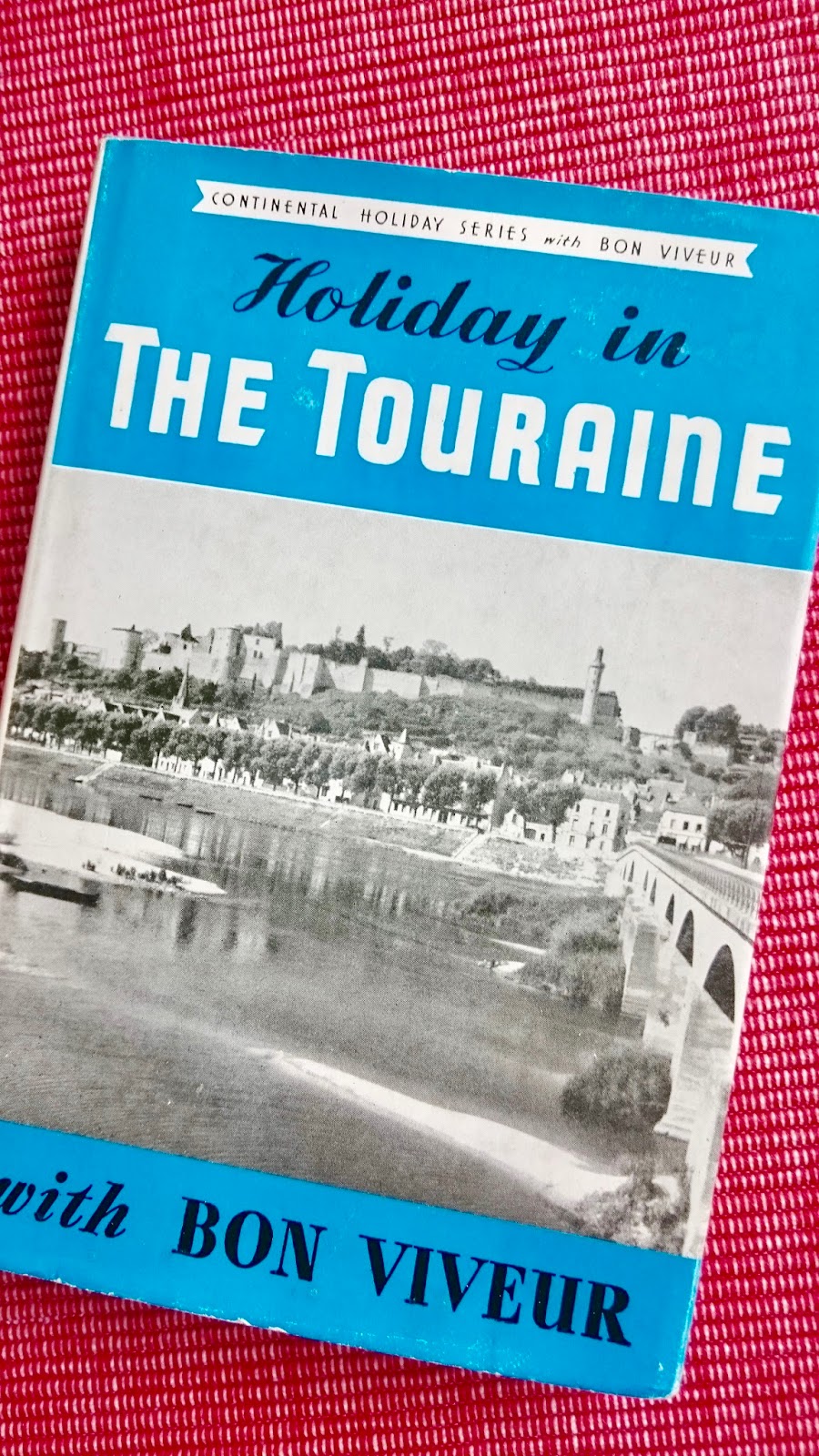
My mission - I just HAD to find the most celebrated hotel in Fanny's guidebook to the Tours - the rather splendid sounding Hôtel Metropole. She'd already mentioned it strongly in her guide to Wining and Dining in France. What might today's Gateaux de la Maison be? Would Fanny perhaps have tasted the very same one, in the very same setting? More details were given in the tour guide Holiday in the Touraine she published in 1956. With the address in hand, 14 Place Jean Jaunes, I set off to explore. A lack of data plan on my mobile meant I was transported back to the time that Fanny was writing. Just as in the 1950s, armed only with Fanny's guide, I had limited information, but a great supply of hope and belief.
A short walk from the Gare de Tours, the main square in the town centre appears to be undergoing a period of change. Regeneration we might call it. Many of the Grande Hôtels stand empty or have been re-propositioned with a variety of other uses. Surely the Hôtel Metropole would not have succumbed to such progress? The leafy square spreads out as if to make room for the expansive tram system which now strides the Rue Nationale, seemingly splitting the city in two. Stretching from north of La River Loire to the somewhat appropriately named (perhaps) Winston Churchill Boulevard in the south, the tram sees to be well used and smooth running. I never used it, preferring to walk.
In Place Jean Jaunes itself, people find comfortable spots in the various pavement cafés and those strange enclosed perspex spaces which many restaurants favour now, neither seemingly attached to the main restaurant nor flying absolutely solo. Islands of meeting and eating space. Without facilities. Fanny noted this was also the case in 1956, where celebrated chefs around the Touriane region told her 'we put the cooking and wines first, the ambiance and toilettes last', so it seems nothing has changed.
I wander round several times. Hôtel De Lille. Hôtel De L'Europe. Grand Hôtel. Hôtel De L'Universe. all there and all splendid buildings, giving the air of being THE 'place to stay' in town, just as Fanny suggested. Fanny noted that the Hôtel De L'Universe was plain to see in particular, even by the most myopic. So, I wasn't in need of an eye examination, but where was the glory of the Hôtel Metropole? Fanny was by now teasing me with details of their Crêpes Bordelaise, which apparently no-one, not even Fanny herself, can cook better that the chef there.
Hôtel Metropole had an ample eighty bedrooms, so would surely be in plain sight too, myopic or not. Wandering up and down Place Jean Jaunes in search of number 14 it did not appear to be so. Just as I was about to consult Fanny's guide to popular French phrases for weary travellers, No Spik French, and attempt to order a Daily Mail each day, or where to find the best dentist (as these are surely the essential phrases) in the hope that someone took pity on my French abilities and replied in English so I could ask about the Metropole, I saw it. Standing proud and smug, taunting me and jeering at me for not noticing it sooner. Also crushing me completely by having transformed itself into an H&M. The closest I could get to sharing a space where Fanny had been would be to buy a t-shirt.
Showing posts with label Bon Viveur. Show all posts
Thursday, 8 June 2017
Thursday, 22 September 2016
Fanny Italia #3 - Common Market Cookery - Italy
We know that Fanny Cradock was no fan of Italian cuisine. We know that she felt it was inferior to her beloved French. We know she described it as running the gamut of 'A to B' compared to the 'A to Zee' of France. We also know however that this did not stop her writing about it all the time. Italian cookery was featured throughout the partwork, and even graced two distinct books written by Fanny. In 1974 she published her Common Market Cookery book on Italy, based on her jaunts to the continent for BBC TV's Nationwide programme, followed by the Bon Viveur book of Pasta Cookery in 1975, in partnership with the British Pasta Information Bureau. Not bad for someone who really wasn't fond of the grub.
With Pasta Cookery, Fanny was aiming to concentrate on inexpensive dishes for family meals, or entertaining friends, using varieties of pasta which lend themselves to the 'incorporation of left-overs' such as cannelloni, spaghetti or lasagne. Indeed Fanny says they are 'purse-stretchers at the table', only without the inclusion of the astronomically priced at the time Parmesan Cheese. Fanny's main advice is that pasta should never resemble stewed knitting, nor be flabby. Always al dente, slightly firm to the teeth. You would never eat your knitting, would you?
I'm heading to Turin and Piedmont while in Italy, and as Fanny has already established, these areas are more gastronomic than most. She's still no fan of course, despite, or perhaps as a result of, the skill of Italian chefs of being past masters at conjuring up delicacies from their limited arc of raw materials. Polenta that resembles a bath sponge is one example. Made in a blackened pot, stirred with a vine twig and poured onto a scrubbed wooden table, the Italian family will gather round with their forks ready to eat it. Only on 'high days and holidays' will a little meat or dried fruits be added. You get the impression that Fanny hasn't had a good experience while in Italy, although this book is supposed to be a celebration and an encouragement to visit and recreate the dishes.
Fanny recounts all her travels across Italy, and details the food, and regional specialities that she has found. More than enough for a book. All in about 150 recipes. Not just pasta, but hors d'oeuvres, soups, pizzas, rice, fish, poultry, meat, vegetables, eggs, cheese, sauces, salads, puddings and ice-creams. All showing what a limited diet those poor Italians have. It's not their fault, they just don't have access to the ingredients. They are limited. And poor. Not Fanny's favourites at all.
And don't get her started on the breakfasts. I'll need to watch out for the Italian businessmen, and women in particular, as well as students of both sexes, standing around in slit-alleys of minute cafés gulping coffee, dunking their buns with reverberating sucks. It sounds dodgy. I shall take Fanny's warning, and order large cups of coffee with additional jugs of hot water. I'm sure no-one will be offended. So, I think I am ready to make my way to Italy now and enjoy all that it has to offer. Which Fanny says is not much. Thanks Fanny. All that remains is for me to learn the names of all the pasta shapes. If I do them alphabetically it will be easier I think. All I need to do is learn A and B. Italy here I, somewhat nervously, come.
With Pasta Cookery, Fanny was aiming to concentrate on inexpensive dishes for family meals, or entertaining friends, using varieties of pasta which lend themselves to the 'incorporation of left-overs' such as cannelloni, spaghetti or lasagne. Indeed Fanny says they are 'purse-stretchers at the table', only without the inclusion of the astronomically priced at the time Parmesan Cheese. Fanny's main advice is that pasta should never resemble stewed knitting, nor be flabby. Always al dente, slightly firm to the teeth. You would never eat your knitting, would you?
I'm heading to Turin and Piedmont while in Italy, and as Fanny has already established, these areas are more gastronomic than most. She's still no fan of course, despite, or perhaps as a result of, the skill of Italian chefs of being past masters at conjuring up delicacies from their limited arc of raw materials. Polenta that resembles a bath sponge is one example. Made in a blackened pot, stirred with a vine twig and poured onto a scrubbed wooden table, the Italian family will gather round with their forks ready to eat it. Only on 'high days and holidays' will a little meat or dried fruits be added. You get the impression that Fanny hasn't had a good experience while in Italy, although this book is supposed to be a celebration and an encouragement to visit and recreate the dishes.
Fanny recounts all her travels across Italy, and details the food, and regional specialities that she has found. More than enough for a book. All in about 150 recipes. Not just pasta, but hors d'oeuvres, soups, pizzas, rice, fish, poultry, meat, vegetables, eggs, cheese, sauces, salads, puddings and ice-creams. All showing what a limited diet those poor Italians have. It's not their fault, they just don't have access to the ingredients. They are limited. And poor. Not Fanny's favourites at all.
And don't get her started on the breakfasts. I'll need to watch out for the Italian businessmen, and women in particular, as well as students of both sexes, standing around in slit-alleys of minute cafés gulping coffee, dunking their buns with reverberating sucks. It sounds dodgy. I shall take Fanny's warning, and order large cups of coffee with additional jugs of hot water. I'm sure no-one will be offended. So, I think I am ready to make my way to Italy now and enjoy all that it has to offer. Which Fanny says is not much. Thanks Fanny. All that remains is for me to learn the names of all the pasta shapes. If I do them alphabetically it will be easier I think. All I need to do is learn A and B. Italy here I, somewhat nervously, come.
Monday, 8 February 2016
Down and Out in London
When she wasn't encouraging us to squirt copious amounts of food colouring into every dish we were creating, Fanny Cradock was keen that we spent our time travelling around, soaking up as much culture as we could, and of course eating copious amounts of perfectly normally coloured food. Fanny wished of course that we did it in a very particular style - hers. I'm about to head off to London for a well deserved jaunt, and wondered how well her guide book of 1953 would hold up and help me to plan a suitably colourful trip?
Fanny says her 'unique' book will ensure that I have a happy and satisfying visit to the capital city, which is just what I am after. The book serves up, apparently, history as a 'fruity background' to the main mission of aiding me to lunch and dine in London's many fine restaurants. Naturally Fanny and Johnnie are the only people suitably qualified to help me on this quest, combining their 'gastronomic knowledge, literary skill and insight' (not to mention modesty) into the average person's problems of what dishes and wines to order. The average person. That's me.
Bon Viveur in London, compiled from various Daily Telegraph columns and articles from Fanny and Johnnie promises to give me the names of many restaurants, the prices of their dishes, detailed reports of the house specialities and even recipes which used at 'some' restaurants which I can introduce at home. So with a clarion call of 'Je ferai de mon possible' we are to be convinced that Fanny will indeed do her very best for us... Within limits. London of 1950 had changed beyond recognition from it's heyday of the late Victorian-Edwardian era as a 'gastronomes paradise'. Fanny notes that as a result of the two wars, much of the promised colour and fruity charm has been shed.
In 1953, Fanny is stepping into a restaurant on our behalf and seeing it with quite different eyes from the times when she allegedly went for 'private and personal enjoyment'. Now it's all about us, the average people. Fanny notes her task is akin to the painting of the Forth Bridge - endless - in that chefs move about, restaurateurs change and management switch. Reading through the guide there are so many altered places that I wish I could visit - the 'luxury class' of the Five Hundred Club in Albemarle Street, or perhaps an open sandwich lunch in the Débutantes Bar in the Brief Encounter on Brompton Road. Oh I forgot, I'm average, not high class.
I'll be staying on the South Bank. Fanny doesn't have recommendations for 'South'. Fanny recommends I eat at Whistlers Room Restaurant in the Tate Britain Gallery on Millbank. It's just across the river. Guess what, it's still there! I wonder if the unpretentious Mrs Adams is still feeding the hungry on 'good plain foodstuffs' - this is not a place for indulgent gastronomes - but Fanny recommends the soup. Will it still be hot and genuinely palatable? Will Kitty the star waitress still be adding a touch of extra character to the place with her watchful service? Will Chef Jasper still make his usual tour of the tables to enquire if all is well? Even for me, an everyday, average, lacking in colour person? Let's find out...
Fanny says her 'unique' book will ensure that I have a happy and satisfying visit to the capital city, which is just what I am after. The book serves up, apparently, history as a 'fruity background' to the main mission of aiding me to lunch and dine in London's many fine restaurants. Naturally Fanny and Johnnie are the only people suitably qualified to help me on this quest, combining their 'gastronomic knowledge, literary skill and insight' (not to mention modesty) into the average person's problems of what dishes and wines to order. The average person. That's me.
Bon Viveur in London, compiled from various Daily Telegraph columns and articles from Fanny and Johnnie promises to give me the names of many restaurants, the prices of their dishes, detailed reports of the house specialities and even recipes which used at 'some' restaurants which I can introduce at home. So with a clarion call of 'Je ferai de mon possible' we are to be convinced that Fanny will indeed do her very best for us... Within limits. London of 1950 had changed beyond recognition from it's heyday of the late Victorian-Edwardian era as a 'gastronomes paradise'. Fanny notes that as a result of the two wars, much of the promised colour and fruity charm has been shed.
In 1953, Fanny is stepping into a restaurant on our behalf and seeing it with quite different eyes from the times when she allegedly went for 'private and personal enjoyment'. Now it's all about us, the average people. Fanny notes her task is akin to the painting of the Forth Bridge - endless - in that chefs move about, restaurateurs change and management switch. Reading through the guide there are so many altered places that I wish I could visit - the 'luxury class' of the Five Hundred Club in Albemarle Street, or perhaps an open sandwich lunch in the Débutantes Bar in the Brief Encounter on Brompton Road. Oh I forgot, I'm average, not high class.
I'll be staying on the South Bank. Fanny doesn't have recommendations for 'South'. Fanny recommends I eat at Whistlers Room Restaurant in the Tate Britain Gallery on Millbank. It's just across the river. Guess what, it's still there! I wonder if the unpretentious Mrs Adams is still feeding the hungry on 'good plain foodstuffs' - this is not a place for indulgent gastronomes - but Fanny recommends the soup. Will it still be hot and genuinely palatable? Will Kitty the star waitress still be adding a touch of extra character to the place with her watchful service? Will Chef Jasper still make his usual tour of the tables to enquire if all is well? Even for me, an everyday, average, lacking in colour person? Let's find out...
Monday, 21 September 2015
Diamonds Are Forever - Sixty Years of Kitchen Magic
Somewhat unbelievably, 2015 marks the simply sensational sixtieth anniversary of Fanny Cradocks first ever proper TV show. Well, proper in Fanny's own special way. Prior to 1955 she had been a regular on radio of course, dispensing Hints for Housewives on Womans Hour, cooking up 'dishes which can be done in a flash'. However, it wasn't long before Fanny (then know plainly as Phyllis) and Johnnie transferred to TV. Their first 15-minute BBC show, The Cradocks with Kitchen Magic, was interestingly even then billed as 'an unusual style of TV cookery to a TV audience', but the ratings delivered with them scoring 73% of the potential audience despite its after dark time slot. I don't think any footage exists, although they later recreated it for Gas Board promotional film, but what a treat if it ever turned up!
Fanny and Johnnie filmed a follow up, the crackingly titled The Cradocks are Frying Tonight ('an evening dress version of their afternoon show') for the BBC before switching to independent TV for Associated Rediffusion who lured them with the glory of full half hour shows. Fanny felt they were much more suited to them than the measly 15 minutes the BBC offered. Chez Bon Viveur and Fanny's Kitchen were independent hits, but they soon returned to the BBC with Challenge in the Kitchen - where Fanny was pitted against a French male chef to explore 'if men cooked better than women' - and their very first Christmas show, the Bon Viveur Gala Christmas Dinner broadcast from the Royal Albert Hall.
The 1950's ended with yet more TV appearances with Fanny and Johnnie introducing their soon-to-be-well-established cookery club idea to the Mainly for Women afternoon show by making assiette de crudités and boxes of chocolates. Presumably these were particularly called for back then. They continued to make appearances on a variety of programmes, among them making exciting party feasts For Deaf Children and making a case for elegant presentation on Home at One Thirty. It was here that Fanny introduced her idea to make three course meals in 15 minutes. Beat that Jamie! Fifty years before his quick-fire series, just saying.
Fanny was still developing her unique persona and style, personally, as a TV cook and as a TV personality, confusingly popping up as a gardening expert in Living Today before returning to radio for Beginning to Cook, following another familiar future theme of six elementary lessons. The 1960's were a boon time for Fanny and TV however, with Kitchen Party, Home Cooking, Adventurous Cooking, Problem Cooking, Ten Classic Dishes, the ground-breaking Colourful Cookery which Fanny was surely born for and Giving a Dinner Party all airing. All with the essential accompanying booklet of course, and all in between popular appearances on Juke Box Jury or Call My Bluff. We just couldn't get enough Fanny.
The 60's also saw Fanny's first full Christmas series, Christmas Cooking, which covered the Pudding, The Cake and the Birds - all the festive fundamentals. The 1970's are often seen as the glory years for Fanny on TV, but perhaps this is simply because most of the footage still exists? With Fanny Cradock Invites, she invited us to a range of parties each episode from Cheese and Wine, Sunday Brunch and even one for Teenagers. very much the Nigella of her day. Again, it was all in the booklet. Fanny jumped from Generation Game appearances to frolicking around Europe exploring their cuisines and giving expert advice to other cooks for Nationwide. This new role as 'advice giver' would come back to haunt but, but as 1975 continued we saw perhaps her most famous shows, the wonderful Fanny Cradock Cooks for Christmas, which are still shown regularly each festive season, often to collective gasps from TV audiences and Twitter alike.
The 1970's also saw the demise of Fanny's TV career with the ill-judged Gwen Troaks Banquet on the Big Time. It is often cited as her final TV appearance, following a rude demolition of poor Gwen's ideas and skills. In scenes which would be popular for 'judges' today, the viewers in the 70's found it hard to swallow. However, during the 1980's she popped up on Pebble Mill, Wogan and the unusually titled Sin on Saturday to name but a few. I'd love to see that one particularly! Her final TV cooking slots were for independent breakfast TV, introducing the early morning TV-am viewers to the wonders of filo pastry.
Rather sadly, most of Fanny's TV appearances remain either in the vaults or have disappeared forever, sometimes popping up in a welcome manner on compilation shows and tribute programmes like TV Heroes, Look Who's Cooking and the Way We Cooked. I'd love to have a rummage around in the archives though, and I'm sure we'd all enjoy the televisual treats that could be uncovered. Perhaps the BBC are already planning a suitably splendid Fanny Cradock Diamond Anniversary Celebration? We are still hungry to see Fanny's unusual style of cookery... Aren't we?
Fanny was still developing her unique persona and style, personally, as a TV cook and as a TV personality, confusingly popping up as a gardening expert in Living Today before returning to radio for Beginning to Cook, following another familiar future theme of six elementary lessons. The 1960's were a boon time for Fanny and TV however, with Kitchen Party, Home Cooking, Adventurous Cooking, Problem Cooking, Ten Classic Dishes, the ground-breaking Colourful Cookery which Fanny was surely born for and Giving a Dinner Party all airing. All with the essential accompanying booklet of course, and all in between popular appearances on Juke Box Jury or Call My Bluff. We just couldn't get enough Fanny.
The 1970's also saw the demise of Fanny's TV career with the ill-judged Gwen Troaks Banquet on the Big Time. It is often cited as her final TV appearance, following a rude demolition of poor Gwen's ideas and skills. In scenes which would be popular for 'judges' today, the viewers in the 70's found it hard to swallow. However, during the 1980's she popped up on Pebble Mill, Wogan and the unusually titled Sin on Saturday to name but a few. I'd love to see that one particularly! Her final TV cooking slots were for independent breakfast TV, introducing the early morning TV-am viewers to the wonders of filo pastry.
Monday, 6 April 2015
How to Jug a Bon Viveur
I'm not sure how Fanny Cradock would feel about sharing the page with others, even other food writers. Especially other food writers? Were there other food writers? After all, why would one need to read anyone else's words when her own guidance, knowledge and expertise was freely available to be absorbed and put into action in exactly the way she describes? Fanny, and Johnnie, wrote regular columns in The Telegraph under the moniker of Bon Viveur to reassure, and inadvertently perhaps, reprimand, housewives across the land with their words. They were not alone however. There were other food writers. Many of those also wrote for The Telegraph. Do you think Fanny knew that at the time?
I practically ran down to my local booksellers on publication day when a collection of food writings originally published in The Telegraph were recently collected together and republished in one volume. I couldn't wait to snap up a copy. How To Jug A Hare has been compiled and edited by Sarah Rainey, with a foreword by Bee Wilson. What a lovely job it must have been to dive into those archives and discover the delights of culinary craftsmanship to share again with us hungry foodies. And what a lovely job they have done!
Fanny features heavily throughout, naturally, which is a real treat for us all. A selection of sixteen sublime articles, scooped up from storage and presented again for us to chortle along with. Let's not forget though, it's not all Fanny, many other fantastic food writers from history are expertly laid side by side. Fanny sits comfortably, almost dizzyingly, beside Egon Ronay, Clement Freud, Elizabeth David, Elizabeth Craig, Claudia Roden, Robert Carrier, Hugh Fearnley-Whittingstall, Josceline Dimbleby and many others. All brilliant names from through the years, and all brilliant pieces of food writing to show off. Fanny arches proudly across them all, she even receives the ultimate accolade from the editor - a whole chapter dedicated to 'Cranky Cradock'.
Whether Fanny is telling readers how to plan for 'the years most indigestible meal' (Christmas Dinner), how to 'put a wronged casserole to rights' or sharing the delights of Aunt Meg's flower-pot loaves, she does it with her usual humour and forthrightness in equal measure. Food writing columns are uber-seasonal but the skill of the editor in this collection is to position writing from 1899 alongside selections from 1959 and the more modern day, arranged by season not chronology. As a reader you often have to turn back to the given date to check - some themes seem so very modern. I guess food fads come and go, but it's fascinating to read about fashionable issues that seem like trends in this way. It provides a very pleasing perspective.
Fannys final entry in this collection is her 'Pet Hates of 1971' (although later columns do appear earlier) which so easily could've been published today. Fanny is cross about the endless cellophane 'over-wrapping' which often results in her struggling and breaking her nails trying to gain access to various products. She's fuming that manufacturers are disguising less product in larger packets. She's raging at marketing speak misusing the English language with frightful phrases like 'Fresh Frozen'. 'Fresh is one thing, Frozen is another, both can be very good but like male and female, they cannot be the same', Fanny tells us. The whole collection is a magnificently enjoyable read, wisely combined and wonderfully compelling. Whether or not Fanny would have preferred the whole volume to be dedicated to her and her alone remains unknown. Fanny Cradock can so often be overlooked in culinary history as simply a figure of fun. She undoubtedly was, but for me to see her re-placed in history as one of the great food writers is as reassuring and reprimanding as she herself was back in the day.
I practically ran down to my local booksellers on publication day when a collection of food writings originally published in The Telegraph were recently collected together and republished in one volume. I couldn't wait to snap up a copy. How To Jug A Hare has been compiled and edited by Sarah Rainey, with a foreword by Bee Wilson. What a lovely job it must have been to dive into those archives and discover the delights of culinary craftsmanship to share again with us hungry foodies. And what a lovely job they have done!
Fanny features heavily throughout, naturally, which is a real treat for us all. A selection of sixteen sublime articles, scooped up from storage and presented again for us to chortle along with. Let's not forget though, it's not all Fanny, many other fantastic food writers from history are expertly laid side by side. Fanny sits comfortably, almost dizzyingly, beside Egon Ronay, Clement Freud, Elizabeth David, Elizabeth Craig, Claudia Roden, Robert Carrier, Hugh Fearnley-Whittingstall, Josceline Dimbleby and many others. All brilliant names from through the years, and all brilliant pieces of food writing to show off. Fanny arches proudly across them all, she even receives the ultimate accolade from the editor - a whole chapter dedicated to 'Cranky Cradock'.
Fannys final entry in this collection is her 'Pet Hates of 1971' (although later columns do appear earlier) which so easily could've been published today. Fanny is cross about the endless cellophane 'over-wrapping' which often results in her struggling and breaking her nails trying to gain access to various products. She's fuming that manufacturers are disguising less product in larger packets. She's raging at marketing speak misusing the English language with frightful phrases like 'Fresh Frozen'. 'Fresh is one thing, Frozen is another, both can be very good but like male and female, they cannot be the same', Fanny tells us. The whole collection is a magnificently enjoyable read, wisely combined and wonderfully compelling. Whether or not Fanny would have preferred the whole volume to be dedicated to her and her alone remains unknown. Fanny Cradock can so often be overlooked in culinary history as simply a figure of fun. She undoubtedly was, but for me to see her re-placed in history as one of the great food writers is as reassuring and reprimanding as she herself was back in the day.
Tuesday, 9 September 2014
Bon Viveur's Eat, Drink, Discover Scotland
Fanny and Johnnie had so many careers on the go at any one time, with different pseudonyms for each venture, and mostly all having a foodie connection. Their anonymous restaurant reviews, which appeared in the Daliy Telegraph, using the Bon Viveur moniker, were extremely popular. Fanny herself used to boast that they could 'make or break' a place once they were in print. They never accepted offers to review, that would be vulgar, and only revealed their identity after eating and settling the bill. The original food bloggers! For five years from 1950 until 1955 they remained elusive, but once their faces were firmly attached to their words, they found a new way to review and recommend. They expanded on their restaurant reviews to include travel and discovery, presumably for those less fortunate than themselves to hear about all sorts of exotic and fantastic adventures at home and across Europe. Their newspaper columns continued to charm readers, and they released several volumes of 'travel guides' for home and abroad. The original travel bloggers!
One of their most popular editions was their Guide to London and the British Isles. Advertised as the definitive manual informing readers 'where to dine, wine, visit, stay, relax and entertain' around the country. As with most of Fannys output, it was largely recycled from their columns and expanded from a previous volume which looked at London only. As Fanny used to say 'money for old rope'. The original entrepreneurs! The guide itself is charming and the Scottish Section lists a variety of places to explore from Aberfoyle to Turnberry. Each location gives the very best hotels, a headline of what to expect - 'Motorists Mecca', 'Shooting', 'Escape from Cities' or perhaps 'For Business Men' - contact details, the all important review, prices, what local speciality food to expect, what drinks are likely to be available, what sights can be seen around and about and crucially, of bizarrely, if dogs are welcome. The original Dugs'n'Pubs!
Fanny liked Scottish cuisine, and was a trailblazer for Haggis before it was seen as a national treasure. She gave recipes to make your own at home, mainly as she felt that the very best ones which were produced in Scotland were kept by the Scots themselves, leaving only small and considerably inferior ones available in shops locally. By locally she meant in London. It's one of those recipes that starts, 'First clean a sheeps stomach carefully...' Fanny claimed to be half French from time to time too, so included recipes for the French version too, which she called Franchemoyle. She liked to balance out any debate of provenance! The original diplomat!
Either way, she recommended it be served with a fine Scotch Whisky and enjoyed while discovering the country! She even claimed that Haggis cured her of a nervous breakdown, or was it simply marvellous marketing? You decide. Certainly the original Bon Viveur's!
The Bon Viveur guides were essential reading to track down what to Eat, Drink and Discover. Fanny and Johnnie claimed to aim to share their extensive knowledge and good taste with us all, and I have no doubt that their books were clutched by excited travellers and followed with fervour. Today it's even easier to find out what's new, what's local and what's trendy with so many online reviews, TV shows and festivals celebrating food and drink.
Eat Drink Discover Scotland, Scotland’s largest celebration of Scottish food & drink will open its doors on Friday 12th September, allowing visitors the opportunity to experience the very best Scotland has to offer all in one day! Billed as the ultimate celebration of food and drink in Scotland, it's a three-day foodie extravaganza, bringing together over a hundred exhibitors showcasing top notch Scottish food & drink, a stellar line-up of celebrity chefs (Fanny of course was the original!) and a packed programme of demonstrations, tastings, talks and sampling sessions. I'm heading along to see what I can Eat, Drink and Discover about Scotland. Fanny and Johnnie would likely be there in a flash too, probably insisting it be billed as Bon Viveur's Eat, Drink, Discover Scotland though. And they'd sell you a book about it afterwards. And a homemade Haggis. And you'd be delighted.
Eat Drink Discover Scotland is one of the highlights of the Scottish Food & Drink Fortnight 2014. An annual celebration, this year the fortnight runs from 6th-21st September, during which there will be a calendar of events aimed at encouraging people to try some new food adventures such as foraging, visiting a pick your own farm or even just trying a new product or recipe.
Created to promote the healthy, locally sourced food and drink available throughout the country, the 2014 celebration aims to be the biggest yet. The festival will also act as an excellent introduction the Scottish Government’s 2015 Year of Food and Drink celebrations.
Eat Drink Discover Scotland has been put together by the Royal Highland & Agricultural Society of Scotland (RHASS). Chief Executive, Stephen Hutt, said: “Our vision when creating this event was to provide a unique regional showcase. At Eat Drink Discover Scotland you can truly taste Scotland in one day – from Orkney Lamb to Galloway Chillies – all regions are represented.”
Tickets for the must-attend food and drink event of the year are on sale now, at
www.eatdrinkdiscoverscotland.co.uk
• Organised by Royal Highland & Agricultural Society of Scotland (RHASS)
• Advance Tickets £12.50(£10) Children under 15 go free
• Royal Highland Centre, Ingliston
• Free Parking
• Opening times: Friday 12noon-8pm Saturday 10am-6pm Sunday 10am-5pm
• Advance Tickets £12.50(£10) Children under 15 go free
• Royal Highland Centre, Ingliston
• Free Parking
• Opening times: Friday 12noon-8pm Saturday 10am-6pm Sunday 10am-5pm
Subscribe to:
Posts (Atom)


